

As Donald Trump cuts funding to Antarctica, will the US be forced off the icy continent?
- Written by: Lynda Goldsworthy, Research Associate, Institute for Marine and Antarctic Studies, University of Tasmania
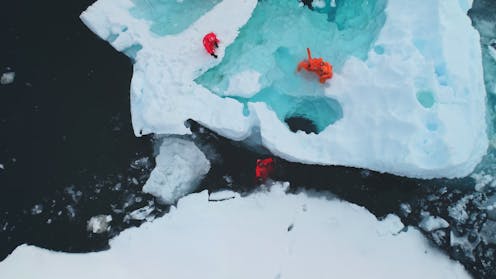
President Donald Trump has begun eroding the United States presence in Antarctica by announcing deep funding cuts to his nation’s science and logistics on the icy continent.
The Trump administration has significantly reduced funding for both Antarctica’s largest research and logistics station, McMurdo, and the National Science Foundation which funds US research in Antarctica.
More cuts are foreshadowed. If carried through, US science and overall presence in Antarctica will be seriously diminished – at a time when China is significantly expanding its presence there.
Since 1958, the US has been a leader in both Antarctic diplomacy and science. Shrinking its Antarctic presence will diminish US capacity to influence the region’s future.
Why the US matters in Antarctica
The US has historically focused its Antarctic influence in three key areas:
1. Keeping Antarctica free from military conflict
The US has built considerable Antarctic geopolitical influence since the late 1950s. Under President Dwight D. Eisenhower, it initiated (and later hosted) negotiations that led to the development of the 1959 Antarctic Treaty.
It was also key to establishing the fundamental principles of the treaty, such as using the Antarctic region only for peaceful purposes, and prohibiting military activities and nuclear weapons testing.
2. Governing Antarctica together
The US was influential in developing the international legal system that governs human activities in the Antarctic region.
In the 1970s, expanding unregulated fishing in the Southern Ocean led to serious concerns about the effects on krill-eating species – especially the recovery of severely depleted whale populations.
The US joined other Antarctic Treaty nations to champion the Convention on the Conservation of Antarctic Marine Living Resources (CAMLR), signed in 1980. It prioritises conservation of Southern Ocean ecosystems and all species, over maximum fish harvesting.
The US also contributed to the 1991 Protocol on Environmental Protection. Among other measures it prohibits mining and designates Antarctica as “a natural reserve, devoted to peace and science”.
3. Scientific research and collaboration
The US operates three year‑round Antarctic research stations: Palmer, Amundsen-Scott and McMurdo.
McMurdo is Antarctica’s largest research station. Amundsen-Scott is located at the South Pole, the geographic centre of Antarctica, and the point at which all Antarctic territorial claims meet. The South Pole station is thus important symbolically and strategically, as well as for science.
The US has the largest number of Antarctic scientists of any nation in the continent.
US scientific work has been at the forefront of understanding Antarctica’s role in the global climate system, and how climate change will shape the future of the planet. It has also played a major role in Southern Ocean ecosystem and fisheries research.
This research has underpinned important policies. For example, US input into models to predict and manage sustainable krill yields has been pivotal in regulating the krill fishery, and ensuring it doesn’t harm penguin, seal and whale populations.
The US has also been a staunch supporter of a comprehensive network of marine protected areas in the Southern Ocean. The Ross Sea Region Marine Protected Area proposed by the US and New Zealand is the largest in the world.
A broad ripple effect
The US influence in Antarctica extends beyond the list above. For example, the US has a significant Antarctic-based space program. And US citizens make up most Antarctic tourists, and the US plays a significant role in regulating tourism there.
The full extent of the Trump administration’s cuts is still to play out. But clearly, if they proceed as signalled, the cuts will be a major blow not to just US interests in Antarctica, but those of many other countries.
The US has the best-resourced logistics network in Antarctica. Its air transport, shipping and scientific field support has traditionally been shared by other countries. New Zealand, for instance, is closely tied with the US in resupply of food and fuel, and uses US air and sea logistics for many operations to the Ross Sea region.
And joint research programs with the US will be affected by reduced funding in Antarctica directly, and elsewhere.
For example, reported cuts to the climate programs of NASA and the National Oceanic and Atmospheric Administration (NOAA) may hamper satellite coverage of the Antarctic and Southern Ocean. This would affect Australian scientists collecting data on ocean temperature, sea-ice state and other metrics used in climate research and weather forecasting.
Worrying times ahead
China has signalled its intention to be a key geopolitical player in Antarctica and has greatly expanded its Antarctic presence in recent years.
China has five Antarctic research stations. Its sixth summer station is due for completion in 2027. China also operates two icebreaker ships, helicopters and a fixed-wing aircraft in Antarctica and is building new, large krill trawlers.
Both China and Russia, are increasingly active in their opposition to environmental initiatives such as marine protected areas.
A smaller US presence creates greater opportunities for others to shape Antarctica’s geopolitics. This includes pressure to erode decades-long protection of the Antarctic environment, a push for more intensive fish and krill harvesting, and potentially reopening debate on mining in the region.
Lynda Goldsworthy and Tony Press co-authored the chapter Power at the Bottom of the World in the new book Antarctica and the Earth System.
Authors: Lynda Goldsworthy, Research Associate, Institute for Marine and Antarctic Studies, University of Tasmania


















