

Comet, rocket, space junk or meteor? Here’s how to tell your fireballs apart
- Written by: Michael J. I. Brown, Associate Professor in Astronomy, Monash University
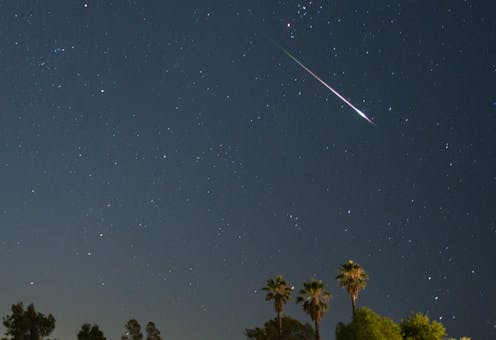
There’s a blaze of light across the sky! A fireball is seen by thousands, and mobile phone and dashcam footage soon appears on social media.
But what have people just seen? A mix of social media hashtags suggests confusion about what has streaked overhead. Was it a Soviet Venus probe? Was it one of Elon Musk’s satellites or rockets? Was it a meteor? Was it a comet?
While these objects have some similarities, there are crucial differences that can help us work out what just passed over our heads.
Shooting stars, meteors and comets
Shooting stars can often be seen on dark, clear nights in the countryside as brief flashes of light travelling across the sky. Usually, they are gone in just a second or two.

Shooting “stars” are not stars, of course. They are produced by dust and pebbles burning up high in the atmosphere, typically above 50km in altitude. Comets are often a source of this dust, and regular showers of shooting stars happen when Earth travels through comets’ orbits.
Sometimes shooting stars burn with colours that reflect their composition – including iron, magnesium and calcium.
Meteors and shooting stars are actually the same thing. But when people talk about meteors, they often mean bigger and brighter events – bolides. Bolides result from rocks and boulders plunging into Earth’s atmosphere, resulting in bright flashes of light that can outshine all the stars and planets in the night sky.
Bolides can reach the lower atmosphere and sometimes produce audible sonic booms. Occasionally pieces of the bolide – meteorites – even make it to Earth’s surface.
The Chelyabinsk fireball was a bolide.While bolides can survive longer than shooting stars, they also don’t last for long. As they are initially travelling at tens of kilometres per second, they don’t take long to traverse the atmosphere.
The Chelyabinsk meteor, the largest bolide known to impact Earth in over a century, shone brightly for only 20 seconds or so.
If you see something blaze across the sky, it almost certainly isn’t a comet. Comets are so far away from us that their vast speeds are imperceptible to the human eye. Furthermore, while comets are sometimes depicted as fiery, their glow is more subtle.
Space junk
Maybe the bright flash you just saw was space junk? Perhaps. The number of orbital rocket launches and satellites has increased rapidly in recent years, and this has resulted in some spectacular reentries, which are often discarded rocket stages.
Like meteors, space junk travels at vast speeds as it travels through the atmosphere and it begins burning up spectacularly. Also like meteors, you can see colours indicative of the materials burning up, such as steel and aluminium. However, there are a few things that distinguish space junk from meteors.
When rockets and satellites are launched into orbit, they typically travel along paths that roughly follow Earth’s curvature. So when space junk begins to enter the atmosphere, it’s often travelling almost horizontally.
Space junk also travels at slower speeds than shooting stars and meteorites, entering Earth’s atmosphere at roughly 8km/s rather than tens of kilometres per second.
Because of these factors, space junk can take minutes to enter the atmosphere and travels hundreds of kilometres in the process. Over this time, the space junk will slow down and break up into pieces, and the more solidly constructed parts might make it down to Earth.
The slower pace of space junk fireballs gives people time to grab phones, take footage and post on social media, perhaps with a little colourful commentary added for good measure.
A Russian rocket reenters the atmosphere over south eastern Australia.Rockets
While space junk can produce a light show, rockets can also put on amazing displays. If you happen to be near Cape Canaveral or Vandenberg Space Force Base in the United States, or Wairoa in Aotearoa New Zealand, then it’s not unexpected to see a rocket launch. You get smoke, flames and thundering noise.
But in other parts of the world you may get a different view of rockets.
Rockets that bring satellites into our orbit accelerate to 8km/s. As they do, they travel many hundreds of kilometres at over 100km altitude. American satellite launches often travel near the coast, passing major cities including Los Angeles.
As rockets approach orbit, they are more subtle than the flames and noise of liftoff. Rockets produce plumes of exhaust gases that rapidly and silently expand in the vacuum of space.
While these plumes are typically seen near launch sites, they can be visible elsewhere, too.
Sometimes rocket engines are ignited after reaching an initial orbit to boost satellites to higher orbits, send probes into the Solar System or slow rockets down for reentry. Rockets may also vent excess fuel into space, again producing plumes or spirals of gases. While not necessarily a common occurrence, these have been seen all over the world.
A deorbit burn over Western Europe.Do look up
There’s a lot to see in the night sky – the familiar Moon, stars and planets. But there’s the unexpected, too – something blazing across the sky in minutes or even mere seconds. While fireballs may be puzzling at first, they are often recognisable and we can figure out what we’ve just witnessed.
Have you had the good fortune to see a fireball for yourself? If not, pop outside on a clear dark night. Perhaps you will see something unexpected.
Authors: Michael J. I. Brown, Associate Professor in Astronomy, Monash University


















