

Should Joan Didion’s therapy notes to her husband about their daughter have been published?
- Written by: Gemma Nisbet, Lecturer in Professional Writing and Publishing, Curtin University
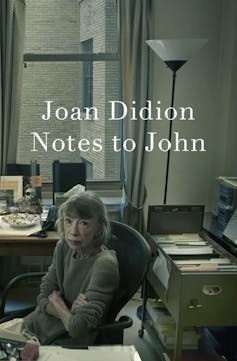
Joan Didion died, aged 87, in 2021. When a new volume of her diaries was announced, anticipation was high: her personal nonfiction is the foundation of her formidable literary legacy. But as details emerged, readers began to question the ethics of its publication.
Billed as offering “astonishingly intimate” insights, Notes to John recounts conversations with Didion’s psychiatrist between December 1999 and January 2003. It draws on a series of letters addressed to Didion’s husband, fellow writer and frequent collaborator, John Gregory Dunne.


 Harper Lee.
Rob Carr/AAP
The role of the writer
Didion did publish her own thoughts on this subject. A near-lifelong devotee of Ernest Hemingway, she criticised the posthumous publication of work left unfinished when he died in 1961.
In a 1998 New Yorker article, she noted Hemingway’s disdain for such practices, quoting a letter he’d written in 1952 to an author working on a book about his early career:
Writing that I do not wish to publish, you have no right to publish. I would no more do a thing like that to you than I would cheat a man at cards or rifle his desk or wastebasket or read his personal letters.
Didion also saw in Hemingway’s famously precise prose style further evidence of the wrongheadedness of such endeavours. Hemingway was a writer for whom seemingly minor points of grammar, syntax and punctuation were deeply consequential. As Didion wrote,
This was a man to whom words mattered. He worked at them, he understood them, he got inside them.
In her telling, the power of his writing arose from his exacting control over his craft: over what was included, but also what was left out. To make decisions on such matters without the input of the author was, she argued, nothing less than “a denial of the idea that the role of the writer in his or her work is to make it”.
Harper Lee.
Rob Carr/AAP
The role of the writer
Didion did publish her own thoughts on this subject. A near-lifelong devotee of Ernest Hemingway, she criticised the posthumous publication of work left unfinished when he died in 1961.
In a 1998 New Yorker article, she noted Hemingway’s disdain for such practices, quoting a letter he’d written in 1952 to an author working on a book about his early career:
Writing that I do not wish to publish, you have no right to publish. I would no more do a thing like that to you than I would cheat a man at cards or rifle his desk or wastebasket or read his personal letters.
Didion also saw in Hemingway’s famously precise prose style further evidence of the wrongheadedness of such endeavours. Hemingway was a writer for whom seemingly minor points of grammar, syntax and punctuation were deeply consequential. As Didion wrote,
This was a man to whom words mattered. He worked at them, he understood them, he got inside them.
In her telling, the power of his writing arose from his exacting control over his craft: over what was included, but also what was left out. To make decisions on such matters without the input of the author was, she argued, nothing less than “a denial of the idea that the role of the writer in his or her work is to make it”.
 Joan Didion criticised the posthumous publication of Ernest Hemingway’s work, saying: ‘This was a man to whom words mattered’.
Lloyd Arnold Hulton Archive/Getty Images
A matter of style
Like Hemingway, Didion was a master stylist, known for the crystalline elegance of her prose and her investment in questions of writerly craft. There can be a mistaken tendency to think of autobiographical writing as straightforwardly confessional – simply opening a vein onto the page – but this was never Didion’s way.
Even when her writing felt emotionally raw and self-revelatory, it was always finely wrought, informed by those lessons from Hemingway about the power of deliberate omission. This was, after all, a woman sufficiently private that she kept her treatment for breast cancer secret for years from everyone but Dunne.
Many of the hallmarks of Didion’s writerly style are present in Notes to John: the fragmentary quality, the clarity of her prose, even snakes as recurrent image. But in recounting this emotionally fraught subject matter at little temporal remove, she becomes direct to the point of bluntness.
At one point, for example, Didion’s psychiatrist praises her “extraordinary insight” into her relationship with her own mother. She responds:
Extraordinary or not […] it’s not much help in just getting on with life. It’s even counterproductive, considering that my mother is now 89. It’s not as if we’re going to resolve anything by confronting this.
Of course, it soon becomes apparent Didion’s relationship to her mother is highly relevant to how she has parented her daughter. If, as one of Didion’s most widely quoted lines puts it, she wrote to “find out what I’m thinking, what I’m looking at, what I see and what it means”, in Notes to John, that process is seemingly very much a work in progress.
All of this contributes to the sense of reading something not intended to be published in anything like its current form – and thus not yet rising to the status of masterpiece. Didion would go on to write about at least some of this subject matter in later books, particularly 2011’s Blue Nights, which chronicles her grief after Quintana’s death in 2005, less than two years after Dunne’s passing. But the way this material is handled in Blue Nights is markedly different.
Joan Didion criticised the posthumous publication of Ernest Hemingway’s work, saying: ‘This was a man to whom words mattered’.
Lloyd Arnold Hulton Archive/Getty Images
A matter of style
Like Hemingway, Didion was a master stylist, known for the crystalline elegance of her prose and her investment in questions of writerly craft. There can be a mistaken tendency to think of autobiographical writing as straightforwardly confessional – simply opening a vein onto the page – but this was never Didion’s way.
Even when her writing felt emotionally raw and self-revelatory, it was always finely wrought, informed by those lessons from Hemingway about the power of deliberate omission. This was, after all, a woman sufficiently private that she kept her treatment for breast cancer secret for years from everyone but Dunne.
Many of the hallmarks of Didion’s writerly style are present in Notes to John: the fragmentary quality, the clarity of her prose, even snakes as recurrent image. But in recounting this emotionally fraught subject matter at little temporal remove, she becomes direct to the point of bluntness.
At one point, for example, Didion’s psychiatrist praises her “extraordinary insight” into her relationship with her own mother. She responds:
Extraordinary or not […] it’s not much help in just getting on with life. It’s even counterproductive, considering that my mother is now 89. It’s not as if we’re going to resolve anything by confronting this.
Of course, it soon becomes apparent Didion’s relationship to her mother is highly relevant to how she has parented her daughter. If, as one of Didion’s most widely quoted lines puts it, she wrote to “find out what I’m thinking, what I’m looking at, what I see and what it means”, in Notes to John, that process is seemingly very much a work in progress.
All of this contributes to the sense of reading something not intended to be published in anything like its current form – and thus not yet rising to the status of masterpiece. Didion would go on to write about at least some of this subject matter in later books, particularly 2011’s Blue Nights, which chronicles her grief after Quintana’s death in 2005, less than two years after Dunne’s passing. But the way this material is handled in Blue Nights is markedly different.
 Where Notes to John moves in a chronological fashion through time, Blue Nights mimics the workings of memory with its non-linearity. Notes to John feels, formally speaking, like exactly that: a series of notes or journal entries covering a specific span of time. Blue Nights, however, takes advantage of the expansive, hybrid possibilities of the essay to cast its net wider and tell a fuller story about love, parents and children, guilt and grief.
Notably, in Blue Nights, Didion does discuss Quintana’s diagnoses with conditions including borderline personality disorder, but largely elides the specific nature of her addiction. In Notes to John, it is faced head on and discussed in detail.
Didion was a writer known for her obliqueness – for her mastery of what the Irish writer Brian Dillon calls the essayists’ “sidelong glance”; that is, a way of illuminating difficult subject matter by approaching it indirectly.
Notes to John’s forthrightness is thus a contrast to Didion’s classic nonfiction. There, her narratives often proceed by a logic of association, asking readers to make connections via metaphor and to fill in the gaps to see how this relates to that.
In the space of a single chapter in Blue Nights, for example, Didion goes from recounting Quintana’s wedding day to recalling the family’s home in suburban Los Angeles to reflecting on the process of getting a New York driver’s licence when they later moved east.
There’s discussion of a psychiatric text about suicide from the 1930s, a quote from the ancient Greek playwright Euripides, and the image of Quintana in 2003, “in an induced coma, breathing only on a respirator” during “the first in a cascade of medical crises that would end twenty months later with her death”.
This mode of storytelling is quintessential Didion. It can give rise to accusations of ambiguity or evasiveness – charges levelled at her work more than once. But it also has the potential to protect an author and the people around them as they share intimacies, keeping them firmly in control of what is revealed, and not.
Marital eavesdropping
Notes to John is also troubled by a question of intended readership. One of the people responsible for its publication – Didion’s agent Lynn Nesbit, also one of her literary trustees – has acknowledged this material “wasn’t written to be published”. Its title makes clear it was written for an audience of one: for Dunne.
This is also evident stylistically, in its second-person narration directed at a “you” so familiar with the people and events it mentions that Didion doesn’t need to explain throwaway references to “the Nick narrative” or someone called Marian. Footnotes have been inserted to clarify that the former refers to Dunne’s strained relationship with his older brother, while the latter was Quintana’s boss at a magazine. Their presence emphasises that we are eavesdropping on intimate martial conversations.
Where Notes to John moves in a chronological fashion through time, Blue Nights mimics the workings of memory with its non-linearity. Notes to John feels, formally speaking, like exactly that: a series of notes or journal entries covering a specific span of time. Blue Nights, however, takes advantage of the expansive, hybrid possibilities of the essay to cast its net wider and tell a fuller story about love, parents and children, guilt and grief.
Notably, in Blue Nights, Didion does discuss Quintana’s diagnoses with conditions including borderline personality disorder, but largely elides the specific nature of her addiction. In Notes to John, it is faced head on and discussed in detail.
Didion was a writer known for her obliqueness – for her mastery of what the Irish writer Brian Dillon calls the essayists’ “sidelong glance”; that is, a way of illuminating difficult subject matter by approaching it indirectly.
Notes to John’s forthrightness is thus a contrast to Didion’s classic nonfiction. There, her narratives often proceed by a logic of association, asking readers to make connections via metaphor and to fill in the gaps to see how this relates to that.
In the space of a single chapter in Blue Nights, for example, Didion goes from recounting Quintana’s wedding day to recalling the family’s home in suburban Los Angeles to reflecting on the process of getting a New York driver’s licence when they later moved east.
There’s discussion of a psychiatric text about suicide from the 1930s, a quote from the ancient Greek playwright Euripides, and the image of Quintana in 2003, “in an induced coma, breathing only on a respirator” during “the first in a cascade of medical crises that would end twenty months later with her death”.
This mode of storytelling is quintessential Didion. It can give rise to accusations of ambiguity or evasiveness – charges levelled at her work more than once. But it also has the potential to protect an author and the people around them as they share intimacies, keeping them firmly in control of what is revealed, and not.
Marital eavesdropping
Notes to John is also troubled by a question of intended readership. One of the people responsible for its publication – Didion’s agent Lynn Nesbit, also one of her literary trustees – has acknowledged this material “wasn’t written to be published”. Its title makes clear it was written for an audience of one: for Dunne.
This is also evident stylistically, in its second-person narration directed at a “you” so familiar with the people and events it mentions that Didion doesn’t need to explain throwaway references to “the Nick narrative” or someone called Marian. Footnotes have been inserted to clarify that the former refers to Dunne’s strained relationship with his older brother, while the latter was Quintana’s boss at a magazine. Their presence emphasises that we are eavesdropping on intimate martial conversations.
 Notes to Joan was written for an audience of one: her husband John Gregory Dunne (right).
AAP
The portrait of Didion that emerges is thus startlingly vulnerable: we see her frailties, anxieties and doubts – particularly regarding her and Dunne’s parenting of Quintana, who they adopted as a newborn – far more directly than in her other published writing.
Perhaps there is value in this: another of Didion’s literary trustees, her longtime editor Shelley Wanger, has said she hoped the book’s unguarded quality would offer a corrective to Didion’s somewhat chilly public image.
I can also see that Didion’s candour may provide comfort to readers dealing with similar difficulties. Notes to John has much to say that is resonant and truthful about depression, anxiety, addiction and the grinding difficulties of supporting a loved one through such challenges.
“You and your husband are going through hell,” Didion’s psychiatrist tells her during a discussion of “a hard weekend” in which she and Dunne had worried for Quintana’s safety. “You can only love her,” the doctor says. “You can’t save her.”
Ethical responsibilities
I am less inclined to agree with those who suggest the ethical ramifications of publishing this material are less relevant because Didion, Dunne and their daughter are no longer alive to suffer the pain or embarrassment of exposure.
Life writing scholar G. Thomas Couser has argued that while death could “seem to suggest utter invulnerability to harm” when it comes to being written about, it may actually “be the state of ultimate vulnerability and dependency”, given that the deceased can offer neither consent nor self defence.
From this perspective, Notes to John’s depiction of Quintana is particularly troubling. Readers gain an intimate view of what must have been some of her most vulnerable moments as she struggles with addiction and mental ill-health.
Notes to Joan was written for an audience of one: her husband John Gregory Dunne (right).
AAP
The portrait of Didion that emerges is thus startlingly vulnerable: we see her frailties, anxieties and doubts – particularly regarding her and Dunne’s parenting of Quintana, who they adopted as a newborn – far more directly than in her other published writing.
Perhaps there is value in this: another of Didion’s literary trustees, her longtime editor Shelley Wanger, has said she hoped the book’s unguarded quality would offer a corrective to Didion’s somewhat chilly public image.
I can also see that Didion’s candour may provide comfort to readers dealing with similar difficulties. Notes to John has much to say that is resonant and truthful about depression, anxiety, addiction and the grinding difficulties of supporting a loved one through such challenges.
“You and your husband are going through hell,” Didion’s psychiatrist tells her during a discussion of “a hard weekend” in which she and Dunne had worried for Quintana’s safety. “You can only love her,” the doctor says. “You can’t save her.”
Ethical responsibilities
I am less inclined to agree with those who suggest the ethical ramifications of publishing this material are less relevant because Didion, Dunne and their daughter are no longer alive to suffer the pain or embarrassment of exposure.
Life writing scholar G. Thomas Couser has argued that while death could “seem to suggest utter invulnerability to harm” when it comes to being written about, it may actually “be the state of ultimate vulnerability and dependency”, given that the deceased can offer neither consent nor self defence.
From this perspective, Notes to John’s depiction of Quintana is particularly troubling. Readers gain an intimate view of what must have been some of her most vulnerable moments as she struggles with addiction and mental ill-health.
 Joan Didion sits in front of a photo of herself holding her daughter Quintana Roo and another picture of her daughter’s wedding.
Kathy Willens/AAP
We watch – through the eyes of her loving, fretful and perhaps overprotective mother – as she fumbles, relapses and at times, says things to her parents it seems likely she’d have lived to regret.
We see mother and daughter’s extreme closeness, perhaps even codependency (“You and Quintana had been for too long two people in the same skin,” the doctor observes).
We also see Didion’s guilt at what she regards as her culpability for her child’s inability to cope with life, in part for the way she has projected her own at-times debilitating anxieties onto her. “I had always been afraid we would lose her,” Didion admits.
All of this frequently makes for devastating reading. But it also gives the clear sense that Didion recognised her daughter as what Couser terms “a vulnerable subject” – and so strove to protect her, in her published writing as in her life.
Frozen in time
Notes to John peters out in January 2003, following Didion’s account of a fractious joint psychiatry session with Quintana.
As readers, we know how things will end: with a woman mourning both her husband and daughter, and turning to writing to try – as she always has – to make sense of it all. In the pages of these journals, however, she is frozen in time: “I was trying to keep her alive,” she says of Quintana. “Because she was killing herself day by day.”
Should Notes to John have been published? Or should it have been left to the relative obscurity of the archive, where it would have been read by Didion scholars, biographers and super fans, rather than a potential audience of millions?
From an ethical standpoint, I think the latter option would have been more defensible. But it’s also true that this revealing, raw and often hauntingly moving little book will stay with me – in large part for the complex portrait of Didion’s guilt and devotion to her daughter that it reveals.
If this article has raised issues for you, or if you’re concerned about someone you know, call Lifeline on 13 11 14.
Authors: Gemma Nisbet, Lecturer in Professional Writing and Publishing, Curtin University
Joan Didion sits in front of a photo of herself holding her daughter Quintana Roo and another picture of her daughter’s wedding.
Kathy Willens/AAP
We watch – through the eyes of her loving, fretful and perhaps overprotective mother – as she fumbles, relapses and at times, says things to her parents it seems likely she’d have lived to regret.
We see mother and daughter’s extreme closeness, perhaps even codependency (“You and Quintana had been for too long two people in the same skin,” the doctor observes).
We also see Didion’s guilt at what she regards as her culpability for her child’s inability to cope with life, in part for the way she has projected her own at-times debilitating anxieties onto her. “I had always been afraid we would lose her,” Didion admits.
All of this frequently makes for devastating reading. But it also gives the clear sense that Didion recognised her daughter as what Couser terms “a vulnerable subject” – and so strove to protect her, in her published writing as in her life.
Frozen in time
Notes to John peters out in January 2003, following Didion’s account of a fractious joint psychiatry session with Quintana.
As readers, we know how things will end: with a woman mourning both her husband and daughter, and turning to writing to try – as she always has – to make sense of it all. In the pages of these journals, however, she is frozen in time: “I was trying to keep her alive,” she says of Quintana. “Because she was killing herself day by day.”
Should Notes to John have been published? Or should it have been left to the relative obscurity of the archive, where it would have been read by Didion scholars, biographers and super fans, rather than a potential audience of millions?
From an ethical standpoint, I think the latter option would have been more defensible. But it’s also true that this revealing, raw and often hauntingly moving little book will stay with me – in large part for the complex portrait of Didion’s guilt and devotion to her daughter that it reveals.
If this article has raised issues for you, or if you’re concerned about someone you know, call Lifeline on 13 11 14.
Authors: Gemma Nisbet, Lecturer in Professional Writing and Publishing, Curtin University 

















