

Modern Australian
The Times

if our eyes see upside down, how does the brain flip the picture?

  • Written by Daniel Joyce, Senior Lecturer in Psychology, University of Southern Queensland
if our eyes see upside down, how does the brain flip the picture?

I heard that we see upside down, but our brain flips the image. How does it do that?

–Jasmine, Mount Evelyn, Victoria

Our eyes work thanks to light. Objects we can see are either sources of light themselves – like a candle or a phone screen – or light bounces off them and makes its way to our eyes.

First, light passes through the optical components of the eyes such as the cornea, pupil and lens.

Together, they help focus the light onto the retina that senses light, while also controlling the intensity of light to help us see well while avoiding damage to the eye.

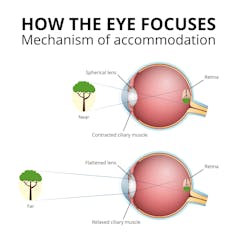
The function of the lens is to correctly focus light that comes from objects at different distances. This process is known as accommodation.

Marochkina Anastasiia/Shutterstock While performing this important task, light passing through the lens becomes inverted. This means that light from the top of the object falls lower on the retina than light from the bottom, which falls higher on the retina. So, light exiting the lens to land on the retina is indeed flipped upside down. But that doesn’t mean the brain is actually flipping the picture “back”. Here’s why. The orientation doesn’t actually matter While the light being interpreted by the brain is “upside down” compared to the real world, the question is: is that actually a problem for us? From your own experience you can tell the answer is probably no. We seem to navigate and interact with the world just fine. So, where in the brain is the image flipped or rotated 180 degrees to be the “right way up” again? You may be surprised to learn that vision scientists reject the idea a flipping or rotation needs to happen at all. This is because of how our brains process visual information. The object you perceive is “encoded” by the firing of various neurons – brain cells that process information – in various locations in the brain. This pattern of firing is what encodes the information about the object you’re focusing on. That info takes into account the object’s relation to everything else in the scene, your body in the world, and your movements. As long as the relative encodings of these are all consistent with one another, as well as stable, there’s no need for a flip to happen at all. We can function with ‘upside down’ goggles! Several studies have looked at how we adapt to large changes in visual input by asking people to wear goggles that flip the image coming in. This means the image lands on the retina the “right way up”, so to speak, but upside down from what the brain has learned it should be. In the 1930s, two scientists in Austria performed the Innsbruck Goggle Experiments. For weeks or even months at a time, participants in these studies wore goggles that altered the way the world around them looked. This included goggles that turn the incoming image upside down.
A person blinks while wearing an ‘invertoscope’ – goggles that turn the incoming image upside down. Dmitry Hoh/Wikimedia Commons, CC BY-SA

As you can imagine, people wearing these goggles at first found it really difficult to get by in their day-to-day activities. They would stumble and bump into things.

But this was temporary.

Participants reported seeing the world upside-down for the first few days, with difficulties navigating the environment, including trying to step over ceiling lights that appeared to them as on the floor.

Around the fifth day, however, performance seemed to improve. Things that were at first seen upside down now appeared the right way up, and this tended to improve with more time.

In other words, with continued exposure to the upside-down world, the brain adapted to the changed input.

More recent studies are beginning to identify which areas of the brain are involved in being able to adapt to changes in visual input, and what the limits of our ability to adapt might be.

Adaptation may even allow “colour blind” people to see colour better than is predicted from their condition.

Authors: Daniel Joyce, Senior Lecturer in Psychology, University of Southern Queensland

Read more https://theconversation.com/curious-kids-if-our-eyes-see-upside-down-how-does-the-brain-flip-the-picture-254303

Why Tooth Fillings Are Important For Protecting Damaged Teeth

Cavities and minor tooth damage are common dental problems that can worsen if left untreated. Professional tooth fillings help restore damaged teeth, ...

The Connection Between Visibility and Driver Confidence

Operating a vehicle safely requires an immediate, uncompromised stream of visual information from the surrounding road environment. A driver's decis...

Important Things To Know Before Starting An SMSF Setup

Planning for retirement requires careful financial decisions, and many Australians are now looking for more direct control over how their superannua...

Why Retail Cleaning Plays a Key Role in Customer Experience and Business Success

Professional retail cleaning services are an essential part of maintaining a welcoming, safe, and professional environment for customers and staff...

Simple Ways to Make a Commercial Property More Appealing to Buyers

Selling or leasing a commercial property isn’t just about listing the square metres, taking a few photos and waiting for the right person to appea...

What Café Owners Should Know Before Upgrading Their Display Setup

A café display fridge does a lot more than keep cakes cold and sandwiches fresh. It quietly shapes the way customers browse, the way staff move beh...

Creating a Backyard That Feels Comfortable All Year Round

A great backyard doesn’t need to be huge, expensive or perfectly styled. Most of the time, the spaces people actually use are the ones that feel e...

How Homeowners Can Make Smarter Energy Decisions Before Upgrading

Energy upgrades used to feel like something you only looked into after a power bill gave you a nasty surprise. These days, though, more homeowners a...

Why Retail CX Breaks During Peak Sales Events and How to Prevent It

Retail customer experience has become one of the most important drivers of revenue growth, especially during high-intensity sales periods. However, ev...

15 South Indian Dishes Everyone Should Try

If your only experience of "Indian food" is butter chicken and garlic naan, South Indian cuisine is going to feel like discovering an entirely new c...

What Every Homeowner Should Know About Roof and Drainage Maintenance

A home's roof and drainage system work together every day to protect the property from water damage. While many homeowners focus on visible areas such...

From Plans to Priced Quote: The Estimating Workflow Most Builders Skip

For a small one-off job, an experienced builder can size up the materials in their head. The problem is that most jobs are not small one-off jobs, and...

Organisational Experts Share Their Tips for Achieving a Clutter-Free Kitchen

They say the kitchen is the heart of a house which means a clutter-free kitchen not only makes your home in general look nicer, it also makes cookin...

10 Creative Ways AI Image Extenders Are Transforming Digital Content Creation in 2026

Introduction Artificial intelligence continues to reshape the digital landscape, and one of the most exciting innovations in 2026 is the rise of AI i...

What to Do When You're Arrested in Victoria

Most people have thought about this in the abstract. A knock at the door, a hand on the shoulder, a car pulled over on the Hume. In the abstract, th...

Common Financial Disputes During Separation

Separation hits on many levels, not just emotionally. When a partnership ends, untangling the financial side — assets, debts, and everything built t...

Why Posting More Content is Killing Your Brand

More content. More often. More platforms.Most brands have been running this playbook for three years. Most brands have nothing to show for it.Not be...

Garden Clean-Up vs. Regular Maintenance: Which Do You Really Need?

Most people ring a gardener and ask for a "tidy up." What they mean by that, and what the garden actually needs, are often two completely different ...

















