

As the Latrobe Valley moves away from coal jobs, could a green worker’s cooperative offer a solution?
- Written by: Gregory Patmore, Emeritus Professor of Business and Labour History, University of Sydney
Worker cooperatives may sound like something out of the 19th century, but they still exist in the age of global capitalism.
In Spain, for instance, the Mondragon Corporation is a huge worker-run cooperative based around 95 collectives – the largest cooperative in the world.
Worker cooperatives produce products or services. But they are run very differently. Workers can become members of the cooperative they work for by buying a share of the business. This gives them a vote in how the business is run and a share of net income, after costs have come out.
Co-ops do not have external shareholders – the profits stay with workers. Rather than bosses deciding and workers carrying out the tasks, worker cooperatives are based on democratic principles. Big decisions are discussed and then voted on, and each member gets one vote. They offer a direct way for workers to control their production and shape the economy.
In Australia, these models peaked in the 1980s. Most are gone, though a few older cooperatives are still running, such as Tasmanian recycling cooperative Resource Work Collective, founded in 1993.
In recent years, there’s been renewed interest in the model. The Earthworker cooperative network focused on Victoria’s Latrobe Valley. The goal: find new types of employment and products in a coal area undergoing transition.

How well does the model work?
Mondragon is the most well-known example. Founded in 1956 in the Basque region of northern Spain, Mondragon grew and became self-sustaining. It has developed supporting institutions such as research and development companies and even a university. It also established a credit union, which attracted capital and provided loans to cooperatives.
While Mondragon is a successful example, these organisations face a number of barriers to their survival.
Critics have argued worker cooperatives tend to fail as workers do not understand the market for their products, but Mondragon undercuts this criticism.
Worker cooperatives can have difficulties raising capital. Some banks can be reluctant to invest as they may lack familiarity or sympathy with the model.
Instead, workers may put some or all of their savings into the organisation to get it started. Taking these kinds of risks means some workers may be focused on getting immediate rewards, rather than investing surplus funds or building up cash reserves.
Workers can sometimes choose to transform a successful cooperative into a capitalist enterprise to achieve greater capital gains.
Surprisingly, trade unions are generally hostile and suspicious of worker cooperatives. Union organisers may fear worker-owners could see little need for trade unions in representing their interests, or that cooperatives could undercut union wages and conditions to remain competitive.
To date, worker cooperatives have had a limited impact in Australia, despite the relatively strong historical position of workers.
Compared to member cooperatives and other types, worker’s cooperatives tend to be short lived in Australia. That’s because most were formed by workers after an industrial dispute or to maintain employment during economic downturns.
In 1987, for instance, workers retrenched by a major communications company decided to form a co-op which became the Electronic Service Centre in Fairfield, New South Wales. A later example is Abrasiflex, a NSW company bought by workers facing retrenchment in 1993. Both cooperatives failed by the early 2000s.
Their popularity peaked in the 1980s, when the model was promoted by state Labor governments. Policymakers saw them as a short term means to resolve unemployment, rather than a long term means to secure economic democracy.
The model lost traction in the early 1990s due to an economic downturn, capital shortfalls and changing political circumstances.
New energy
The idea for Earthworker came from discussions between unionists and environmentalists over job creation and the environment. Earthworker founders were influenced by the Green Bans.
As the project’s website states:
Conflict can occur between environmentalists who want to shut down certain industries, and unionists who want to protect jobs […] we should work together for a “just transition” and create jobs that aren’t just better for the earth, but for workers too.
In this respect, Earthworker has much in common with the Cleveland Model in the United States, which links green business, local economic development and fair labour practices.
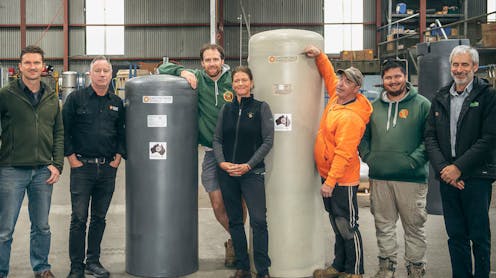
Earthworker only formally became a cooperative in 2011, though discussions date back to the late 1990s. In 2016, the network bought a hot water tank manufacturer in Morwell and began making their own tanks and solar hot water systems as the Earthworker Energy Manufacturing Co-operative. The cooperative is aimed at helping the Latrobe Valley’s transition away from coal power jobs.

Earthworker promotes the payment of trade union wage rates and conditions. The goal is to build a network of cooperatives supporting each other to build economies of scale.
Their other cooperatives include Earthworker Construction (residential construction, landscaping and maintenance) and Earthworker Smart Energy (improving thermal efficiency and comfort in homes). These cooperatives are generally small, with 10 members or fewer.
Another cooperative, Redgum Cleaning, closed down in 2023. It was not viable due to staff shortages, increased costs and work cancellations during the pandemic. Paying union rates in a competitive industry also assisted its demise.
By contrast, the Earthworker Energy Manufacturing Co-operative has found a way to survive in a competitive market.
Niche or mainstream?
Australian worker cooperatives ensure manufacturing and services remain locally owned and controlled. Could they expand? It’s possible.
Capital remains a major issue for Australian worker cooperatives such as Earthworker. Without capital, it’s hard to scale. Government efforts to expand domestic manufacturing often overlook this model.
The Earthworker network points to one future for Australian worker cooperatives. Despite the failures of the past, Earthworker’s focus on building a network of sustainable businesses rather than a single cooperative is a promising path.
Authors: Gregory Patmore, Emeritus Professor of Business and Labour History, University of Sydney


















