

how a Bengali book in Broken Hill sheds new light on Australian history
- Written by: Samia Khatun, Senior Lecturer, SOAS, University of London
Some 1,000 kilometres inland from Sydney, over the Blue Mountains, past the trees that drink the tributaries of the Darling River, there stands a little, red mosque. It marks where the desert begins.
The mosque was built from corrugated iron in around 1887 in the town of Broken Hill. Its green interiors feature simple arabesque and its shelves house stories once precious to people from across the Indian Ocean. Today it is a peaceful place of retreat from the gritty dust storms and brilliant sunlight that assault travellers at this gateway to Australia’s deserts.
 The corrugated iron mosque in Broken Hill.
Samia Khatun
The corrugated iron mosque in Broken Hill.
Samia Khatun
By a rocky hill that winds had “polished black”, the town of Broken Hill was founded on the country of Wiljakali people. In June 1885, an Aboriginal man whom prospectors called “Harry” led them to a silver-streaked boulder of ironstone and Europeans declared the discovery of a “jeweller’s shop”.
Soon, leading strings of camels, South Asian merchants and drivers began arriving in greater numbers at the silver mines, camel transportation operating as a crucial adjunct to colonial industries throughout Australian deserts. The town grew with the fortunes of the nascent firm Broken Hill Propriety Limited (BHP) — a parent company of one of the largest mining conglomerates in the world today, BHP-Billiton.
As mining firms funnelled lead, iron ore and silver from Wiljakali lands to Indian Ocean ports and British markets, Broken Hill became a busy industrial node in the geography of the British Empire. The numbers of camel merchants and drivers fluctuated with the arrival and departure of goods, and by the turn of the 20th century an estimated 400 South Asians were living in Broken Hill. They built two mosques. Only one remains.
In the 1960s, long after the end of the era of camel transportation, when members of the Broken Hill Historical Society were restoring the mosque on the corner of William Street and Buck Street, they found a book in the yard, its “pages blowing in the red dust” in the words of historian Christine Stevens. Dusting the book free of sand, they placed it inside the mosque, labelling it as “The Holy Koran”. In 1989, Stevens reproduced a photo of the book in her history of the “Afghan cameldrivers” .
I travelled to Broken Hill in July 2009. As I searched the shelves of the mosque for the book, a winter dust storm was underway outside. Among letters, a peacock feather fan and bottles of scent from Delhi, the large book lay, bearing a handwritten English label: “The Holy Koran”.
Turning the first few pages revealed it was not a Quran, but a 500-page volume of Bengali Sufi poetry.
Sitting on the floor, I set out to decipher Bengali characters I had not read for years. The book was titled Kasasol Ambia (Stories of the Prophets). Printed in Calcutta, it was a compendium of eight volumes published separately between 1861 and 1895. It was a book of books. Every story began by naming the tempo at which it should be performed, for these poems were written to be sung out loud to audiences.
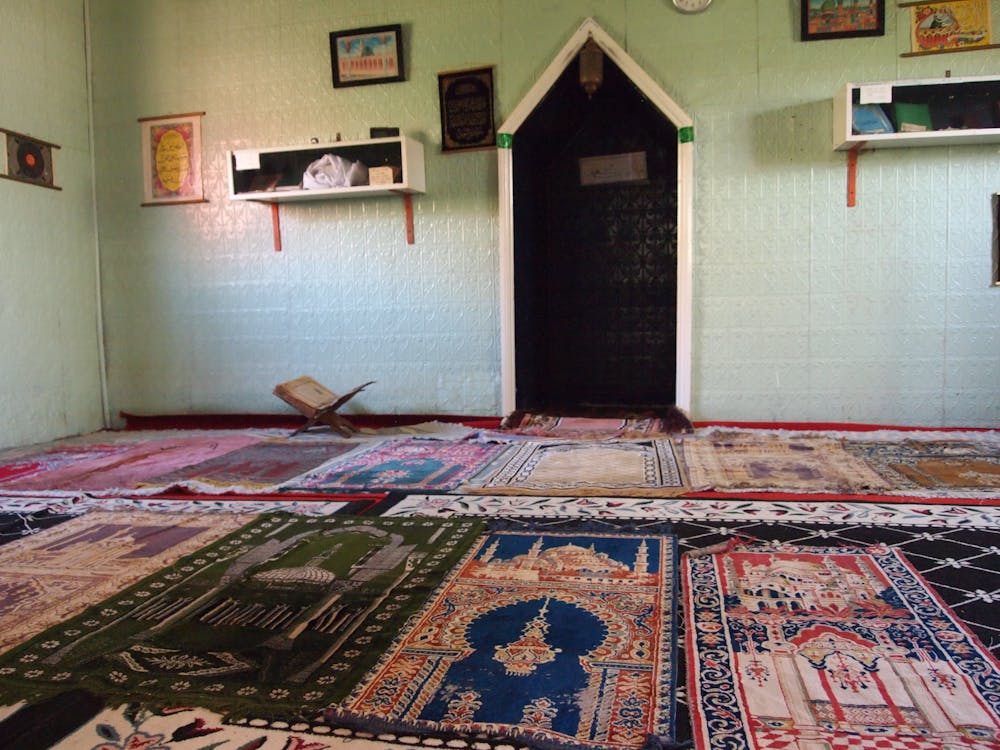 The mosque’s interior.
Samia Khatun
The mosque’s interior.
Samia Khatun
As I strained to parse unfamiliar Persian, Hindi and Arabic words, woven into a tapestry of 19th-century Bengali grammar, I slowly started to glimpse the shimmering imagery of the poetry.
Creation began with a pen, wrote Munshi Rezaulla, the first of the three poets of Kasasol Ambia. As a concealed pen inscribed words onto a tablet, he narrates, seven heavens and seven lands came into being, and “Adam Sufi” was sculpted from clay. Over the 500 pages of verse that follow, Adam meets Purusha, Alexander the Great searches for immortal Khidr, and married Zulekha falls hopelessly in love with Yusuf.
As Rezaulla tells us, it was his Sufi guide who instructed him to translate Persian and Hindi stories into Bengali. Overwhelmed by the task, Rezaulla asked, “I am so ignorant, in what form will I write poetry?”
In search of answers, the poet wrote, “I leapt into the sea. Searching for pearls, I began threading a chain.” Here the imagery of the poet’s body immersed in a sea evokes a pen dipped in ink stringing together line after line of poetry. As Rezaulla wrote, “Stories of the Prophets (Kasasol Ambia) I name this chain.”
Its pages stringing together motif after motif from narratives that have long circulated the Indian Ocean, Kasasol Ambia described events spanning thousands of years, ending in the sixth year of the Muslim Hijri calendar. Cocooned from the winds raging outside, I realised I was reading a Bengali book of popular history.
Challenging Australian history
In the time since Broken Hill locals dusted Kasasol Ambia of sand in the 1960s, why had four Australian historians mislabelled the book? Why did the history books accompanying South Asian travellers to the West play no role in the histories that are written about them?
Moreover, as Christine Stevens writes, the people who built the mosque in North Broken Hill came from “Afghanistan and North-Western India”. How, then, did a book published in Bengal find its way to an inland Australian mining town?
Captivated by this last enigma, I began looking for clues. First, I turned to the records of the Broken Hill Historical Society. Looking for fragments of Bengali words in archival collections across Australia, I sought glimpses of a traveller who might be able to connect 19th-century Calcutta to Broken Hill.
As I searched for South Asian characters through a constellation of desert towns and Australian ports once linked by camels, I encountered a vast wealth of non-English-language sources that Australian historians systematically sidestep.
A seafarer’s travelogue narrated in Urdu in Lahore continues to circulate today in South Asia and in Australia, while Urdu, Persian and Arabic dream texts from across the Indian Ocean left ample traces in Australian newspapers.
One of the most surprising discoveries was that the richest accounts of South Asians were in some of the Aboriginal languages spoken in Australian desert parts. In histories that Aboriginal people told in Wangkangurru, Kuyani, Arabunna and Dhirari about the upheaval, violence and new encounters that occurred in the wake of British colonisation, there appear startlingly detailed accounts of South Asians.
Central to the history of encounter between South Asians and Aboriginal people in the era of British colonisation were a number of industries in which non-white labour was crucial: steam shipping industries, sugar farming, railway construction, pastoral industries, and camel transportation. Camels, in particular, loom large in the history of South Asians in Australia.
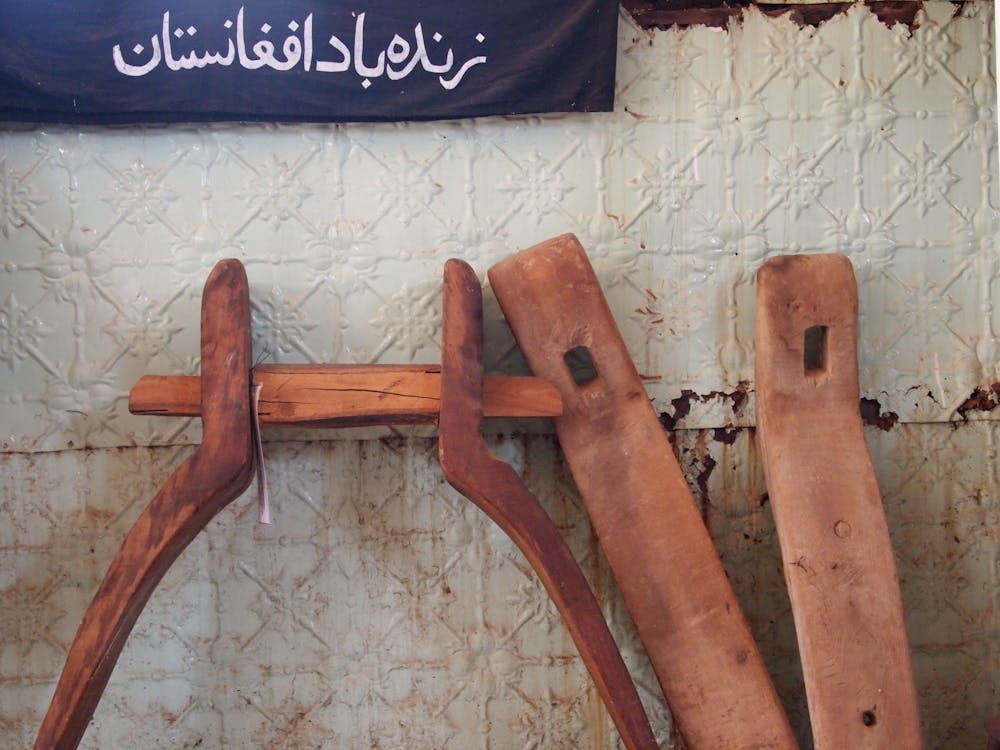 Camel harnesses at the mosque.
Samia Khatun
Camel harnesses at the mosque.
Samia Khatun
From the 1860s, camel lines became central to transportation in Australian desert interiors, colonising many of the long-distance Indigenous trade routes that crisscross Aboriginal land. The animals arrived from British Indian ports accompanied by South Asian camel owners and drivers, who came to be known by the umbrella term of “Afghans” in settler nomenclature.
The so-called Afghans were so ubiquitous through Australian deserts that when the two ends of the transcontinental north-south railway met in Central Australia in 1929, settlers rejoiced in the arrival of the “Afghan Express”. Camels remained central to interior transportation until they were replaced by motor transportation from the 1920s. Today the transcontinental railway is still known as “the Ghan”.
As a circuitry of camel tracks interlocking with shipping lines and railways threaded together Aboriginal lives and families with those of Indian Ocean travellers, people moving through these networks storied their experiences in their own tongues. Foregrounding these fragments in languages other then English, this book tells a history of South Asian diaspora in Australia.
Asking new questions
I start by reading the copy of Kasasol Ambia that remains in Broken Hill, and interpret the many South Asian- and Aboriginal-language stories I encountered during my search for the reader who brought the Bengali book to the Australian interior. Entry points into rich imaginative landscapes, these are stories that ask us to take seriously the epistemologies of people colonised by the British Empire.
 My aim is to challenge the suffocating monolingualism of the field of Australian history. In my new book, Australianama, I do not argue for the simple inclusion of non-English-language texts into existing Australian national history books, perhaps with updated or extended captions.
Instead, I show that non-English-language texts render visible historical storytelling strategies and larger architectures of knowledge that we can use to structure accounts of the past. These have the capacity to radically change the routes readers use to imaginatively travel to the past. Stories in colonised tongues can transform the very grounds from which we view the past, present and future.
In July 2009, when I first encountered Kasasol Ambia, the Bengali book long mislabelled as a Quran made front-page news in Broken Hill. With touching enthusiasm, the journalist announced that I would “begin work on a full translation shortly”.
My aim is to challenge the suffocating monolingualism of the field of Australian history. In my new book, Australianama, I do not argue for the simple inclusion of non-English-language texts into existing Australian national history books, perhaps with updated or extended captions.
Instead, I show that non-English-language texts render visible historical storytelling strategies and larger architectures of knowledge that we can use to structure accounts of the past. These have the capacity to radically change the routes readers use to imaginatively travel to the past. Stories in colonised tongues can transform the very grounds from which we view the past, present and future.
In July 2009, when I first encountered Kasasol Ambia, the Bengali book long mislabelled as a Quran made front-page news in Broken Hill. With touching enthusiasm, the journalist announced that I would “begin work on a full translation shortly”.
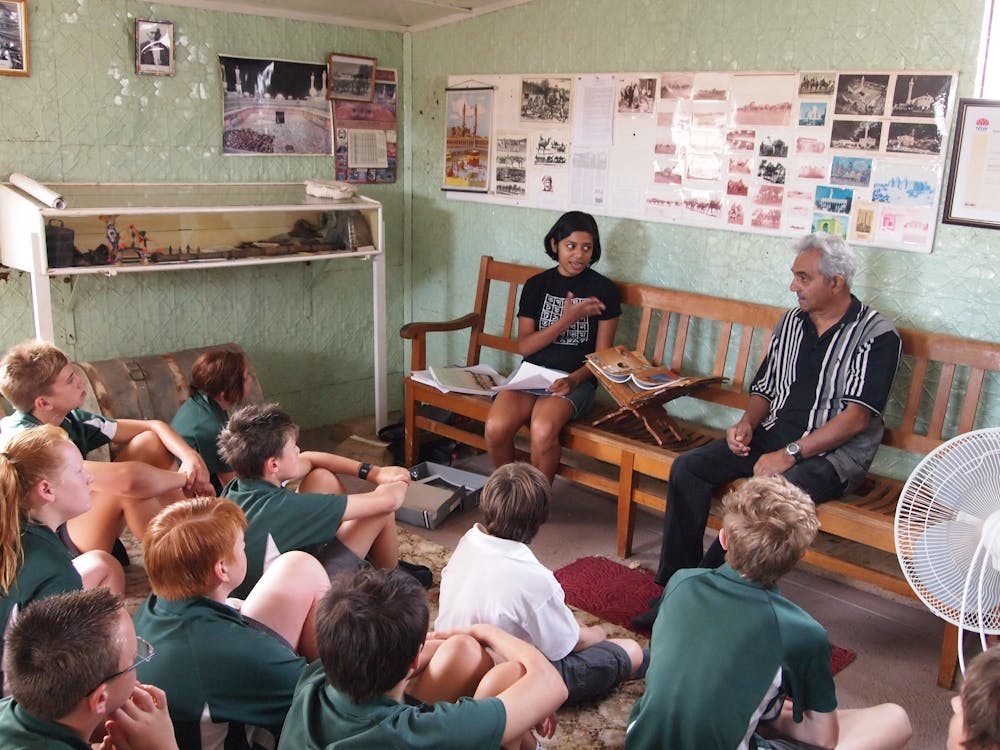 The author talks to local school children in the mosque in 2012 with Bobby Shamroze, a descendant of the original South Asians who worked in the area.
Eirini Cox
Overwhelmed by such a task, I began trawling mosque records held by the Broken Hill Historical Society, soon beginning a search through port records, customs documents and government archives. I did not know how to decipher the difficult book, and so in these archival materials I hoped to glimpse, however fleetingly, the skilled 19th-century reader who had once performed its poetry.
Slowly, it dawned on me that I was following the logic that Rezaulla outlines in his schema for translation. For I too had stepped into the imaginative world of the poetry in search of answers to some hard questions: How do we write histories of South Asian diaspora which pay attention to the history books that travelled with them? Who was the unnamed traveller who brought Bengali stories of the prophets to Broken Hill? Can historical storytelling in English do more than simply induct readers into white subjectivities?
Threading together seven narrative motifs that appear in Kasasol Ambia, I began to piece together a history of South Asians in Australia.
This is an edited extract from Australianama by Samia Khatun, UQP, rrp $34.95, out from 6 September.
The author talks to local school children in the mosque in 2012 with Bobby Shamroze, a descendant of the original South Asians who worked in the area.
Eirini Cox
Overwhelmed by such a task, I began trawling mosque records held by the Broken Hill Historical Society, soon beginning a search through port records, customs documents and government archives. I did not know how to decipher the difficult book, and so in these archival materials I hoped to glimpse, however fleetingly, the skilled 19th-century reader who had once performed its poetry.
Slowly, it dawned on me that I was following the logic that Rezaulla outlines in his schema for translation. For I too had stepped into the imaginative world of the poetry in search of answers to some hard questions: How do we write histories of South Asian diaspora which pay attention to the history books that travelled with them? Who was the unnamed traveller who brought Bengali stories of the prophets to Broken Hill? Can historical storytelling in English do more than simply induct readers into white subjectivities?
Threading together seven narrative motifs that appear in Kasasol Ambia, I began to piece together a history of South Asians in Australia.
This is an edited extract from Australianama by Samia Khatun, UQP, rrp $34.95, out from 6 September.
Authors: Samia Khatun, Senior Lecturer, SOAS, University of London


















