

Spotify continues to change music. What’s next – will AI musicians replace music made by humans?
- Written by: John Hawkins, Senior Lecturer, Canberra School of Politics, Economics and Society, University of Canberra
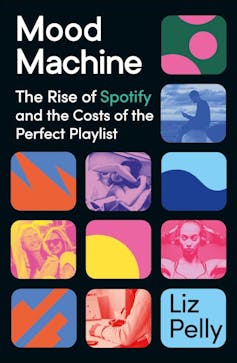
Spotify was started, according to its official claims, because its founders “love music and piracy was killing it”. In Mood Machine, music journalist Liz Pelly argues this is rewriting history.
In fact, she points out, Spotify founder Daniel Ek initially patented a platform around 2006, for circulating “any kind of digital content”. Only months later did he and his co-founder decide music might be the most profitable form of content.
Review: Mood Machine: The Rise of Spotify and the Costs of the Perfect Playlist – Liz Pelly (Hodder & Stoughton)
Ek grew up in a working-class suburb of Stockholm. A neighbour recalled that, while still at school, Ek had set up a website-making business – and was earning more than his teachers. Rejected for a job at Google, he founded an ad-targeting business, Advertigo. After he sold it to tech entrepreneur Martin Lorentzon, the two men registered a new company: Spotify.

‘The Google of music’
Spotify would allow users to find their desired piece of music quickly. Ek described it in 2009 as “essentially the Google of music”, Pelly writes. He had a “maniacal focus” on ensuring a user would get a virtually instantaneous response when they pressed play; no annoying buffering.
Spotify launched in Europe in 2008 and in the United States in 2011. It listed on the stock market in 2018. Spotify has just recorded its first annual profit. It is valued at over US$100 billion: more than the three leading recording companies combined.
It had 678 million users at March 2025: of them, 268 million were paying subscribers. The rest contribute to Spotify’s earnings by listening to advertisements: the so-called “freemium” model.
Boon or bane of musicians?
Music streaming now accounts for 84% of recorded music revenue, according to Pelly – and Spotify is the largest music streamer.
Initially, Spotify looked like a boon to musicians, she writes. It could save music from the threat of “pirate” downloading, which gave no payments to creators. But many musicians are critical of the low payments artists get: fractions of a cent per stream.
Spotify claims that in 2024 it paid out more than US$10 billion to the music industry. It claims nearly 1,500 artists are earning over US$1 million annually.
Spotify pays the recording and publishing rights holders, not the singers and songwriters. How much the latter gets depends on their contracts with the record companies. The system is complicated, indirect and not that transparent.
‘Mixtapes still work’ – so do playlists
Spotify gradually shifted towards playlists, to simplify the process of users selecting music. Some playlists, like “today’s top hits”, just consisted of the currently most popular songs. These are like the “top 40” format of many commercial radio stations.
Spotify also hired music experts to compile their choice of the best new releases. The compilers of the most popular of these playlists, such as the playlist “rap caviar”, became very influential. A Spotify advertisement in 2013 made the analogy between playlists and mixtapes (as featured in Nick Hornby’s High Fidelity), claiming “mixtapes still work”.
Spotify advertising claims ‘mixtapes still work’, referencing High Fidelity.Spotify also increasingly tried to increase passive listening. It introduced playlists geared to match the existing tastes of listeners and allow for how these might vary across the day. It termed this “music for every moment”: music to exercise to, background music for studying, music to help you sleep and so on. I have a playlist of songs about economics.
Ek said in 2016: “we really want to soundtrack every moment of your life”.
One of the parts of the book I found most intriguing was Pelly’s discussion of how this echoes a strategy developed by Thomas Edison around a century ago. He produced shellac 78 rpm records with titles such as “in moods of wistfulness” and “for more energy!”.
In 2014, Spotify made large investments in “algorithmic personalisation”. This suggested music similar in key, tempo, time signature, acousticness, danceability, loudness, mode and energy to whatever the user was already choosing.
This kept users “within their comfort zone (or as Spotify thought of it, their customer retention zone)”. But it meant users were much less likely to encounter new styles and artists, or broaden their musical horizons.
Generic music and AI
While Spotify denies it, Pelly claims Spotify commissions session musicians, playing under assumed names, to record very generic-sounding music, for playlists such as “chill instrumental beats”. Pelly gives an example of 20 songwriters using 500 names to produce thousands of tracks, streamed millions of times.
A “looming cloud” is the prospect AI-generated music will displace human musicians and singers in Spotify’s playlists, Pelly writes. She mentions that Spotify blocked a start-up called Boomy, which released over 14.5 million AI-generated songs – and has since struck up a partnership with Warner.
Another controversy is around Spotify’s Discovery Mode, which offers artists more promotion of their songs in exchange for accepting lower payments. But if most artists do this, the promotions cancel each other out, leaving all the artists worse off.
How Spotify is changing music
Pelly quotes an independent record label founder who says Spotify has changed the nature of the music being made.
It’s not sustainable to put out challenging records […] you have to put out records that are going to get repeat listens in coffee shops […] that are going to be playlist friendly.
This is despite some music fans saying the music they experience as “life-changing, really profound” is different from the songs they play most often.
Songs streamed are only monetised after 30 seconds. This has created “a particular emphasis placed on perfecting song intros […] songwriters would just dive directly into the chorus”. So, no more songs with long waits for the vocals, like U2, the Temptations, Dire Straits or Pink Floyd.
Artists who want their songs to appear on playlists need them to match a particular mood or context. This means songs increasingly “remain in a single emotional register throughout”.
It may mean artists are less likely to release songs with marked tempo changes, such as Dexys’ Midnight Runners’ Come on Eileen (1982), Led Zeppelin’s Stairway to Heaven (1971), Queen’s Bohemian Rhapsody (1975) or Franz Ferdinand’s Take Me Out (2004). There may still be much smaller tempo changes, such as Taylor Swift’s Evermore from 2020.
Artists may now be less likely to release songs with marked tempo changes, such as Dexys’ Midnight Runners’ Come on Eileen.The “Spotify for artists” service provides artists with data about the streaming of their songs. A band planning a tour can see in which cities or countries they are most popular. They can even alter their set lists to include the songs particularly popular in particular areas.
But Spotify monitors use of this facility, Pelly writes – and it is not clear how they use the data. Over time, it may encourage artists to repeat aspects of their most popular songs, rather than innovate and evolve.
A serious look
The book is interesting and informative, but somewhat dryer than some other recent exposes of the tech sector. Partly this is because Ek is a less colourful character than X’s Elon Musk, or Meta’s Mark Zuckerberg and Sheryl Sandberg.



















