

A sculpture made from 80 tonnes of sand, Mirrorscape is remarkable – but too much is left unsaid
- Written by: Robert Clarke, Senior Lecturer in English, University of Tasmania
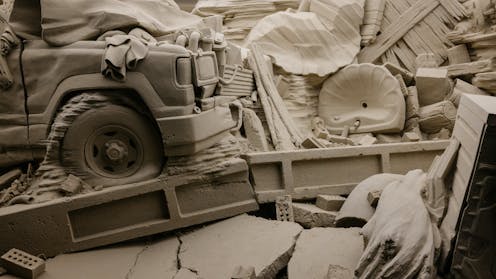
The first impulse is to kick it. After all, it’s a sand sculpture. And as everyone who has grown up near a beach appreciates, if it’s made of sand, then it’s asking to be kicked. But for the wall-high protective glass, Mirrorscape, by the French artist Théo Mercier, may not have survived my visit to MONA.
On a low, curved stage sits a scene of mundane wreckage. Two utility vehicles serve as centrepieces. One is upturned, its front chassis exposed. It rests on the carcass of a two-seater lounge. A mattress is draped over the upper side of the wreck, a broken log, a signifier of the non-human world in this otherwise secular scene of anthropocentric waste, rests against the lower side.
The other vehicle is upright but seriously damaged. Another mattress rests against it. A bundle of electrical conduit spills out of the tray. A worker’s boot limps over the bedding like a deflated balloon.

Strewn around the battered wrecks are pieces of domestic infrastructure and appliances: bricks, cracked concrete slab, a washing machine, broken joists and beams, snarled corrugated iron sheets.
It’s as though a couple of ute loads of tradies have smashed into a Derwent Park bungalow and scampered off.
This scene is framed by a curved wall of brushed metal panelling, lit above by fluorescent light panels, and sealed behind a wall of glass. This glass is both a protector of the delicate eroding sculpture, and another contrasting visual metaphor employing the work’s foundational element, sand.
Commitment to realism
Mercier is a sculptor and a stage director, and the controlled composition of this scene of chaos attests to his multiple talents.
The team of sculptors – Kevin Crawford, Enguerrand David, Sue McGrew and Leonardo Ugolini – have crafted a remarkable piece.
The commitment to realism is impressive, from the quilting in the mattresses, to the indentations on the utes’ bodywork, to the creases in the sofa cushions, and the sly joke of a finely crafted sandshoe as if discarded by one of the artists as they stepped from the sculptural into the spectatorial space.
Looking closer, the human objects – utes, mattresses, sofas – merge into or out of sandstone rock faces, like those found along Derwent River, including the peninsula upon which MONA stands.

What are we to make of the deliberate collapsing of the “natural” and “human-made” in this piece?
Mercier styles Mirrorscape as a “diorama of catastrophe”. He describes it as:
a sculpted dystopian landscape […] using 80 tonnes of compacted sand […] inspired by different dark forces, such as tsunamis, earthquakes, hurricanes, wars, bulldozers – the powers of destruction.
The conflation of “natural” and “man-made” here, and in the composition of the work, grates. While Mirrorscape may reflect a “man-made” landscape of disaster, precisely whose landscape is it, and who ultimately is responsible for it?
A work about class
Mirrorscape is superficially a work about class. Its blunt appropriation of the signifiers of working-class labour and domesticity contradicts the claim that the scene is an archetypal landscape, or humanity’s refuse.
Mirrorscape might be appreciated as a witty piece reflecting on the kind of “treasures” of our age that future archaeologists might excavate in a local tip. But I found it provided little connection to the contemporary subjects of our present-day disasters.
Mirrorscape is haunted, so to speak, by the figures who drove the wrecked utes, slept on the wasted mattresses. But their identities and complex lives, very much of our own time, are rendered invisible.
As a meditation on catastrophe and the “powers of destruction,” Mirrorscape offers a conservative reckoning: that the contemporary human tragedies of inequality, alienated labour, class division and the waste these produce are the “natural” order of things.
 Mirrorscape is haunted by the figures who drove the wrecked utes, slept on the wasted mattresses.
Photo credit: Mona/Jesse Hunniford. Image courtesy of the artist and the Museum of Old and New Art, Hobart, Tasmania, Australia.
Mirrorscape is haunted by the figures who drove the wrecked utes, slept on the wasted mattresses.
Photo credit: Mona/Jesse Hunniford. Image courtesy of the artist and the Museum of Old and New Art, Hobart, Tasmania, Australia.
This is evident in the way the human objects merge into and out of the rock faces, each designed to erode to the common element: sand.
In interviews, Mercier stresses the work’s debt to locality, and his engagement with the working-class suburbs neighbouring MONA:
It was really important to me that everything was really strongly locally grounded, so that you can actually see your own mattress, your own car, your own catastrophe […] it’s a landscape that mirrors you.
But really, how local is this scene, and what value is there in the reflections it provokes? There is little in this sculpture that relates it directly to the place where it is displayed.
The images Mercier has chosen, while unconventional, are nevertheless generic. This dulls the potential for the kind of reflection on catastrophe that might impel a change in the minds of its viewers.
Will MONA’s well-heeled attendees recognise their implication in the human catastrophe this work seeks to capture? Will visitors from the suburbs that neighbour MONA appreciate the reflection that Mirrorscape offers?
If art is to play any role in motivating us to confront the catastrophes that are now upon us, it needs to go beyond the kind of slowly eroding stasis that is Mirrorscape’s defining quality.
Mirrorscape is at MONA, Hobart, until February 16 2026.
Authors: Robert Clarke, Senior Lecturer in English, University of Tasmania


















