

your guide to the 2025 Stella shortlist
- Written by: Lucy Neave, Associate Professor, English, School of Literature, Languages and Linguistics, Australian National University
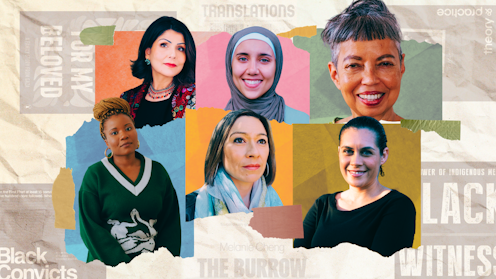
The Stella Prize has created a space for voices that might once have been whispers. This year’s shortlist – made up entirely of books by women of colour – is a testament to the importance of truthfulness, painstaking research and the urgency of confronting shame.
The shortlisted books pay particular attention to gaps in white patriarchal colonial histories, and the need to unsettle firmly held beliefs. Such challenges take place in intimate spheres: in the home, in a rural town, in Australian institutions (especially in universities), and in national and international arenas. Several books evoke nations, including Australia, that have long been culturally, linguistically and racially diverse – though this diversity has often been obscured.
The shortlisted books take diverse and experimental forms. They include novels, a novel with nonfiction elements, a family memoir with fictionalised events, a collection of essays and a history grounded in rigorous archival work. Each book is also an irresistible read: compelling and unsettling.
Translations by Jumaana Abdu
Translations is a beautifully crafted novel with a haunting atmosphere. The novel traces protagonist Aliyah’s relationship with nine-year-old daughter Sakina, her journey into rural Australia and how she becomes embedded in her community.


 This book, based on Chingaipe’s rigorous and determined archival research, shows that convicts of African ancestry were transported to Australia on ships in the First Fleet and into the 1850s. Many of these men and women had been trafficked to the Caribbean as slaves, or were descendants of slaves. Several transported Black convicts were political prisoners, who had resisted colonisation in their countries of origin.
Chingaipe’s book is especially interesting for the connections it makes between the Transatlantic slave trade and the transport of Black convicts. While slavery existed in Australia in various forms, Chingaipe’s book explicates how subjugation as part of slavery served as a blueprint for the convict system. The book also examines connections between the growing of sugar in the Caribbean and in Mauritius – where the ban on slavery was not enforced – and in Australia, where sugarcane was first grown by an enslaved black man.
Black Convicts is thorough and impeccably researched. It is especially admirable for its piecing together of the lives of people who exist only as archival traces. It contains compelling sections on encounters between First Peoples and convicts of African descent, and on Black convict women and Black political prisoners.
Theory & Practice by Michelle de Kretser
Theory & Practice appears to contain elements of fiction, essay and memoir. The book starts with what it terms an “abandoned novel”, a fragment about a man travelling alone in Europe, who spent two years of his childhood on a sheep station. I was briefly lulled by this story: like the rest of the book, it is engrossing and vividly written. But then, Theory & Practice unfolds in a brilliant, surprising and transformative way, demonstrating de Kretser’s immense skill as a writer.
This book, based on Chingaipe’s rigorous and determined archival research, shows that convicts of African ancestry were transported to Australia on ships in the First Fleet and into the 1850s. Many of these men and women had been trafficked to the Caribbean as slaves, or were descendants of slaves. Several transported Black convicts were political prisoners, who had resisted colonisation in their countries of origin.
Chingaipe’s book is especially interesting for the connections it makes between the Transatlantic slave trade and the transport of Black convicts. While slavery existed in Australia in various forms, Chingaipe’s book explicates how subjugation as part of slavery served as a blueprint for the convict system. The book also examines connections between the growing of sugar in the Caribbean and in Mauritius – where the ban on slavery was not enforced – and in Australia, where sugarcane was first grown by an enslaved black man.
Black Convicts is thorough and impeccably researched. It is especially admirable for its piecing together of the lives of people who exist only as archival traces. It contains compelling sections on encounters between First Peoples and convicts of African descent, and on Black convict women and Black political prisoners.
Theory & Practice by Michelle de Kretser
Theory & Practice appears to contain elements of fiction, essay and memoir. The book starts with what it terms an “abandoned novel”, a fragment about a man travelling alone in Europe, who spent two years of his childhood on a sheep station. I was briefly lulled by this story: like the rest of the book, it is engrossing and vividly written. But then, Theory & Practice unfolds in a brilliant, surprising and transformative way, demonstrating de Kretser’s immense skill as a writer.
 A short essayistic section provides a rationale for the book’s title. It discusses an Israeli military commander who, inspired by poststructuralist and Situationist concepts, tunnels through the walls in a Palestinian city – with brutal consequences. But the ease with which “theory” (de Kretser primarily means poststructuralist and feminist theories) can be implemented in practice is not the point of the novel. The voice of its narrator tells us: “the book I needed to write concerned breakdowns” between the theoretical and practical.
Set in 1980s Melbourne, de Kretser’s novel is centred on a protagonist studying a masters degree in English literature. Breakdowns in theory and practice include the sexism and racism at the university where the narrator is studying, despite the department’s avowed embrace of feminist theory, and the narrator’s torrid relationship with an engineering student.
While working on her masters, the protagonist realises the gulf between her attachment to the “Woolfmother” – the figure of maternal mentorship embodied by Virginia Woolf – and the blatant racism expressed in Woolf’s journals. In practice, the protagonist is supported not by her engagement with theory, but by her friendships with a gay academic who nurses men dying of AIDS, and a Greek–Australian woman artist.
This book is completely consuming.
Black Witness by Amy McQuire
Amy McQuire’s Black Witness examines and dramatises a series of events that have been sensationalised in the mass media. They include the death of Mulrunji Doomadgee on Palm Island and the community’s response, and the Northern Territory Intervention.
A short essayistic section provides a rationale for the book’s title. It discusses an Israeli military commander who, inspired by poststructuralist and Situationist concepts, tunnels through the walls in a Palestinian city – with brutal consequences. But the ease with which “theory” (de Kretser primarily means poststructuralist and feminist theories) can be implemented in practice is not the point of the novel. The voice of its narrator tells us: “the book I needed to write concerned breakdowns” between the theoretical and practical.
Set in 1980s Melbourne, de Kretser’s novel is centred on a protagonist studying a masters degree in English literature. Breakdowns in theory and practice include the sexism and racism at the university where the narrator is studying, despite the department’s avowed embrace of feminist theory, and the narrator’s torrid relationship with an engineering student.
While working on her masters, the protagonist realises the gulf between her attachment to the “Woolfmother” – the figure of maternal mentorship embodied by Virginia Woolf – and the blatant racism expressed in Woolf’s journals. In practice, the protagonist is supported not by her engagement with theory, but by her friendships with a gay academic who nurses men dying of AIDS, and a Greek–Australian woman artist.
This book is completely consuming.
Black Witness by Amy McQuire
Amy McQuire’s Black Witness examines and dramatises a series of events that have been sensationalised in the mass media. They include the death of Mulrunji Doomadgee on Palm Island and the community’s response, and the Northern Territory Intervention.
 Her essays demonstrate the extent to which Indigenous people are disbelieved by the media and by the justice system, and the ramifications of ignoring Black witnesses. I was familiar with many of the events discussed in the book, and how they had been reported on. But McQuire’s explosive essays demonstrate the flawed and exaggerated approach to reporting on Indigenous communities and people, and the extent to which the media (at times) takes its cues from political leaders and the police. As McQuire writes: “journalists are not held accountable for not only their failures but their complicity in the continuing oppression of Aboriginal peoples on our own shores”.
McQuire repeatedly points out the racist iconography and assumptions underpinning many of the narratives about Indigenous people which circulate in Australian media reports and public conversation. In these essays, her reporting centres Indigenous voices and acts of witnessing.
McQuire’s passion makes the essays in the book compelling. This book should be required reading for all Australians, especially for writers, journalists and politicians.
Cactus Pear for my Beloved by Samah Sabawi
Cactus Pear for My Beloved patiently and evocatively creates the world of Palestine before the Nakba – the expulsion of Palestinians from their lands in 1948 – as well as the period between 1948 and 1967.
Her essays demonstrate the extent to which Indigenous people are disbelieved by the media and by the justice system, and the ramifications of ignoring Black witnesses. I was familiar with many of the events discussed in the book, and how they had been reported on. But McQuire’s explosive essays demonstrate the flawed and exaggerated approach to reporting on Indigenous communities and people, and the extent to which the media (at times) takes its cues from political leaders and the police. As McQuire writes: “journalists are not held accountable for not only their failures but their complicity in the continuing oppression of Aboriginal peoples on our own shores”.
McQuire repeatedly points out the racist iconography and assumptions underpinning many of the narratives about Indigenous people which circulate in Australian media reports and public conversation. In these essays, her reporting centres Indigenous voices and acts of witnessing.
McQuire’s passion makes the essays in the book compelling. This book should be required reading for all Australians, especially for writers, journalists and politicians.
Cactus Pear for my Beloved by Samah Sabawi
Cactus Pear for My Beloved patiently and evocatively creates the world of Palestine before the Nakba – the expulsion of Palestinians from their lands in 1948 – as well as the period between 1948 and 1967.
 It evokes the author’s grandparents, who lived in a place named Tuffah, part of the Old City of Gaza. Israeli authorities and institutions, such as universities (see, for more information, Maya Wind’s Towers of Ivory and of Steel) have suppressed scholarly and public discussion of the Nakba. Sabawi’s book begins by evoking a time before the British withdrawal from Palestine.
This is an emotionally affecting, clearly written family story, based on oral testimony from Sabawi’s father, who overcame his family’s poverty to become a writer and a poet. In a heartbreaking author’s note, Sabawi mentions travelling to Gaza to conduct research for the book in 2023, and to reconnect with family members. It was only when she returned to Australia and was putting “the final touches” on the manuscript that Israel invaded Gaza in the wake of the October 7 attacks. Since then, her family’s homes have been destroyed, and most have left Gaza or are trying to search for a safe place “where there is none”.
Sabawi’s book is remarkable for its lucid prose and its straightforward evocation of the lives lived by the majority of Gazans, as well as the effects of repeated ethnic cleansing and dispossession.
Authors: Lucy Neave, Associate Professor, English, School of Literature, Languages and Linguistics, Australian National University
It evokes the author’s grandparents, who lived in a place named Tuffah, part of the Old City of Gaza. Israeli authorities and institutions, such as universities (see, for more information, Maya Wind’s Towers of Ivory and of Steel) have suppressed scholarly and public discussion of the Nakba. Sabawi’s book begins by evoking a time before the British withdrawal from Palestine.
This is an emotionally affecting, clearly written family story, based on oral testimony from Sabawi’s father, who overcame his family’s poverty to become a writer and a poet. In a heartbreaking author’s note, Sabawi mentions travelling to Gaza to conduct research for the book in 2023, and to reconnect with family members. It was only when she returned to Australia and was putting “the final touches” on the manuscript that Israel invaded Gaza in the wake of the October 7 attacks. Since then, her family’s homes have been destroyed, and most have left Gaza or are trying to search for a safe place “where there is none”.
Sabawi’s book is remarkable for its lucid prose and its straightforward evocation of the lives lived by the majority of Gazans, as well as the effects of repeated ethnic cleansing and dispossession.
Authors: Lucy Neave, Associate Professor, English, School of Literature, Languages and Linguistics, Australian National University 

















