

The deluge in NSW sounds a warning to rural and regional communities elsewhere
- Written by: Piet Filet, Adjunct Industry Fellow, Australian Rivers Institute, Griffith University
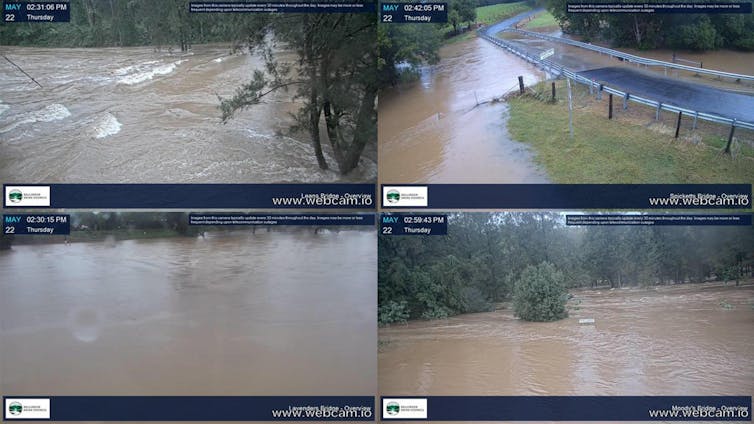
Heavy rain continues to fall across the Hunter and Mid North Coast of New South Wales. Rivers are bursting their banks and spreading over floodplains, leaving many areas on flood watch. And now, this emergency is heading south.
The unfolding disaster shows just how vulnerable rural catchments and regional communities are to extreme rainfall. It comes just a few months after extensive flooding hit western Queensland.
The flooding issues for rural and regional Australia are quite distinct from city areas, where populations are concentrated and urban runoff is the main danger. So what can Australia’s regional and rural communities learn from this extreme weather event?
Highly exposed communities
NSW’s Mid North Coast comprises farmland and bushland, with steep hilly country at the back of river catchments and more urban settlements closer to the coast.
Residents are spread across rural properties and lifestyle bushland blocks as well as local villages and bigger towns. Taree is home to about 17,000 people. About 50,000 people live in Port Macquarie and 36,500 live elsewhere in the Port Macquarie-Hastings local government area.
The population also swells with regular weekend and holiday visitors coming to enjoy coastal, river and mountain settings.
With people and communities spread right across these catchments, they can be left highly exposed when heavy rain falls. Flooding is likely, roads and rail are often cut off and life is turned upside down.

Short catchments in coastal areas fill rapidly
The nature of the landscape – including the geography, the size of the rivers and the shape of the catchment area – largely determines the flood hazard.
The catchments of the Mid North Coast feature short, east-flowing streams and rivers up against the Great Dividing Range. Some ranges are just 20–30 kilometres from the coast. Others are no further than 100–150km from the coast.
When heavy rain hits this steep bushland country, runoff water is quickly concentrated in streams. When these streams join with other creeks and waterways, the concentrated flows overwhelm the natural storage volumes of these waterways. So the water rises and breaks the banks, flowing out across the adjacent floodplains.
Prior rainfall along the east coast, over the past two to three months, means less moisture can soak into the soil and runoff increases. As a consequence:
houses, community facilities and business are inundated
river and creek crossings are being cut, low lying roads on floodplains flooded and railway lines threatened
local water supply and sewerage treatment plants - often in low lying parts of the landscape - are at risk
livestock and household pets, horses and other animals are at risk
wildlife in bushland and waterways are being displaced
local wetlands are being overwhelmed
estuaries are being flooded and in some cases, slugs of sediment and nutrients are being washed downstream and out into coastal waters.
Other rural and regional communities face similar impacts during floods. As the magnitude of this event becomes clear, it is a timely warning for other communities to plan for future floods in their catchments.

The human dimension
As the flooding unfolds, the safety of people and their property is a high priority. Many people have been displaced, leaving their homes for safer locations. Others have been stranded by rising floodwaters.
Many will be feeling stress, fear and uncertainty. This will affect their mental health and wellbeing, and that of their families and local communities. So psychological support is needed both now and after the disaster.
Local and state government agency staff, non-government organisations and volunteers will be active at emergency response and recovery centres to support and guide affected people through this difficult time.
It’s vital that staff and volunteers are prepared and trained in mental health first aid.
Flood preparedness planning must also consider a mix of communication support networks for both the emergency response phase and the recovery phase. And there are opportunities to establish permanent community hubs for building resilience post floods, fires, cyclones and heatwaves.
Major flooding and heavy rain continue for New South Wales, 22 May 2025 (Bureau of Meteorology)Preparing for a new chapter
After the 2011 floods in southeast Queensland, I helped set up a national network of professionals striving to develop better ways to design, implement and sustain flood solutions for more resilient communities. This involves not the immediate emergency response, but the 10-50 year plans needed to help communities reduce the harm of flooding and adapt to climate-related risks.
Long-term flood-risk planning includes options on flood mitigation, such as dykes and levees. It also involves multiple approaches to adaptation, such as household flood resilience. This might mean raising houses off the ground, or relocating residents away from high-risk areas.
The approach, which started in collaboration with Brisbane City Council, is now being used in Queensland and New South Wales, and has been supported by the federal government.
In impacted cities, authorities and communities have committed to prioritising new ways to adapt and minimise the impacts from flood waters. Similarly in rural and regional areas, measures to reduce flood impacts – at both the landscape and household scale – must become more common, to ensure community resilience.
Authors: Piet Filet, Adjunct Industry Fellow, Australian Rivers Institute, Griffith University


















