

funding growth at the expense of pay equity for women could cost National in the long run
- Written by: Jennifer Curtin, Professor of Politics and Policy, University of Auckland, Waipapa Taumata Rau
In 1936, when the National Party was created through a merger of the United and Reform parties, there was a recognition among the power brokers that attracting women’s votes was crucial.
National’s women’s organisations were integral to mobilising support. Throughout the 1940s, the party’s publicity material promised the women of New Zealand a happy family life. This was a consistent approach over the next 20 years, and National was rewarded with the women’s vote.
Intermittent research on gender differences in vote choice between 1963 and 1993 indicate women made up between 45% and 51% of National’s support compared to 36% and 43% of Labour’s support.
After 1996, this trend became less consistent. The New Zealand Election Study indicates a decreasing share of the women’s vote going to National, and fluctuations in vote choice among both women and men.
Given the advent of proportional representation, some volatility may be expected. But there are also some constants. There is evidence women are more likely than men to support government spending on social policy, and they are significantly less likely than men to vote for National’s coalition partners NZ First and ACT.
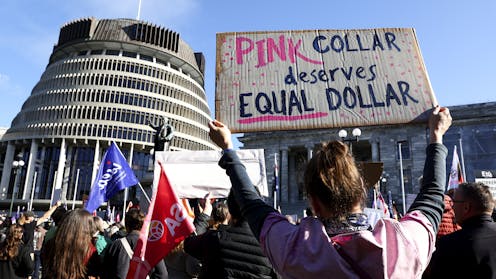
Now, with Budget 2025 – in particular its reliance on funds that would otherwise have gone towards settling pay equity claims – National’s historical success at attracting the women’s vote may be under threat.
Growth before pay equity
The budget represents a ruthless determination to deliver economic growth, including through its centrepiece “Investment Boost” tax breaks for businesses investing in productive assets.
There is additional funding for health, defence, education and disability services, and the establishment of a social investment fund, and the budget left national superannuation untouched (for the remainder of this coalition government’s term, at least).
It focused instead on KiwiSaver. Contributions from employers and employees will increase from 3% to 4%, while the government contribution will be halved for those earning under NZ$180,000 and cancelled for those earning over this amount.
In summary, the new operational spend comes to $6.7 billion while savings, reprioritised spending and revenue-raising initiatives totalled $5.3 billion. As a result, the government has produced the lowest operational allowance in a decade ($1.3 billion) and promised $4 billion in new capital expenditure.
But it was the radical restructuring and cancellation of pay equity for a range of undervalued female-dominated occupations that funded this budget. Almost half of the $12 billion recouped will be spent on the business tax incentives.
The government expects the initiative will increase GDP and wages by 1% to 1.5% over the next 20 years. But given the gender-segregated structure of New Zealand’s labour market, it may take some time for women to benefit from the Investment Boost.
The gender gap and economic growth
Applying a systematic and evidence-based gender analysis as part of the budget preparation process would have revealed more inclusive ways of delivering economic growth.
For example, OECD modelling demonstrates the historical importance of increases in women’s labour market participation for economic growth, but notes that persistent gender gaps remain in productive capcity and hours of employment.
Closing these gaps could potentially add a 0.1 percentage point of additional economic growth per year, culminating in a 3.9% boost to GDP in the next 35 years.
Moreover, increasing women’s labour force participation may be a valuable mechanism to limit declines in the size of the labour force, given the rapidly ageing population.
Such an outcome would require increased government investment in childcare and early childhood education for under twos, ideally for more than 20 hours per week.
This would be a significant investment, given OECD data shows the net cost of childcare in New Zealand is as much as 38% of a two-earner couple’s average earnings (after accounting for government subsidies or benefits). This is considerably more expensive than most OECD member states.
Potential cost to National
Income and spending averages often mask more extreme impacts for different groups of women and men. For example, traditional economic models value labour used in the production of goods and services in the “market economy” but exclude the production of goods and services for their own use.
For wāhine Māori, non-market work includes care for whānau, community and land, as well as upholding the mana of the marae, and the intergenerational transfer of knowledge.
Finally, implementing pay equity, recognising the economic value of the unpaid care economy, and providing increased financial support for childcare, would also contribute to closing the gender pension gap.
Westpac data shows men have an average KiwiSaver balance 16% higher than women’s, most likely attributable to gender wage gaps and parenting career breaks.
Therefore the reduction in government contributions to KiwiSaver, and National’s desire to lift the retirement age, matter more to women because statistically they have a longer retirement to fund.
Budget 2025 came at a cost to many women in New Zealand, and it may yet come at a cost for National.
Authors: Jennifer Curtin, Professor of Politics and Policy, University of Auckland, Waipapa Taumata Rau


















