

A First Nations writer’s fellowship was withdrawn by Queensland’s government. What’s going on?
- Written by: Jo Caust, Associate Professor and Principal Fellow (Hon), School of Culture and Communication, The University of Melbourne
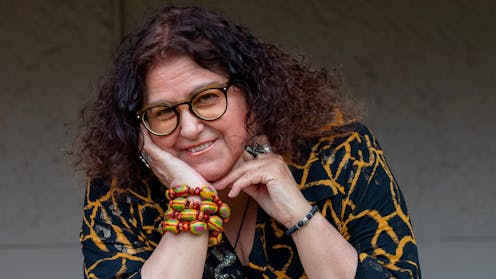
This week, Martu writer Karen Wyld had her A$15,000 black&write fellowship withdrawn – just hours before the (cancelled) ceremony at State Library of Queensland, where she was to receive it for a fiction manuscript on the Stolen Generations. The Queensland arts minister, John-Paul Langbroek, and premier David Crisafulli had directly intervened. They wrote to the library’s chairwoman and its and CEO “voicing their concerns”, according to the Australian.
A reporter from the paper knew before Wyld did about the withdrawal of her fellowship, which annually grants two First Nations writers $15,000 and a publishing opportunity with University of Queensland Press. Wyld (who now publishes under K. A. Ren Wyld), received an email asking for a reaction before she was informed of the withdrawal – in a “very brief, polite conversation” with Library CEO Vicki McDonald, who “mentioned” a tweet Wyld had posted, then deleted, in October 2024.
In it, Wyld had described former Hamas leader Yahya Sinwar as a “martyr”, praising him for “resisting colonisation”, after he was killed by Israeli forces. She told the Guardian this week she “could have worded” the tweet “less emotional”.
This is not the first time a leading artist has been penalised for sharing an opinion about the situation in the Middle East. Taking away significant professional opportunities carries real consequences for artists and writers, among the poorest paid workers in Australia. There are rigorous processes around deciding who gets these opportunities too: what does it mean when they are overridden, particularly for political purposes?

Recent history of withdrawn arts opportunities
In February 2025, Creative Australia announced the withdrawal of the Venice Biennale commission to Lebanese Australian artist Khaled Sabsabi, because he had made work several years before featuring Hezbollah leader Hassan Nasrallah. Sabsabi was then accused of making work “promoting” Osama bin Laden. This was not the case. He was, in fact, using irony in his work – but this subtle difference was ignored.
In the wake of the Venice Biennale withdrawal, an exhibition of Sabsabi’s work at the Monash University Museum of Art was cancelled – but in good news, it will now go ahead. On Thursday, the university announced it has reversed its decision, at least in part due to student advocacy.
This week’s State Library controversy in Queensland was preceded in March 2024, by trouble at State Library of Victoria. It decided to cancel a program of “Teen Bootcamp” workshops run by authors who had voiced their support for Palestine and their opposition to Israel’s invasion of Gaza following the Hamas attacks of October 7 2023.
Leading Australian writers such as Michelle de Kretser and Tony Birch declared they would no longer work with the library as a result; over 100 staff wrote in protest to the Library’s CEO.
Langbroek, the Queensland Arts Minister said in Queensland parliament this week:
Whilst I support the principles of free expression and creative diversity, any perception that taxpayer funded awards being granted to individuals who justify terrorism undermines public trust both in our institutions and in the cultural sector more broadly.“
Creative Australia said Sabsabi’s award had been withdrawn in the interests of
an unacceptable risk to public support for Australia’s artistic community and could undermine our goal of bringing Australians together through art and creativity.
These two artists won major awards, having been selected by a rigorous process – and were denied them because of direct political interference. The black&write fellowship receives funding from Creative Australia, as well as the Copyright Agency.
In both cases, the justification for the withdrawal of funding is that the public might withdraw support for the arts and cultural community.

A Murdoch war on arts grants
Since February 2025, various journalists from the Australian have been waging a war of sorts on artists and Creative Australia. In February, its Business section criticised the organisation for having
hired, funded and nurtured artists whose personas revolve around anti-Western, anti-Australian or anti-Zionist "resistance” narratives, sometimes all three.
This led to the then Shadow Minister for the Arts, Senator Claire Chandler, asking in the Senate:
Why is the Albanese government allowing a person who highlights a terrorist leader in his artwork to represent Australia on the international stage at the Venice Biennale?
Christopher Allen, the Australian’s visual arts editor, then argued in early March “anyone with any judgement would have avoided choosing an artist connected with the nations involved in the conflict”, referring to Sabsabi’s Lebanese nationality.
On March 1, Australian journalist Steve Waterson questioned the existence of arts grants, asking “why people whose talent (if it exists at all) is insufficient to support them should expect to have their fantasies indulged by the taxpayer”.
Allen also argued against Creative Australia’s focus on diversity among its funding criteria. Diversity is just one of the criteria, but the overriding criteria is always the merit of the work.
Allen argued “the façade of "diversity” has “led to the current crisis”. He also accused the funding body’s staff of “pursuing an ideological agenda”, even criticising the board’s “spectacular gender imbalance”, for having nine women and four men. This is an odd comment, when a male artist was chosen and historically the gender balance on the board has often been in reverse.
Political interference: Menzies to now
Australia has a history of political interference in the arts award process, most notably during the Menzies era. Menzies personally vetted “who got what” from the Commonwealth Literary Fund. He did not want anyone with left-wing views to get funding, so he asked ASIO to check all the applicants before any approvals were given.
The Australia Council, now known as Creative Australia, was officially established in 1975 on the principle of arm’s-length funding as a statutory authority, so arts funding decisions were separated from the politics of the day. This mechanism was designed to ensure that arts funding was independent of political views.
 Australia’s arts funding decisions, including for writers, were designed to be separate from politics and politicians.
Czapp Arpad/Pexels
Australia’s arts funding decisions, including for writers, were designed to be separate from politics and politicians.
Czapp Arpad/Pexels
Why it matters
Artists are also at the bottom of the economic ladder in terms of income. Recent research shows they’re among the worst paid workers in Australia, earning an average A$13,937 per year from their arts practice. Most Australian authors earn only a little more: just $18,200 a year from their writing on average.
Nevertheless, through their work they can communicate powerful messages, meaning politicians see them as influential. Artists will always be public commentators: this is part of their role. Removing their government awards could be seen as a form of control.
Getting a grant or award is very difficult, and individuals must go through a long and arduous process. Sabsabi, for example, applied four times for the Venice Commission before he was chosen. Wyld’s manuscript was assessed by a panel, including a publisher representative, before being selected as the winner of the black&write fellowship.
Given how little most artists earn, a grant or an award is enormously significant in terms of not just their reputation, but their livelihood. To then have this cancelled at the last minute, after being been told they are successful, is cruel and insensitive. When this follows a rigorous, publicly disclosed process, as in the case of both Sasabi and Wyld, it is also undemocratic.
Authors: Jo Caust, Associate Professor and Principal Fellow (Hon), School of Culture and Communication, The University of Melbourne


















