

Trump’s steel tariffs are unlikely to have a big impact on Australia. But we could be hurt by what happens globally
- Written by: Scott French, Senior Lecturer in Economics, UNSW Sydney
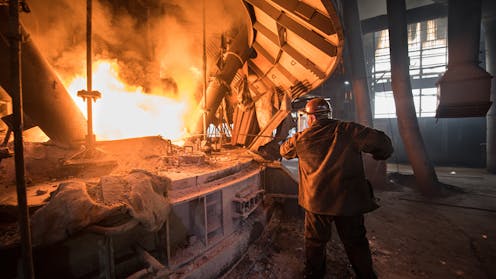
Just one day after the US Court of Appeals temporarily reinstated the Trump Administration’s Liberation Day tariffs of between 10% and 50% on nearly every country in the world, Trump announced tariffs on all US imports of steel and aluminium will increase from 25% to 50%.
He told the rally of steel workers in Pennsylvania the increase would come into effect Wednesday US time.
Trump said the increase “will even further secure the steel industry in the United States.” But Australia’s trade and tourism minister, Don Farrell, called them “unjustified and not the act of a friend” and “an act of economic self-harm that will only hurt consumers and businesses who rely on free and fair trade.”
There was hope Australia would obtain an exemption from the original tariffs introduced in February. But it now seems clear Trump is intent on applying the tariffs across the board. And, unlike the Liberation Day tariffs, these are unlikely to face significant legal challenges.
So, how will the steel tariffs affect Australians? To understand this, it is important to understand how it will affect the US and its other trading partners.
The direct effect will be small
As with the original 25% tariffs, the direct effect on Australian steel and aluminium producers will not be profound.
Only about 10% of Australia’s steel and aluminium exports, and less than 1% of its overall production, goes to the US. Australia’s own BlueScope Steel’s North Star mill in Ohio is actually set to benefit from the tariffs.
But most Australians will feel the effects of the tariffs through the indirect effects on US manufacturing and America’s trading partners.
Impact on the US
We know a lot about how US manufacturing will be affected because this has all happened before. In 2002, George W. Bush imposed tariffs of 8%-30% on steel products, before withdrawing them less than two years later. And Trump imposed tariffs of 25% on steel and 10% on aluminium in his first term.
Research has shown the tariffs did slightly increase US metal production but at great cost. In addition to increasing prices for US consumers, as tariffs typically do, the Bush steel tariffs reduced overall employment, as manufacturers that use steel as an input laid off workers or went out of business.
Further, while these tariffs were only in place for a short time, the affected US industries took years to recover, and many never have.
The same thing happened with the tariffs from Trump’s first term, where any gains in steel and aluminium production were more than offset by losses in metal-consuming industries.
For Australians, this means many products we buy from the US are going to get more expensive. This includes vehicles and aircraft as well as machinery and medical equipment used by Australian producers. And if the past is a guide, many products will simply become unavailable.
Effects on trading partners
While Australia does not export large amounts of steel and aluminium to US, other countries do. The higher tariffs will further depress the Canadian and Mexican metals industries, which can affect Australian industry in several ways.
First, if North American consumers are buying less of everything, that reduces demand for Australia’s exports, both directly and indirectly as the reduced spending makes its way down the supply chain.

Second, the affected metals manufacturers will look for other markets for their products. Canada is not likely to flood Australia with cheap aluminium, but it may, for example, displace some of our exports to South Korea. And this is happening as the OECD is warning of excess steel capacity, driven in part by China’s outsized steel subsidies.
But this is not all bad news for Australians. While local steel and aluminium producers will suffer from the diversion of supply from the US, a temporary fall in prices would offer some relief after the post-pandemic rise in building and infrastructure costs.
Retaliatory tariffs
On top of all these effects are the effects of retaliatory tariffs by other countries, as the EU has already threatened. Like the US tariffs, these tariffs will make consumers on both sides poorer, reducing demand for Australian exports. But they will open new markets as well. For example, China’s retaliatory tariffs on US almonds have caused a boom in Australian exports.
The big question for Australia is how this will affect the price of iron ore, by far our largest export. So far, we have not seen major price swings. But if the latest salvo in Trump’s trade war causes the global economy to slow significantly, or if China backs off its steel subsidies, this could change.
State of uncertainty
And perhaps the most significant impact of the latest change in US tariff policy is the effect of ongoing uncertainty over US and global trade policy. Trade policy uncertainty reduces international trade flows and chills business investment.
Whether a business is considering a venture dependent on an input that will be affected by tariffs or, like BlueScope’s Ohio steel mill, might stand to benefit from US tariffs, the uncertainty over what the policy will be tomorrow, let alone five years from now, will make any company hesitant to commit major funds.
A case in point is Whyalla Steelworks, which has received a $2.4 billion rescue package and is currently in administration and seeking a buyer.
With Donald Trump able to upend the global steel industry again at any moment, buyers will be thinking twice before investing billions of dollars, which is bad news for nearly everyone, not least of which the residents of Whyalla, who await the fate of a major local employer.
Authors: Scott French, Senior Lecturer in Economics, UNSW Sydney


















