

Girl power and girl bosses might be ‘feminist’ – but we can’t consume our way to equality
- Written by: Jessica Ford, Senior Lecturer in Media, University of Adelaide
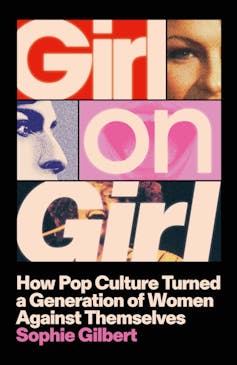
In Girl on Girl, journalist Sophie Gilbert crafts a compelling narrative about how movies, TV, celebrities and pop stars construct a culture that encourages women to internalise misogyny – and even rewards them for it. She traces how this manifests over time, from the 1990s to now, through the sexualisation of young girls in teen “sex” comedies, reality TV makeovers, the mainstreaming of pornography and more.
The book is a useful primer on how largely white, American-centric popular culture makes women’s exploitation commonplace.
It moves swiftly between examples, which could be confusing for readers unfamiliar with the different worlds inhabited by various figures. They include socialite and early reality star Paris Hilton; musician Amy Winehouse, who made headlines with her addiction challenges; and “riot grrrl” feminist rocker Kathleen Hanna.
Girl on Girl: How Pop Culture Turned a Generation of Women Against Themselves – Sophie Gilbert (John Murray)
Girl on Girl does not necessarily break new ground. It does, however, bring together disparate strands of our cultural conversation, largely relying on existing research and cultural commentary. Western popular culture, it argues, provides women with a narrow set of ideals.
Gilbert’s book depicts popular culture as a vehicle for teaching women what kinds of behaviour are acceptable and desirable. These lessons are packaged in alluring parcels, like the Real Housewives, Lindsay Lohan, Britney Spears and Pamela Anderson. Gilbert cleverly draws a line from Madonna as provocateur to the hatred of women oozing from early 2000s rom-coms, the TikTok Trad Wives and Hillary Rodham Clinton’s failed presidential bids.
In the book’s early pages, Gilbert shows how Hanna’s punk slogan of “Girl Power” was “appropriated” by the Spice Girls (who she describes as “sexy women who behaved like toddlers at a wedding”) in 1996. In the process, “Girl Power” went from signalling a movement charged by anger at “diminishment and abuse”, to a feminism of individual empowerment that “made you want to immediately go shopping”. It was then “almost instantly appropriated by brands”.

Packaging empowerment
Popular culture may seem fluffy and inconsequential, but Gilbert emphatically connects it to the material consequences of misogyny. This includes the rolling back of abortion rights in the United States, the election of alt-right men who openly despise women and the normalisation of gendered harassment, violence and abuse.
Gilbert persuasively argues “popular culture is a strikingly predictive and transformative force with regard to the status of women and other historically marginalised groups”.
It’s not just that women are routinely degraded and dehumanised for entertainment. It’s that this cruel spectacle has been normalised over many decades – and has been packaged and sold as empowering and “good for women”.
Gilbert draws connections between the exploitation behind supermodel Kate Moss’s rise to prominence in the 1990s (she was bullied into posing for topless photographs), the ritualised humiliation of early 2000s reality TV and the 2010 publication of “crotch shots” of an 18-year-old Miley Cyrus. In doing so, she charts the varied ways popular media normalises women’s exploitation.

Her investigation complicates the seemingly effortless and empowering facade of these models of femininity. For instance, the stylist for Moss’ 1990 topless shoot for The Face magazine cover that launched her to fame remembers it as “fun” and “instinctual”, while decades later, Moss recalls crying when coerced into taking her top off.
She also remembers feeling “vulnerable and scared” during the 1992 topless Calvin Klein shoot with Mark Wahlberg. “I think they played on my vulnerability,” she said.
Girl on Girl effectively translates the ideas feminist scholars have been unpicking for decades. Its sustained and thoughtful engagement with these ideas is what distinguishes it from similar books of journalism on the gender politics of popular culture.
A common limitation of such books is the false assumption that these ideas are new. However, Gilbert weaves together Rosalind Gill’s postfeminism as a sensibility, Brenda Weber’s work on makeover TV and Kate Manne’s theorisation of misogyny with popular media examples.
In a chapter on the impossible expectations of contemporary femininity, Gilbert applies Gill’s concept of “midriff advertising”, or “low-slung hipster jeans and ten inches of tanned, taut stomach”, to 2000s “it-girl” Nicole Richie. She explains how she was variously shamed for being too fat and then too thin. This led, Gilbert writes:
to her elevation in status from Paris’s sassy sidekick to size-double-zero aughts fashion emblem, a frail, childlike figure whose accessories were so big they threatened to topple her.
 Paris Hilton and ‘sassy sidekick’ Nicole Richie, who was variously shamed for being too fat and too thin.
Damian Dovarganes/AAP
Paris Hilton and ‘sassy sidekick’ Nicole Richie, who was variously shamed for being too fat and too thin.
Damian Dovarganes/AAP
Feminism: everywhere and nowhere
Gilbert’s book is not wholly negative. She also charts the rise (and often fall) of those who push back against the status quo.
In a chapter on “confessional auteurs”, she considers Girls creator Lena Dunham. In another, which considers extreme, violent sex in art, she looks at French filmmaker and novelist Catherine Breillat. In Breillat’s 1999 film, Romance, about a young woman “driven almost to madness” by her boyfriend’s refusal to have sex with her, Gilbert writes:
Breillat stages what she seems to understand as stereotypical male ideals – a woman desperate for sex, a woman bound and gagged – and renders them in ways that make them both psychologically explosive and wholly unsexy.
In the final chapter on “rewriting the path towards power”, she explores the impact of recent feminist-leaning TV, such as Phoebe Waller-Bridge’s Fleabag and Michaela Coel’s I May Destroy You.
Rather than ignoring feminism’s paradoxes and inconsistencies, Gilbert leans into how it is at once everywhere (in advertisements, behind Beyoncé at the VMAs, on t-shirts) and nowhere (rendered toothless, depoliticised, neoliberal).
 Beyonce’s 2014 Video Music Awards performance against a huge FEMINISM sign was a memorable cultural moment.
Jason LaVeris/FilmMagic/GettyImages
Beyonce’s 2014 Video Music Awards performance against a huge FEMINISM sign was a memorable cultural moment.
Jason LaVeris/FilmMagic/GettyImages
Gilbert thoughtfully teases apart the contradictions and schisms in women’s culture (both popular and everyday) to consider the mixed messaging around sexuality, empowerment, femininity and success.
The challenge of interrogating influential celebrities like Kim Kardashian and Taylor Swift is that they tend to embody extreme versions of idealised femininity. Their bodies are at once an instrument of their work and a canvas, on which much is projected. Culturally, they uphold and promote very narrow ideas of heterosexual desirability, perfection and beauty.
Gilbert grapples with how the elevation of beauty as a defining feminine virtue results in fat shaming and fashion policing of everyday women. Discussing the Kardashian-Jenners, she writes:
Their constantly changing faces and bodies present the human form as a perfectible project ready to be molded and painted and tucked in any way that will encourage engagement and sell products.
 Kim Kardashian’s ‘constantly changing’ face and body presents the human form as a perfectible project.
Doug Peters/STAR MAX/AAP
Kim Kardashian’s ‘constantly changing’ face and body presents the human form as a perfectible project.
Doug Peters/STAR MAX/AAP
It is hard to look at the increase in plastic surgery procedures and the prevalence of weight-loss medication usage and not blame celebrities, reality TV and social media influencers. But these women didn’t create this world, they just figured out how to succeed in it. Should we expect them to dismantle the system that empowers them?
Gilbert’s book zeroes in on how popular feminist thinking expects women to change, rather than systems. The responsibility for inequitable institutions – like unpaid parental leave, restricted reproductive healthcare and hostile work cultures – is moved onto individual women to solve. They are expected to bear the burden, rather than society being expected to invest in systemic change. For instance: paid parental leave, affordable accessible healthcare and employment quotas.
The effects are twofold, absolving institutional responsibility and inscribing narcissistic, individualistic ways of thinking.
Consuming our way to enlightenment
Girl on Girl circles around, but never directly takes on a crucial question: should we expect popular culture to do the work of feminism? Can we consume our way to equal pay, reproductive rights, freedom from violence and respect in the workplace? We are encouraged – by popular media itself – to think so.
 There are seemingly endless articles that canonise “feminist TV shows and moments” that “every woman needs to watch”. They encourage viewers to think of themselves as “pop culture-loving feminists”.
This is particularly prominent across online media aimed at women. It views content through the lens of feminism and curates “feminist popular culture” as a recognisable category. This is used to tell us contemporary audiences can – and should – be feminist consumers.
The idea of consuming our way to enlightenment has been sold to us on multiple fronts. Yet feminism was never mainstream. From its early days to now, it has been a scrappy insurgency.
The prominence of “girl power” and “girl bosses” may have lulled us into a false sense of security, but conditions for women (globally and locally) still need improving.
Despite its limitations, we need feminism in media and everyday culture. Kristen Stewart recently reflected, on her directorial debut at Cannes: “having a female body is an overtly political act, if you can get out of bed in the morning and not hate yourself”.
Authors: Jessica Ford, Senior Lecturer in Media, University of Adelaide
There are seemingly endless articles that canonise “feminist TV shows and moments” that “every woman needs to watch”. They encourage viewers to think of themselves as “pop culture-loving feminists”.
This is particularly prominent across online media aimed at women. It views content through the lens of feminism and curates “feminist popular culture” as a recognisable category. This is used to tell us contemporary audiences can – and should – be feminist consumers.
The idea of consuming our way to enlightenment has been sold to us on multiple fronts. Yet feminism was never mainstream. From its early days to now, it has been a scrappy insurgency.
The prominence of “girl power” and “girl bosses” may have lulled us into a false sense of security, but conditions for women (globally and locally) still need improving.
Despite its limitations, we need feminism in media and everyday culture. Kristen Stewart recently reflected, on her directorial debut at Cannes: “having a female body is an overtly political act, if you can get out of bed in the morning and not hate yourself”.
Authors: Jessica Ford, Senior Lecturer in Media, University of Adelaide 

















