

As government cuts bite, public service unions can use ‘soft power’ as well as strikes to win support
- Written by: Jim Arrowsmith, Professor, School of Management, Te Kunenga ki Pūrehuroa – Massey University
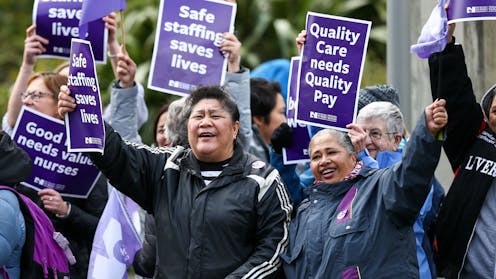
Cuts to the public service, the decision to halt all pay equity claims, and the tight 2025 budget mean public service workers are facing an uncertain future.
Nowhere is this more apparent than in the health sector. Since the 2024 budget, Health NZ has faced several reductions across its workforce. Nurses and rest home workers were also among the 33 pay equity cases stopped to save nearly NZ$13 billion over four years.
Last week, doctors at Gisborne Hospital announced plans to strike due to staffing shortages.
Industrial unrest could well be a feature of the next 18 months and an influence on the current government’s fortunes.
My ongoing research with union leaders, to be published later this year, maps out how they could emerge as a major force mobilising public opinion ahead of the 2026 general election – and how using “soft power” rather than just strikes could be key to success.
This research is part of an international project looking at health sector union strategies in Australia, Canada and the United Kingdom.
The power of unions
Public sector unions have the power to influence change thanks to their concentrated membership in certain sectors, and their ability to cause significant disruptions with strikes. The New Zealand Nurses Organisation, for example, represents 77% of the registered nurse workforce.
But the potential power of New Zealand’s public service unions is tempered by their members’ commitment to the needs of the people they serve – for example, ensuring sick people still receive care.
Public service unions also need support from the public, given the state is their ultimate employer. This means unions first have to use the soft power available to them before deciding to strike.
For unions, soft power includes using employment rules and laws (“institutional” sources of power), alliances with groups representing people who use the sector’s services (“coalitional” sources), and messaging (“ideational”).
In the fight over pay equity, for example, unions are using institutional means (equal pay legislation) to fight for increased wages. They are also building coalitions with groups that use their services, and are articulating a clear case of fairness and efficiency to build wider support.
Even some lobby groups, such as Aged Care Association which represents aged-care facilities, have publicly supported union efforts towards pay equity, recognising the need for higher wages to address labour shortages.
Healthcare is a political frontline
In healthcare, the government pledged $8.2 billion in funding over four years in its first budget in 2024. In 2025, it set aside an extra $447 million for primary and out-of-hours care.
But unions representing doctors and nurses say the government is “just treading water”, identifying 4,800 vacancies in the current plan.
According to the unions, gaps include one in five senior hospital doctor positions and a quarter of hospital shifts lack sufficient nurses or midwives (the government has disputed these figures).
The situation is exacerbated by Australia and other countries actively recruiting for healthcare staff. Rising living costs also make New Zealand a less attractive proposition to new migrants.
Recent surveys by other major health unions focus on the impact of staff shortages on worker wellbeing and patient care. The scientific and technical union APEX reports a “workforce in survival mode” and the Public Service Association talks of “healthcare in crisis”.
In the care sector, members of trade union E tū have detailed how chronic understaffing leads to work intensification and insufficient time to care for residential or home-based clients.
A battle of messaging
The unions’ message is one of a vicious circle where staff shortages increase workloads in already demanding jobs, accelerating the number of departures and damaging the provision of care.
Addressing this, unions argue, requires better pay and more staff, including investment to grow the domestic pipeline of healthcare staff over the longer term.
The government’s message, however, refers to past blowouts, fiscal discipline and the need for more private sector involvement, and longer hours to meet its targets.
The question for unions is whether they will be able to get their messaging out to voters more effectively than the government.
In general, the profile of healthcare workers in people’s lives can create a more sympathetic message. Unions have also begun a coordinated strategy to unify and actively engage members as a platform for political outreach.
Campaigns such as the nurses union “Marangi Mai” (Rise Up) and E tū’s “Transforming Care” speak to workers more effectively than remote and protracted equal pay negotiations.
Finally, legal action and protests marshal media attention.
Cases filed under employment and health and safety laws expose “good employer” obligations and the need to ensure safe working conditions. “Informational pickets”, market stalls and alliances with user groups also get the message out, as do short sharp work stoppages.
Amid the ongoing debate around healthcare and what the sector needs, it is clear unions will need to use soft power tactics as well as strikes to advocate for workers. The strategies implemented in the public sector may also provide a road map for private sector workers considering their own actions.
Authors: Jim Arrowsmith, Professor, School of Management, Te Kunenga ki Pūrehuroa – Massey University


















