

A 10-fold increase in rocket launches would start harming the ozone layer – new research
- Written by: Laura Revell, Associate Professor in Atmospheric Chemistry, University of Canterbury
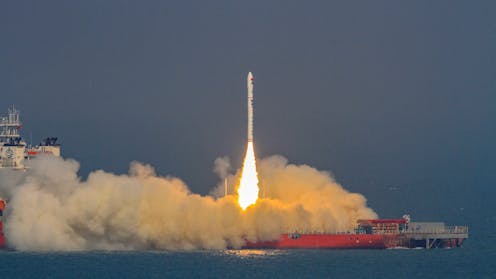
The international space industry is on a growth trajectory, but new research shows a rapid increase in rocket launches would damage the ozone layer.
Several hundred rockets are launched globally each year by a mix of commercial companies and nation-state space programmes. These take place at around 20 sites, almost all in the northern hemisphere, with the most prolific launch rates currently from the United States, China, New Zealand and Russia.
Our latest research explores the tipping point when launching more rockets will begin to cause problems. Our findings show that once rates reach 2,000 launches a year – about a ten-fold increase on last year – the current healing of the ozone layer slows down.
We argue that with care, we can avoid this future. The economic benefits of industry growth can be realised, but it will take a collaborative effort.
Rocket launches thin the ozone layer
The ozone layer protects life on Earth from harmful solar ultraviolet (UV) rays. It is slowly healing from the effects of chlorofluorocarbons and other damaging chemicals emitted last century, thanks to global cooperative agreements under the Montreal Protocol.
Gases and particulates emitted by rockets as they punch through the atmosphere are known to thin the ozone layer. So far, they don’t cause appreciable ozone depletion, as relatively few launches take place each year.
However, launches are steadily increasing. In 2019, there were 102 launches. By 2024, that increased to 258 worldwide. There are expected to be even more in 2025. At multiple sites worldwide, the launch industry projects impressive levels of future growth.
For US-based launches, a three-fold increase in the number of rockets launched in 2023 is expected as soon as 2028.
One driver of this growth is the effort to build out satellite constellations to tens of thousands of units, positioned low in Earth’s orbit. These require many launches to create and are happening in several nations, run by a number of companies.
Once in place, these constellations require ongoing launches to keep them supplied with active satellites.
Potential delay in ozone recovery
To figure out how future launches could affect the ozone layer, we first built a database of ozone-depleting chemicals emitted by rockets currently in use. We then fed this database into a model of Earth’s atmosphere and climate, and simulated atmospheric composition under several scenarios of higher rates of rocket launches.
We found that with around 2,000 launches worldwide each year, the ozone layer thins by up to 3%. Due to atmospheric transport of rocket-emitted chemicals, we saw the largest ozone losses over Antarctica, even though most launches are taking place in the northern hemisphere.
Fortunately, the ozone losses are small. We wouldn’t expect to see catastrophic damage to humans or ecosystems. However, the losses are significant given global efforts underway to heal the ozone layer. The global abundance of ozone is still around 2% lower than before the onset of losses caused by chlorofluorocarbons.
Future ozone losses are not locked in
Encouragingly, we found no significant ozone loss in a scenario of more modest rates of around 900 launches per year. However, this is for the types of rockets that are in use right now around the world.
We focus on current launch vehicles because it is uncertain when the new and massive rockets currently in development will enter use. But these larger rockets often require far more fuel, which creates more emissions at each launch.
Rocket propellant choices make a big difference to the atmosphere. We found fuels emitting chlorine-containing chemicals or black carbon particulates have the largest effects on the ozone layer. Reducing use of these fuels as launch rates increase is key to supporting an ongoing recovery of the ozone layer.
Re-entering spacecraft and satellite debris can also cause damage. However, the global scientific community doesn’t yet fully understand the chemistry around re-entry. Our work provides a realistic “floor” for the lowest level of damage that will occur.
But it is important to remember that these effects are not locked in. It is entirely possible to create a launch industry where we avoid harmful effects, but that would require reducing use of chlorine-containing fuels, minimising black carbon emissions by new rockets and monitoring emissions.
It will take keen effort and enthusiasm from industry and regulators, working together with scientists. But this needs to start now, not after the damage is done.
Authors: Laura Revell, Associate Professor in Atmospheric Chemistry, University of Canterbury


















