

Were the first kings of Poland actually from Scotland? New DNA evidence unsettles a nation’s founding myth
- Written by: Darius von Guttner Sporzynski, Historian, Australian Catholic University
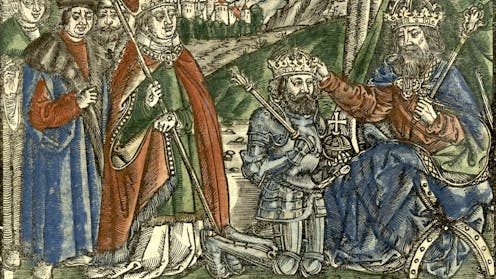
For two centuries, scholars have sparred over the roots of the Piasts, Poland’s first documented royal house, who reigned from the 10th to the 14th centuries.
Were they local Slavic nobles, Moravian exiles, or warriors from Scandinavia?
Since 2023, a series of genetic and environmental studies led by molecular biologist Marek Figlerowicz at the Poznań University of Technology has delivered a stream of direct evidence about these enigmatic rulers, bringing the debate onto firmer ground.
Digging up the dynasty
Field teams have now opened more than a dozen crypts from the Piast era. The largest single haul came from Płock Cathedral in what is now central Poland.
The exhumed bones were dated between 1100 and 1495, matching written records. Genetic analysis showed several individuals were close relatives.
“There is no doubt we are dealing with genuine Piasts,” Figlerowicz told a May 2025 conference.
The Poznań group isolated readable DNA from 33 individuals (30 men and three women) believed to span the dynasty’s full timeline.
Surprise on the Y chromosome
The male skeletons almost all carry a single, rare group of genetic variants on the Y chromosome (which is only carried and passed down by males). This group is today found mainly in Britain. The closest known match belongs to a Pict buried in eastern Scotland in the 5th or 6th century.
These results imply that the dynasty’s paternal line arrived from the vicinity of the North Atlantic, not nearby.

The date of that arrival is still open: the founding clan could have migrated centuries before the first known Piast, Mieszko I (who died in 992), or perhaps only a generation earlier through a dynastic marriage. Either way, the new data kill the notion of an unbroken local male lineage.
Yet genetics also shows deep local continuity in the wider population. A separate survey of Iron Age cemeteries across Poland, published in Scientific Reports, revealed that people living 2,000 years ago already shared the genetic makeup seen in early Piast subjects.
Another project that sequenced pre-Piast burials drew the same conclusion: local Poles were part of the broader continental gene pool stretching from Denmark to France.
In short, even if the Piasts were exotic rulers, they governed a long-established community.
A swamp tells its tale
While the DNA work progressed, another Poznań team dug into the history of the local environment via samples from the peaty floor of Lake Lednica near Poznań, the island-ringed stronghold often dubbed the cradle of the Piast realm.
Their study of buried pollen, published in the Proceedings of the National Academy of Sciences, shows an abrupt switch in the 9th century: oak and lime pollen plummet, while cereal and pasture indicators soar. Traces of charcoal and soot point to widespread fires.
The authors call the shift an “ecological revolution”, driven by slash-and-burn agriculture and the need to feed concentrated garrisons of soldiers guarding local trade routes carrying amber and slaves.
Modelling boom and bust
Using this environmental data, historians and complexity scientists constructed a feedback model of population, silver paid as tribute to rulers, and fort-building. As fields expanded, tributes rose; as tributes rose, chiefs could hire more labour to clear more forest and build forts.
The model reproduces the startling build-out of ramparts at Poznań, Giecz and Gniezno around 990. It also predicts collapse once the silver stopped flowing.
Pollen data indeed show the woodlands recovered to some extent after 1070, while archaeological surveys record abandoned hamlets and shrinking garrisons.
The early Piast state rode a resource boom as the Piasts controlled part of the amber and slave trade routes that linked the shores of the Baltic Sea to Rome.
The impact of Mieszko’s conversion to Christianity on that lucrative trade remains subject to scholarly debate.
Reconciling foreigners and locals
How do these strands fit together? Evidence of a Scottish man in the Piast paternal line does not necessarily imply a foreign conquest. Dynasties spread by marriages as well as by swords.
For example, Świętosława (the sister of the first Piast king, Bolesław the Brave), married the kings of both Denmark and Sweden, and her descendants ruled England for a time. The networks of Europe’s nobility were highly mobile.
Conversely, the stable genetic profile of ordinary folk suggests that, whoever sat on the ducal bench, most people remained where their grandparents had farmed.
The broader research engine
None of this work happens in isolation. Poland’s National Science Centre has bankrolled a 24-person team across archaeology, palaeoecology and bioinformatics since 2014, generating 16 peer-reviewed papers and a public database of ancient genomes.
Conferences at Lednica and Dziekanowice now bring historians and molecular biologists to the same table. The methodological pay-off is clear: Polish labs can now process their own ancient DNA rather than exporting it to Copenhagen or Leipzig.
What still puzzles researchers
Three questions remain. First, does that British-leaning male line really start with a Pict? The closest known match to the Piasts may change as new burials are sequenced.
Second, how many commoners carried the same genetic variant? Spot samples from Kowalewko and Brzeg hint that it was rare among locals, but the data set is small.
Third, why did the silver dry up so fast? Numismatists suspect a shift in Viking routes after 1000 AD, yet the matter is far from settled.
A balanced verdict
Taken together, the evidence paints a nuanced picture. The Piasts were probably not ethnic Slavs in the strict paternal sense, yet they ruled, and soon resembled, an overwhelmingly Slavic realm.
Their meteoric rise owed less to outsider brilliance than to the chance alignment of fertile soils, cheap labour, and an export boom in amber and captives.
As geneticists conduct more DNA sequencing of remains, such as those of princes in crypts at Kraków’s Wawel castle, and palaeoecologists push their lakebed pollen samples back to 7th century, we can expect further surprises.
Authors: Darius von Guttner Sporzynski, Historian, Australian Catholic University


















_(cropped).jpg)