

Medical scans are big business and investors are circling. Here are 3 reasons to be concerned
- Written by: Sean Docking, Research Fellow, School of Public Health and Preventive Medicine, Monash University
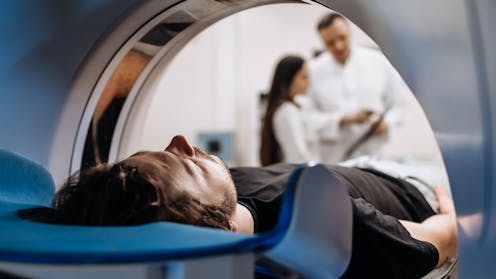
Timely access to high-quality medical imaging can be lifesaving and life-altering. Radiology can confirm a fractured bone, give us an early glimpse of our baby or detect cancer.
But behind the x-ray, ultrasound, CT and MRI machines is a growing, highly profitable industry worth almost A$6 billion a year.
Corporate ownership dominates the sector. In our new study, we show how for-profit corporations own about three in every five private radiology clinics.
As radiology becomes an increasingly attractive target for investors, are we letting business interests reshape a key part of our health-care system?
30 million scans and counting
In 2023–24, two in five Australians had an x-ray, ultrasound, CT scan or MRI. That’s about 30.8 million scans in total (individuals may have two or more scans).
Medicare funds most of this imaging. In fact, imaging is now Medicare’s second-largest area of spending, behind only GP visits.
But a growing number of scans are not bulk billed and patients are out of pocket on average about $125 per scan. An estimated 274,000 Australians are delaying or forgoing scans each year because of the cost.
There have also been dramatic changes behind the scenes. Since the early 2000s, for-profit corporations have been buying small radiologist-owned clinics.
Today, 65% of private radiology practices are owned by publicly listed shareholders or private investors, including private equity firms. This marks a significant shift from clinician-led to investor-driven health care.

Why should we care?
Advocates of corporate ownership suggest this business-focused approach can make the system more efficient through economies of scale. They say this allows consolidation of administration tasks and a reduction in overheads.
Easy access to finance can help buy expensive imaging machines. It can also provide investment towards new technologies, such as artificial intelligence.
Yet, there are three main reasons why corporate ownership of the radiology sector may be cause for concern.
1. It reduces competition
Large corporations buying up a bunch of smaller practices ultimately leads to less competition. In Tasmania, for example, 11 of the 17 private radiology clinics are owned by one company, significantly limiting patient choice.
We also found limited competition among radiology providers in South Australia, the Northern Territory and Australian Capital Territory.
When a single company dominates a local market, it creates the conditions for higher fees and reduced incentives to bulk bill. However, objective data on the impact of reduced competition on the affordability of scans is scarce.
2. It may lead to too many expensive scans
High-cost scans, such as MRIs and CTs, are lucrative. Medicare expenditure on MRI scans alone has doubled since 2012.
This may reflect improved access and a recommended shift towards more sensitive tests for some conditions. However, for-profit corporations now own about 76% of MRI machines in private clinics. These corporations may be financially incentivised to offer more costly imaging over equally effective, lower-cost options.
With profits tied to the number of scans, there’s growing unease financial motives may be influencing when and how often these scans are used.
While radiology corporations are not the ones requesting scans, there is little incentive for them to address overuse of radiology services, an issue for high-income countries such as Australia.
Low-value imaging may also generate overdiagnosis (when something shows up on imaging but will never cause the patient any health issues, for example). It can lead to unnecessarily exposing patients to radiation and cause unwarranted patient (and doctor) anxiety. This can ultimately lead to more tests and unnecessary treatment.

3. Radiology clinics become an asset
Private equity firms view radiology clinics as a commodity to be bought, their value increased, then sold over a relatively short time frame (typically three to seven years).
These firms generate profit not from delivering care, but from boosting the clinic’s value and charging them annual “management fees”.
A prime example is unfolding. I-MED, Australia’s largest radiology provider, is considering listing the business on the Australian Stock Exchange after failing to sell at a reported $3 billion. Its UK private equity owner bought I-MED for about $1.26 billion in 2018. If sold, this would be the latest of multiple owners since delisting from the stock exchange in 2006.
If there are debts, health-care companies can collapse, as we’ve seen recently with hospital chain Healthscope, which is owned by a Canadian-based private equity firm.
Experience of private equity’s role in health care in the United States also offers a cautionary tale. Reductions in the quality of care, asset stripping and ultimately the closure and bankruptcy of vital health-care providers have prompted Congressional investigations. The state of Oregon is on the verge of blocking private equity firms from controlling health-care providers.
What next?
As radiology becomes an increasingly attractive target for investors, questions are mounting about whether this profit-driven model can coexist with the public’s need for affordable, accessible health care.
Medicare was designed to guarantee affordable access to quality health care for all Australians, not guarantee revenue for corporations.
While unwinding corporate participation in the radiology sector is near impossible, there is still time to implement safeguards that prevent wealthy investors from prioritising financial gain over Australians’ health and wellbeing.
Stronger oversight and greater transparency from these corporations are needed to ensure Medicare dollars deliver real value for patients and the public.
We would like to acknowledge Jenn Lacy-Nichols (University of Melbourne) and Martin Hensher (University of Tasmania) who co-authored the paper mentioned in this article.
Authors: Sean Docking, Research Fellow, School of Public Health and Preventive Medicine, Monash University


















