

Extreme weather could send milk prices soaring, deepening challenges for the dairy industry
- Written by: Milena Bojovic, Lecturer, Sustainability and Environment, University of Technology Sydney
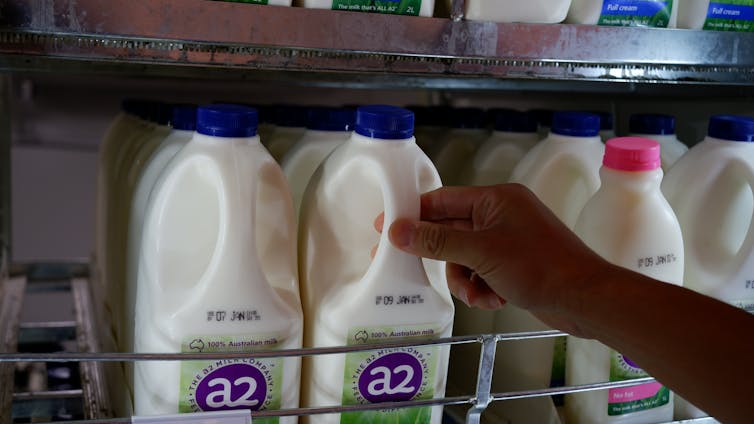
Australia’s dairy industry is in the middle of a crisis, fuelled by an almost perfect storm of challenges.
Climate change and extreme weather have been battering farmlands and impacting animal productivity, creating mounting financial strains and mental health struggles for many farmers.
Meanwhile, beyond the farm gate, consumer tastes are shifting to a range of dairy substitutes. Interest and investment in alternative dairy proteins is accelerating.
Earlier this month, industry figures warned consumers to prepare for price rises amid expected shortages of milk, butter and cheese. Already mired in uncertainty, the dairy industry is now being forced to confront some tough questions about its future head on.
Dairy under pressure
Dairy is Australia’s third-largest rural industry. It produces more than A$6 billion worth of milk each year, and directly employs more than 30,000 people.
But the sector has been under sustained pressure. This year alone, repeated extreme weather events have affected key dairy-producing regions in southern and eastern parts of Australia.

In New South Wales, dairy farmers face increased pressure from floods. In May, many regions had their monthly rainfall records broken – some by huge margins.
In Victoria, drought and water shortages are worsening. Tasmania, too, continues to endure some of the driest conditions in more than a century.
Conditions have prompted many farmers to sell down their cattle numbers to conserve feed and water.
All of this heavily impacts farm productivity. Agriculture has long been predicated on our ability to predict climate conditions and grow food or rear animals according to the cycles of nature.
As climate change disrupts weather patterns, this makes both short and long-term planning for the sector a growing challenge.
High costs, low profits
Climate change isn’t the only test. The industry has also been grappling with productivity and profitability concerns.
At the farm level, dairy farmers are feeling the impacts of high operating costs. Compared to other types of farming (such as sheep or beef), dairy farms require more plant, machinery and equipment capital, mostly in the form of specialised milking machinery.
The price of milk also has many farmers concerned. The modest increase in farmgate milk prices – just announced by dairy companies for the start of the next financial year – left many farmers disappointed. Some say the increase isn’t enough to cover rising operating costs.
Zooming out, there are concerns about a lack of family succession planning for dairy farms. Many young people are wary of taking on such burdens, and the total number of Australian dairy farms has been in steady decline – from more than 6,000 in 2015 to just 4,163 in 2023.
What’s the solution?
Is there a way to make the dairy industry more productive, profitable and sustainable? Australian Dairy Farmers is the national policy and advocacy group supporting the profitability and sustainability of the sector.
In the lead up to this year’s federal election, the group called for $399 million in government investment to address what it said were key priorities. These included:
- investment in on-farm technologies to improve efficiencies
- funding for water security
- upskilling programs for farmers
- support for succession planning.

However, as the industry struggles to grapple with a changing climate, financial strain and mental health pressures, there should also be pathways for incumbent farmers to transition, either to farming dairy differently (such as by reducing herd sizes) or exiting out of dairy farming and into something else.
Dairy without the cows
The push to make dairy production more sustainable and efficient faces its own competition. A number of techniques in development promise dairy products without the cows, through cellular agriculture – and more specifically, “precision fermentation”.
Australian company Eden Brew, in partnership with dairy giant Norco, has plans to produce and commercialise precision fermentation dairy proteins.
And last year, Australian company All G secured approval to sell precision fermentation lactoferrin (a key dairy ingredient in baby formula) in China – another animal-free milk product.
It is important to note that cost and scalability for cellular agriculture remains a challenge.
Nonetheless, Australia’s rapidly growing non-dairy milk market – soy, oat, and so on – is now worth over $600 million annually. This reflects the global shift towards plant-based options driven by health, environmental, and ethical concerns.
Is there a win-win outcome?
Is there a possible future where more funding is given to produce milk at scale through precision fermentation while we also look after incumbent dairy workers, farms and the rural sector at large to diversify or leave the sector altogether?
Some believe this future is possible. This is what researchers call “protein pluralism” – a market where traditional and alternative proteins coexist. Long-term planning from both the dairy industry and government would be needed.
Remember, while techniques like precision fermentation offer the promise of animal-free dairy products, their benefits are largely yet to materialise. How they will ultimately benefit the whole of society remains speculative.
What we can do now
For this reason, some scholars have argued we should prioritise actions that can be taken now. This includes support for practices such as agroecology, which seek to address injustice and inequity in food systems to help empower primary food producers.
A recent study found Australian dairy farmers were interested in financial and technical advice to make decisions about where they take their business in future.
Despite growing recognition of the challenges facing the dairy sector, responses from government and alternative dairy remain uneven. A more coordinated approach is needed for affected farmers, helping them adapt or diversify with guidance from government and industry experts.
Authors: Milena Bojovic, Lecturer, Sustainability and Environment, University of Technology Sydney

















