

Can we heal teeth? The quest to repair tooth enamel, nature's crystal coat
- Written by: Arosha Weerakoon, Lecturer, General Dentist & PhD Candidate, The University of Queensland
Tooth enamel is one of the hardest tissues in the human body. It acts as a protective layer for our teeth, and gives our smile that pearly white shimmer. But when enamel erodes, it can’t regrow itself.
In a significant scientific breakthrough, researchers recently discovered a way to regrow human tooth enamel.
Scientists from China have invented a gel that contains mineral clusters naturally found in teeth. In partially acid-damaged teeth, the gel stimulates crystal regrowth to restore tooth enamel back to its original structure.
While the method is yet to be tested on people, one day this could mean saying goodbye to painful needles, the dreaded dentist drill, and even fillings.
Read more: How often should I get my teeth cleaned?
What is tooth enamel?
Enamel is the outermost layer of our teeth, and protects our pearly whites from wear and tear. It also insulates us from feeling pain and sensitivity.
When this protective coat erodes, our teeth soften and become vulnerable to developing cavities (holes in the teeth) which may require dental treatment such as fillings.
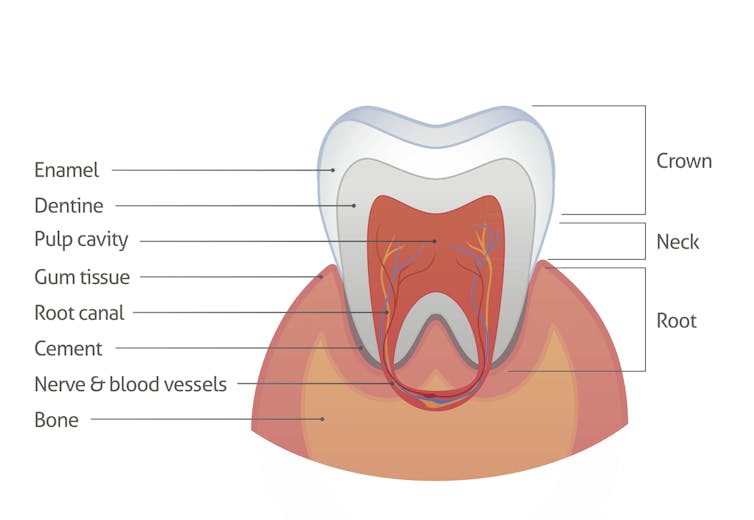 Enamel is the protective outer layer of our teeth.
From shutterstock.com
Enamel is the protective outer layer of our teeth.
From shutterstock.com
Tooth enamel contains the same minerals, calcium and phosphate, found in bone. Unlike bone though, enamel contains relatively more mineral, and enamel crystals are arranged in a complex geometrical pattern.
Under a microscope, enamel crystals are shaped like long ribbons, or spaghetti strands. These crystal strands are assembled into clusters, like packets of dry spaghetti, orientated at 60 degrees to each other. The ribbon clusters, which weave together like honeycomb, are known as rods and inter-rods.
When destroyed, this weave is difficult to recreate, because the cells that form enamel die as our teeth emerge from our gums.
Why does our tooth enamel erode?
While enamel is very hard, it’s also brittle and susceptible to erosion. This occurs when tooth mineral dissolves into our saliva.
Our saliva is constantly trying to balance any “bad guys” it encounters with “good guys” at its disposal. When we get acid in our mouth (a bad guy) the mineral in our saliva (a good guy) tries to bind to it to neutralise the acid, and prevent it from causing harm. This is known as buffering.
If there’s too much acid, or the quality and quantity of our saliva is inadequate, we run out of mineral to buffer the “acid attack”. So in a final effort to neutralise the acidity in our mouth, the mineral in our teeth will dissolve into our saliva. This is when our teeth erode and become vulnerable.
Read more: Child tooth decay is on the rise, but few are brushing their teeth enough or seeing the dentist
Like the erosion we see in our beaches and river beds, under a microscope, eroded enamel surfaces appear moth-eaten and uneven. This is because erosion destroys the crystal organisation I described above.
Current dentist-recommended products repair enamel but cannot regrow the complex crystal structure to recreate a pearly white shimmer. This is why globally, the dental community are very excited about this research.
Can we control erosion?
Our teeth erode when we eat and drink foods rich in acid, including wine, cola beverages, fruit juices, sour lollies, and energy and sports drinks. As a general rule, anything that tastes sour is high in acid. It’s best to avoid or limit acidic food and drinks where possible.
People with medical conditions such as bulimia or acid reflux may be at greater risk of their teeth eroding. If you suffer from these conditions, in addition to getting help from your doctor, it’s best to seek regular dental check-ups.
 We know lollies aren’t good for teeth. But sour lollies in particular contain acid, which contributes to erosion.
From shutterstock.com
We know lollies aren’t good for teeth. But sour lollies in particular contain acid, which contributes to erosion.
From shutterstock.com
When our enamel erodes, it makes our teeth appear yellower. Often, we may also experience toothache or sensitivity because we’ve lost the enamel’s natural insulation.
If your teeth are eroding, a dentist and/or dental hygienist will be able to monitor and help you manage your oral health. In addition to brushing and cleaning between your teeth, your dental professional may also recommend:
- rinsing with a bicarbonate and salt water mouthwash
- chewing sugar-free gum to stimulate an increase in mineral-rich saliva
- using a dentist-recommended toothpaste, special cream and/or mouthwash to help replace lost mineral and repair your teeth
- delaying cleaning your teeth after an “acid attack” to prevent removing softened enamel.
Read more: Two million Aussies delay or don't go to the dentist – here's how we can fix that
How did the scientists regrow enamel?
In a lab, extracted teeth were treated with acid to simulate erosion, then painted with a special gel. This gel contained calcium phosphate ion clusters – mineral clusters naturally found in teeth – mixed with an ingredient called triethylamine (TEA).
After two days in a simulated mouth-like environment, the previously eroded enamel was checked for crystal growth, size, shape, organisation and composition using special microscopes.
The spaghetti-like crystals had regrown seamlessly, and the crystal clusters had correctly orientated themselves to form the rod and inter-rod honeycomb weave.
When will we be able to regrow enamel?
While this technology is something to look forward to, the short answer for now is “not yet”. This study has only been performed on extracted teeth. The researchers are hoping to test their method on mice, and then people soon after.
One of the significant limitations to moving towards animal and human trials is the toxicity of the essential ingredient, TEA. Another challenge is the enamel thickness they were able to repair was at a microscopic level.
Read more: Health check: what's eating your teeth?
But all is not lost. The scientists hope to find a safe way to use TEA with the intention of growing enamel thick enough to fix larger sections of eroded enamel.
For now, the thought of not having to get fillings at the dentist is an exciting prospect on the horizon. So watch this space.
Authors: Arosha Weerakoon, Lecturer, General Dentist & PhD Candidate, The University of Queensland


















