

Workers need better tools and tech to boost productivity. Why aren’t companies stepping up to invest?
- Written by: John Hawkins, Head, Canberra School of Government, University of Canberra
As Prime Minister Anthony Albanese and Treasurer Jim Chalmers turn their attention to improving productivity growth across the economy, it will be interesting to see what the business community brings to a planned summit in August.
Labour productivity (output per hour worked) has barely grown this decade.
Much of the focus in the current debate has been on the role of workers (labour) and industrial relations. Less discussed has been low business investment (capital).
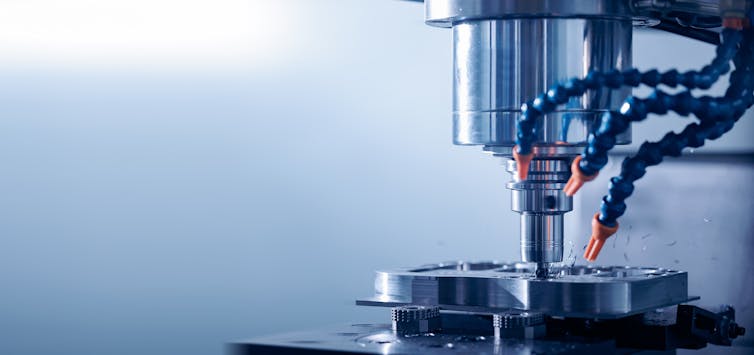
Labour will be more productive if each worker can use more capital: machinery, equipment and technology. Over the medium term, providing workers with more capital – “capital deepening”, in the jargon – tends to be the main contributor to labour productivity growth.
But business investment as a share of gross domestic product (GDP) is currently at its lowest level since the mid-1990s.
Investment is low in both the mining and non-mining sectors. In the latest national accounts report for the March quarter, business investment in machinery and equipment fell 1.7%.
The average worker now uses less capital equipment – machines and computers – than a decade ago. Investment just hasn’t kept pace with growth in employment.
Read more: 'Hard to measure and difficult to shift': the government's big productivity challenge
Why is investment so weak?
One possible reason was put forward by then Reserve Bank governor Philip Lowe in 2023. He suggested that, during the COVID pandemic, firms concentrated on surviving. Seeking out more efficient ways to produce was a lower priority. But post-pandemic, firms seem to have been slow to pivot back to an efficiency focus.
Another reason may be that, until recently, wage growth has been slower than the growth in prices of goods and services produced. This may have reduced the incentives for firms to invest in the equipment needed to boost labour productivity.
A key driver of investment is profitability. Firms are more likely to fund investment from retained earnings than by borrowing or raising capital. But the share of corporate profits in the economy has been quite high in recent years. So this does not explain low investment.
The ‘animal spirits’ are lacking
Business confidence – what economist John Maynard Keynes famously called “animal spirits” – is another important driver.
Share prices, both in Australia and the rest of the world, have grown strongly in recent years. The S&P/ASX 200 index of Australian share prices is close to its all-time high. This would suggest financial markets are very optimistic about the prospects of Australian companies.
Direct surveys of Australian businesses from National Australia Bank suggest conditions (the current situation) and confidence (about the future) are around their long-term average level. So this also does not explain the low investment.
One contributor to low investment may be that firms are applying inappropriately high “hurdle rates”. These refer to the minimum return firms expect from an investment before they will undertake it.
Hurdle rates tend to be “sticky” over time, meaning they do not move much. Many companies still apply hurdle rates of over 12%. These were appropriate back when interest rates and inflation were much higher, but seem too high now as borrowing costs have fallen with interest rate cuts.
The Productivity Commission has suggested one contributor to low investment could be a higher risk premium. Since the global financial crisis in 2007-08, companies and investors may have become more cautious about taking on risk.
Another factor could be growing market power of Australian companies that dominate a sector, making them complacent rather than striving to improve their performance.
The high degree of uncertainty
The Reserve Bank recently compiled two measures of uncertainty. One is derived from stock markets. The other is based on the number of news articles about policy uncertainty.
Both show the current environment is as uncertain now as it was during the early stages of the global financial crisis in 2007–08 and the COVID pandemic.
A common response to uncertainty is to defer decisions on both investment and hiring new workers until the outlook is clearer. A study by the Reserve Bank found that greater uncertainty did indeed reduce investment. But the size of the impact was – you guessed it – uncertain.
What can be done?
Business lobbies often attribute low rates of investment (and anything else they think people may not like) to “excessively high” corporate tax rates. But at 30% for large companies and 25% for small, the company tax rate is low by historical standards.
Some multinational firms may be deterred from entering the Australian market as our company tax rate is above that in some other jurisdictions. It is hard to tell how important this effect is. Company tax is only one of many factors that affect the comparative risk and return of Australia as an investment destination.
The Productivity Commission is investigating whether the corporate taxation system could be made more efficient rather than just lowering rates.
In the meantime, however, firms may be encouraged to invest more by a more stable domestic economic outlook. Inflation is back within the central bank’s 2-3% target range. Employment is around an all-time high proportion of the working age population. The election has removed some political uncertainty with a government holding a clear majority.
Businesses should stop whingeing and start providing workers with the tools they need to become more productive.
This article is part of The Conversation’s series, The Productivity Puzzle. Read the previous article here.
Authors: John Hawkins, Head, Canberra School of Government, University of Canberra


















