

like the LA protesters, the early Romans hated kings, too
- Written by: Peter Edwell, Associate Professor in Ancient History, Macquarie University
Protesters across the United States have brandished placards declaring “no kings!” in recent days, keen to send a message one-man rule is not acceptable.
The defeat of the forces of King George III in the United States’ revolutionary war of 1775–83 saw the end of royal rule in the US. Touting itself as the world’s leading democracy, kings have not been welcome in America for 250 years. But for many, Donald Trump is increasingly behaving as one and now is the time to stop him.
Having studied ancient Roman politics for years, America’s rejection of kingship reminds me vividly of the strong aversion to it in the Roman republic.
Early Romans too, sought a society with “no kings!” – up until, that is, the period following the assassination of Julius Caesar, when everything changed.
The seven kings of Rome
Seven kings ruled Rome, one after the other, after the city was founded in 753 BCE. The first was Romulus who, according to some legends, gave the city its name.
When the last of the kings of Rome was driven from the city in 509 BCE, his key opponent, Lucius Junius Brutus, vowed:
I will pursue Lucius Tarquinius Superbus and his wicked wife and all his children, with sword, with fire, with whatever violence I may; and I will suffer neither him nor anyone else to be king in Rome!
Tarquinius Superbus (meaning “the proud”) had ruled Rome for 25 years. He began his reign by executing uncooperative Senators.
When Tarquinius’ son raped a noblewoman named Lucretia, the Roman population rebelled against the king’s long-running tyranny. The hubris of the king and his family was finally too much. They were driven from Rome and never allowed to return.
A new system of government was ushered in: the republic.
The rise of the Roman republic
In the new system, power was shared among elected officials – including two consuls, who were elected annually.
The consuls were the most powerful officials in the republic and were given power to wage war.
The Senate, which represented the wealthiest sections of society (initially the patrician class), held power in some key areas, including foreign policy.
Less affluent citizens elected tribunes of the plebs who had various powers, including the right to veto laws.
In the republican system, the term king (rex in Latin) quickly became anathema.
“No kings” would effectively remain the watchword through the Roman republic’s entire history. “Rex” was a word the Romans hated. It was short-hand for “tyranny”.
The rise and fall of Julius Caesar
Over time, powerful figures emerged who threatened the republic’s tight power-sharing rules.
Figures such as the general Pompey (106–48 BCE) broke all the rules and behaved in suspiciously kingly ways. With military success and vast wealth, he was a populist who broke the mould. Pompey even staged a three-day military parade, known as a triumph, to coincide with his birthday in 61 BCE.
But the ultimate populist was Julius Caesar.
Born to a noble family claiming lineage from the goddess Venus, Caesar became fabulously wealthy.
He also scored major military victories, including subduing the Gauls (across modern France and Belgium) from 58–50 BCE.
In the 40s BCE, Caesar began taking offices over extended time frames – much longer periods than the rules technically allowed.
Early in 44 BCE he gave himself the formal title “dictator for life” (Dictator Perpetuo), having been appointed dictator two years earlier. The dictatorship was only meant to be held in times of emergency for a period of six months.
When Caesar was preparing a war against Parthia (in modern day Iran), some tried to hail him as king.
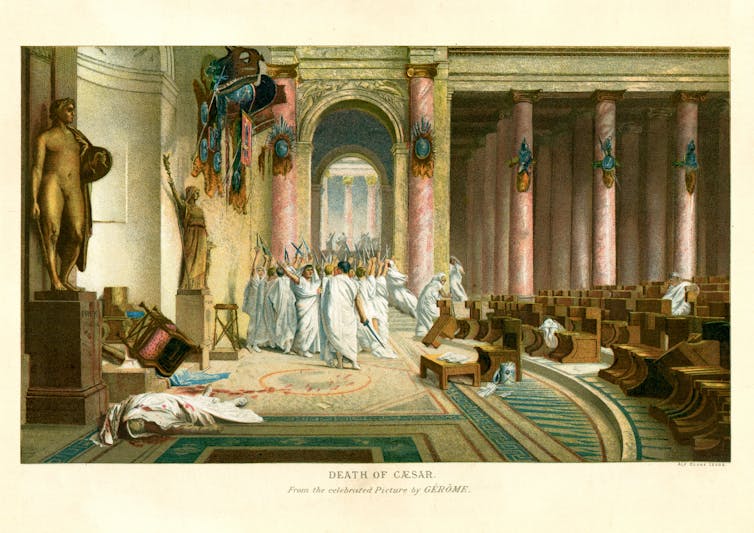
Soon after, an angry group of 23 senators stabbed him to death in a vain attempt to save the republic. They were led by Marcus Junius Brutus, a descendant of the Brutus who killed the last Roman king, Tarquinius Superbus.
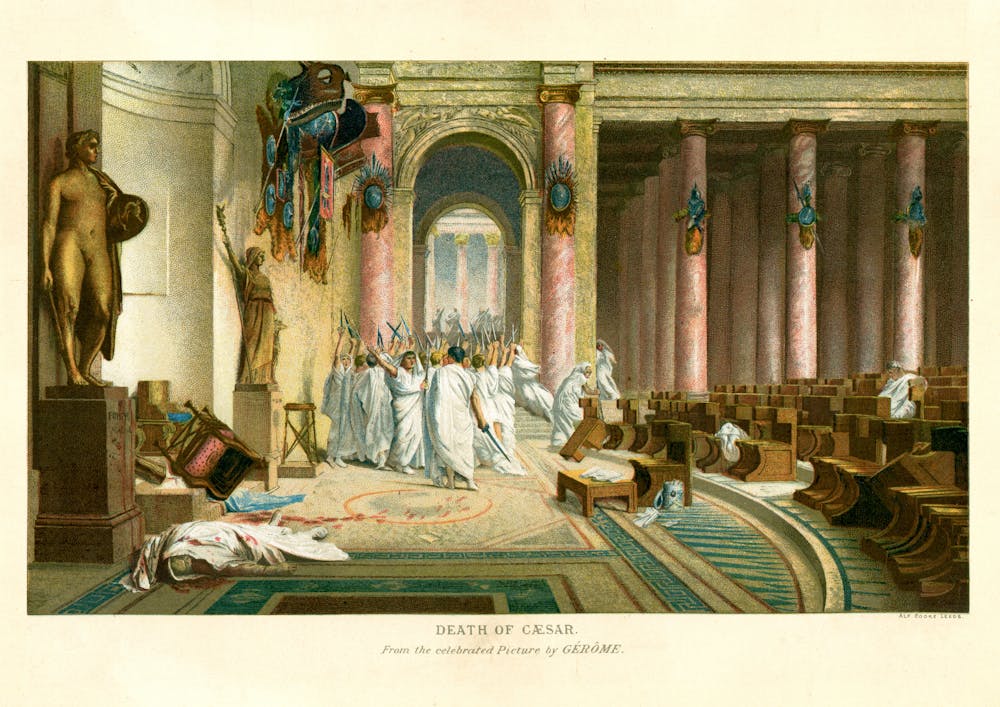
However, the Roman republic was beyond saving despite Caesar’s death. His great nephew Octavian eventually emerged as leader and became known as Augustus (27 BCE – 14 CE). With Augustus, an age of emperors was born.
Emperors were kings in all but name. The strong aversion to kingship in Rome ensured their complete avoidance of the term rex.
‘No kings!’
American protesters waving placards shouting “no kings!” are expressing clear concerns that their beloved democracy is under threat.
Donald Trump has already declared eight national emergencies and issued 161 executive orders in his second term.
When asked if he needs to uphold the Constitution, Trump declares “I don’t know.” He has joked about running for a third term as president, in breach of the longstanding limit of two terms.

Like Caesar, is Donald Trump becoming a king in all but name? Is he setting a precedent for his successors to behave increasingly like emperors?
The American aversion to “king” likely ensures the term will never return. But when protesters and others shout “no kings!”, they know the very meaning of the term “president” is changing before their eyes.
Authors: Peter Edwell, Associate Professor in Ancient History, Macquarie University
Read more https://theconversation.com/no-kings-like-the-la-protesters-the-early-romans-hated-kings-too-259011


















