

Ancient termite poo reveals 120 million-year-old secrets of Australia’s polar forests
- Written by: Alistair Evans, Professor, School of Biological Sciences, Monash University
Imagine a lush forest with tree-ferns, their trunks capped by ribbon-like fronds. Conifers tower overhead, bearing triangular leaves almost sharp enough to pierce skin. Flowering plants are both small and rare.
You’re standing in what is now Victoria, Australia, about 127 million years ago during the Early Cretaceous Period. Slightly to your south, a massive river – more than a kilometre wide – separates you from Tasmania. This river flows along the valley forming between Australia and Antarctica as the two continents begin to split apart.
During the Early Cretaceous, southeastern Australia was some of the closest land to the South Pole. Here, the night lasted for three months in winter, contrasting with three months of daytime in summer. Despite this extreme day-night cycle, various kinds of dinosaurs still thrived here, as did flies, wasps and dragonflies.
And, as our recently published research in Palaeogeography, Palaeoclimatology, Palaeoecology reveals, termites also chewed through the decaying wood of fallen trees. This is the first record of termites living in a polar region – and their presence provides key insights into what these ancient forests were like.
Home makers, not homewreckers
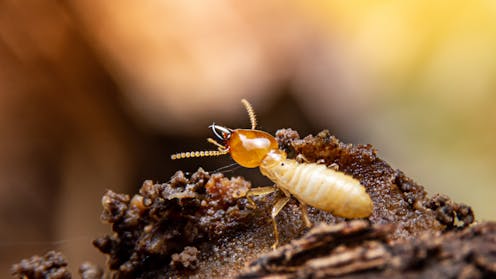
Termites might have a public reputation as homewreckers.
But these wood-eating bugs are a key part of many environments, freeing up nutrients contained in dead plants. They are one of the best organisms at breaking down large amounts of wood, and significantly speed up the decay of fallen wood in forests.

The breakdown of wood by termites makes it easier for further consumption by other animals and fungi.
Their role in ancient Victoria’s polar forests would have been just as important, as the natural decay of wood is very slow in cold conditions.
Although the cold winters would have slowed termites too, they may have thrived during long periods of darkness, just as modern termites are more active during the night.
The oldest termite nest in Australia
Our new paper, led by Monash University palaeontology research associate Jonathan Edwards, reports the discovery of an ancient termite nest near the coastal town of Inverloch in southeastern Victoria. Preserved in a 80-centimetre-long piece of fossilised log, the nest tunnels carved out by termites were first spotted by local fossil-hunter extraordinaire Melissa Lowery.
Without its discoverers knowing what it was then, the log was brought into the lab and we began investigating the origins of its structures.
Understanding the nest was challenging at first: the tunnels exposed on the surface were filled with what looked like tiny grains of rice, each around 2 millimetres long. We suspected they were most likely the coprolites (fossilised poo) of the nest-makers. Once we took a look under the microscope we noticed something very interesting: this poo was hexagonal.

How did this shape point to termites as the “poopetrators”?
Modern termites have a gut with three sets of muscle bands. Just before excretion, their waste is squeezed to save as much water as possible, giving an almost perfect hexagonal shape to the pellets.
The size, shape, distribution and quantity of coprolites meant we had just discovered the oldest termite nest in Australia – and perhaps the largest termite wood nest from dinosaur times.
A global distribution
We continued to investigate the nest with more specific methods.
For example, we scanned parts of it with the Australian Synchrotron – a research facility that uses X-rays and infrared radiation to see the structure and composition of materials. This showed us what the unweathered coprolites inside the log looked like.
We also made very thin slices of the nest and looked at these slices with high-powered microscopes. And we analysed the chemistry of the log, which further supported our original theory of the nest’s identity.
The oldest fossilised termites have been found in the northern hemisphere about 150 million years ago, during the Late Jurassic Period.
What is exciting is that our trace fossils show they had reached the southernmost landmasses by 127 million years ago. This presence means they had likely spread all over Earth by this point.
The termites weren’t alone
Surprisingly, these termites also had smaller wood-eating companions.
During our investigation, we also noticed coprolites more than ten times smaller than those made by termites. These pellets likely belonged to wood-eating oribatid mites – minuscule arachnids with fossils dating back almost 400 million years. Many of their tunnels ring those left by the termites, telling us they inhabited this nest after the termites abandoned it.
 CT reconstructions of termite and mite coprolites show the huge difference in size between them.
Jonathan Edwards
CT reconstructions of termite and mite coprolites show the huge difference in size between them.
Jonathan Edwards
Termite tunnels may have acted as mite highways, taking them deeper into the log. Moreover, because both groups ate the toughest parts of wood, these two invertebrates might have directly competed at the time. Modern oribatid mites only eat wood affected by fungi.
Regardless, our study documents the first known interaction of wood-nesting termites and oribatid mites in the fossil record.
This nest also provides important support for the idea that Australia’s polar forests weren’t dominated by ice, as modern termites can’t tolerate prolonged freezing.
This is the first record of termites living in a polar region, and their presence suggests relatively mild polar winters — something like 6°C on average. Termites would’ve been key players in these ecosystems, kickstarting wood breakdown and nutrient cycling in an otherwise slow environment.
So maybe next time you spot a termite nest, you’ll see a builder, not a bulldozer.
The authors would like to acknowledge the work of Jonathan Edwards who led the research and helped prepare this article.
Authors: Alistair Evans, Professor, School of Biological Sciences, Monash University


















