

how a single movie changed our perception of white sharks forever
- Written by: John Long, Strategic Professor in Palaeontology, Flinders University
It’s been 50 years since Steven Spielberg’s movie Jaws first cast a terrifying shadow across our screens.
At a low point during production, Spielberg worried he’d only ever be known for “a big fish story”. The film, however, did not tank.
Jaws broke box office records and became the highest-grossing movie at the time, only surpassed by the first Star Wars released two years later in 1977.
A combination of mass advertising, familiar “hero” tropes and old-school showmanship launched Jaws as the first modern blockbuster.
Hollywood, and our relationship to oceans and the sharks within them, would never be the same.

An unrealistic monster
In Peter Benchley’s 1974 novel that Jaws is based on, the shark is 6 metres long. For added screen excitement, in the movie it grew to a whopping 7.6 metres.
However, that’s unrealistically large.
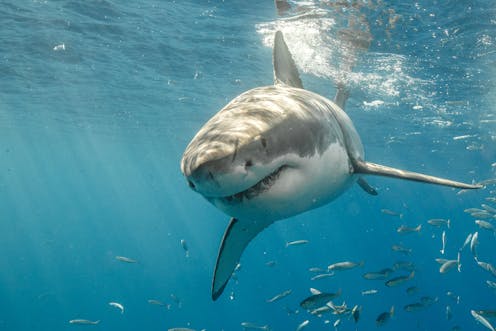
The average size of a mature great white (Carcharodon carcharias, also known as the white shark) is between 4.6 and 4.9 metres for female sharks and up to 4 metres for male sharks.
The largest recorded living specimens peak at about 6 metres, with one monster specimen caught in Cuba in 1945 reaching 6.4 metres.
Earth’s oceans have seen bigger predatory sharks in the past. The biggest one of all time was the megalodon (Otodus megalodon) which lived from 23 to 3 million years ago, and may have been up to 24 metres in length. However, it looked nothing like the modern white shark.
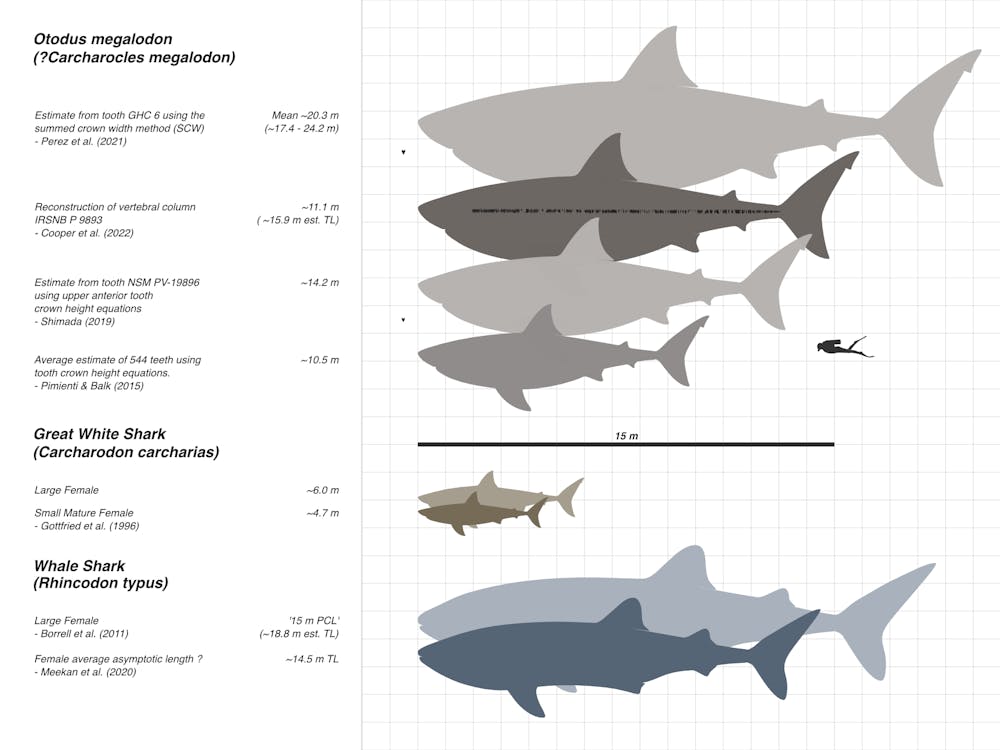
They’re not even directly related – another thing scientists learned quite recently.
Who was the megalodon, then?
White sharks first evolved between 6 and 4 million years ago in the shadows of the megalodon. A recent study showed the megalodon’s large serrated teeth show signs of it being a supreme opportunistic super-predator.
That means it ate just about anything, but especially liked whales and marine mammals.
Read more: Friday essay: Giant shark megalodon was the most powerful superpredator ever. Why did it go extinct?
But white sharks are not directly related to the megalodon, whose lineage began with a shark called Cretalamna during the age of dinosaurs about 100 million years ago.
By contrast, the white shark lineage began with an ancient mako shark, Carcharodon hastalis. It was 7 to 8 metres long and had large, similarly shaped teeth to the modern white shark but lacking serrated edges.
A fossil intermediate species, Carcharodon hubbelli shows the transition over time from weakly serrated to strongly serrated teeth.
How did Jaws affect white shark populations?
Last year, the International Shark Attack File reported 47 unprovoked shark bites to humans worldwide, resulting in seven fatalities. This was well below the previous ten-year average of 70 bites per year; your chances of getting bitten by a shark are extremely rare.
Following the movies that made up the Jaws franchise, there was an increase in hunting and killing sharks – with a particular focus on great white sharks that were already going into a decline due to overfishing, trophy hunting and lethal control programs.
Between 80% and 90% of white sharks have disappeared globally since the middle of the 20th century. Recent estimates calculate there are probably less than 500 individual white sharks in Australian waters right now.
When Jaws first aired, scientists didn’t know how long sharks took to reproduce, or how many offspring a white shark could have each year. We now know it takes about 26 years for a male and 33 years for a female to sexually mature before they can start having pups.
Data about white shark births is sparse, but recently a 5.6-metre-long female caught on a drum line off the coast of Queensland had just four large pups inside her. This is a very small number. Some large sharks, such as the whale shark, can give birth to up to 300 young.
Now that we know just how slow they are to breed, it’s clear it will take many decades to reestablish the “pre-Jaws” population of white sharks – important apex predators in the marine ecosystem.
Will white sharks survive?
White sharks are currently listed as vulnerable.
This classification means if we don’t change the current living conditions for white sharks, including impacts caused by human activities such as commercial fishing, and the impacts of climate change and ocean pollution, they will continue to decline and eventually could go extinct.
Currently, white sharks are protected in several countries and form the basis for an important tourist industry in Australia, South Africa, western United States and most recently Nova Scotia, Canada.
These sharks are iconic apex predators that fascinate people. One of us (John) went cage diving with them recently off the Neptune Islands of South Australia and can attest to how breathtaking it is to watch them in their natural environment.
In terms of economic impact, they are worth far more alive than dead.
 White sharks are a growing tourism draw in several countries.
Andrew Fox, Adelaide, CC BY
White sharks are a growing tourism draw in several countries.
Andrew Fox, Adelaide, CC BY
There’s still much we don’t know about white sharks
The complete white shark genome was first published only in 2019. It has 4.63 billion base pairs, making it much larger than the human genome (3.2 billion base pairs).
The genome revealed some surprising things, like how white sharks show strong molecular adaptations for wound-healing processes, and a suite of “genome stability” genes – those used in DNA repair or DNA damage response.
The transcriptome (or sum total of the messenger RNA) of the white shark showed greater similarity to the human transcriptome than to that of other fishes. This hints that “unexpressed genes” in the shark could one day play a role in uncovering genetic pathways for potential cures in human diseases.
Jaws and its sequels certainly brought white sharks to the attention (and nightmares) of humans, with devastating impacts on how we treated them as a species.
Our relationship with white sharks reflects our relationship with nature more broadly – a feared antagonist within the current capitalist paradigm; an enemy to be tamed, contained or consumed.
As we learn more of the peril and potential of these remarkable creatures, we can learn how to live with them, to see beyond our fears and value their role within our delicate ocean ecosystems.
Authors: John Long, Strategic Professor in Palaeontology, Flinders University


















