

Migrating bogong moths use the stars and Earth’s magnetic field to find ancestral summer caves each year
- Written by: Eric Warrant, Professor of Zoology at the University of Lund, Visiting Fellow at the Australian National University, and Adjunct Professor, University of South Australia
It’s a warm January summer afternoon, and as I traverse the flower-strewn western slopes of Australia’s highest mountain, Mount Kosciuszko, I am on the lookout for a tell-tale river of boulders that winds its way down into the alpine valleys below.
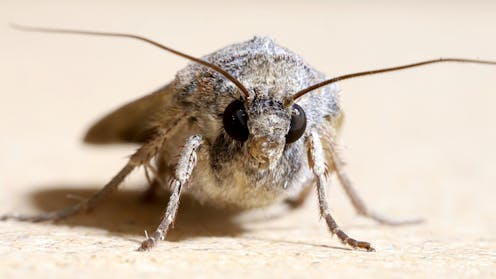
Here, hidden in cave-like hollows and crevices formed deep within the river of boulders, is one of the most spectacular natural phenomena in the insect world – the summer mass gathering of an iconic Australian insect, the bogong moth (Agrotis infusa).
Tightly huddled together in their dim cool cavernous world, with each moth’s head pushed slightly under the wings of the moth just ahead, millions of bogong moths sleep out the summer, slumbering in a state of dormancy known as “aestivation”.
Their little bodies coat the stone surfaces in an endless soft brown carpet, with 17,000 of them tiling each square metre of cave wall. It’s a sight that never fails to take my breath away.

Marathon migrations
To get here, these moths have flown from all over southeast Australia through the spring, arriving from as far away as south-eastern Queensland and far-western Victoria. Converted to human body length, these journeys of roughly 1,000 kilometres would be equivalent to a person circumnavigating Earth twice.
The moths’ marathon voyages to the Alps are likely undertaken to escape the lethal heat of the coming summer in their breeding areas. When the cool of autumn arrives, the moths leave the mountains to produce their own offspring and die.

But how on Earth do they know how to find these caves? How do they know the direction to travel and how do they know when they’ve arrived?
These questions have fascinated me and the other members of my research group for many years. It turns out bogong moths possess a most extraordinary ability to navigate, harnessing Earth’s magnetic field and the stars as compasses to follow their inherited migratory direction.
Moths, magnets and stars
We made these remarkable discoveries in a specialised lab we built a few years ago near Adaminaby in the Snowy Mountains of New South Wales.
First we light-trapped bogong moths that were either migrating towards the Alps in spring or away again in autumn. We next placed them in a special flight arena inside the lab, and finely controlled Earth’s magnetic field (with magnetic coils around the arena) and the starry night sky (by projecting a highly realistic starry night sky on the roof of the arena).
Because we already knew bogong moths have a magnetic sense, we used the coils to completely remove, or null, the magnetic field in the arena. This ensured any orientation using the stars was not confounded by the ability to detect Earth’s magnetic field.
 The orientation of the nighttime sky determines the moths’ direction of movement. When researchers showed moths random star patterns, they flew in random directions.
Dreyer et al./Nature
The orientation of the nighttime sky determines the moths’ direction of movement. When researchers showed moths random star patterns, they flew in random directions.
Dreyer et al./Nature
What we found next astounded us. Using only the local Australian starry night sky projected above them, bogong moths flying in our arena were able to discern and follow their inherited migratory direction – both in spring and in autumn.
If we turned this projected sky by 180°, the moths turned and flew in exactly the opposite direction. If we then took all of the stars in this projected natural sky and randomly distributed them across the roof of the arena, the moths became completely confused and lost their ability to migrate in their inherited migratory direction.
Navigators with tiny brains
In the absence of all other possible cues, bogong moths clearly used the stars as a true compass to discern a geographic direction relative to north.
This is the first invertebrate we so far know of that can do this. Only human beings and some species of night-migratory birds are known to have this ability.
But in moths this ability is even more remarkable considering their brain is approximately one-tenth the volume of a grain of rice and their eyes only a couple of millimetres wide.
A magnetic backup system
We made a final discovery when we moved our flight arena up onto the hill behind the lab under the magnificent dome of the natural starry sky. As expected, the moths were beautifully oriented in their inherited migratory direction.
But on one of these nights the sky was heavily overcast with cloud. To our great surprise, the moths remained oriented in their migratory direction, even though the stars were obscured.
The only remaining cue that could have been used was Earth’s magnetic field, which showed very clearly that moths rely on two compasses – a magnetic compass and a stellar compass.
But of course, two compasses will always be better than one – if one becomes corrupted or drops out, the other can take over. Nature’s perfect solution for robust navigation!
Bogong moths under threat
Despite its fantastic abilities, this tiny navigator is under threat. A result of anthropogenic climate change, the recent drought in Australia saw bogong moth numbers fall by a jaw-dropping 99.5%.
 Endless thousands of generations of bogong moths have slept through summer in a few specific caves dotted across these outcrops.
Eric Warrant
Endless thousands of generations of bogong moths have slept through summer in a few specific caves dotted across these outcrops.
Eric Warrant
Endangered alpine marsupials that depend on the moth’s arrival in spring for food – such as the mountain pygmy possum – suffered heavily as a result.
Droughts in southeast Australia are only predicted to worsen in both frequency and intensity. The future of the bogong moth, as well as the fragile alpine ecosystem that depends on it, does not look very bright.
Authors: Eric Warrant, Professor of Zoology at the University of Lund, Visiting Fellow at the Australian National University, and Adjunct Professor, University of South Australia


















