

Monsters reflect our darkest fears, from zombies to werewolves. But they also bring us together
- Written by: Martine Kropkowski, PhD Candidate, Literature and Culture; Professional & Creative Writing Teacher, The University of Queensland
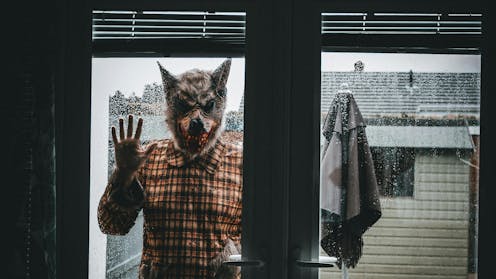
We need each other, people and monsters. Monsters rely on us to exist; they’re only alive because we create them. And people rely on monsters for a variety of reasons: a being to explain a particular cultural moment, or a flesh-and-bones body to represent the “other”, to name just two.
Understanding our fascination with monsters has long occupied the human psyche. And Nicholas Jubber’s Monsterland is the latest foray into this territory.
Part cultural inquiry, part history, part travel book and part reportage, Monsterland tracks down monsters from around the world, recording the stories people share about them, the rituals those people celebrate and the contemporary spaces ancient monsters persist in.
Review: Monsterland: a journey around the world’s dark imagination – Nicholas Jubber (Scribe)
“This book isn’t a search for Big Foot or the Loch Ness Monster,” Jubber explains. “I had no intention of scaling the Himalayas in search of the Yeti (there are better reasons to go mountain-trekking).”
Instead, he sets out to make sense of the monsters we’ve invented, meet the people who cherish their stories, and “peer inside the blurry portal between past and present”.
Going on a monster hunt

As the subtitle promises, Jubber takes readers on “a journey around the world’s dark imagination”. He travels to Cornwall, Bavaria, Morocco, Zagreb, Louisiana. He encounters ogres, zombies, demons, giants, werewolves. And he uses a mixture of methods to explain and analyse his experiences. He draws on cultural and historical scholarship, interviews with locals and his own immersion in place.
Monsters often manifest our deepest and darkest fears. Jeffrey Jerome Cohen, a cultural theorist known for interpreting the meanings of monsters, has written widely on the ways we ascribe meaning to and inscribe meaning upon these creatures. His influence is recognisable in Monsterland.
Cohen proposes several ideas. He describes the monster as “pure culture”, laying out a number of ways we might read it. For instance, he points out the monster’s tendency to resurface throughout history.
Take the vampire, whose classic stories (originating not in Transylvania, but Zagreb, now the capital of Croatia) appear alongside the breakdown of borders and empires throughout history.

 Cornwall’s annual Bolster pageant reenacts the slaying of the region’s infamous monster.
Geograph UK
Jubber also engages with folklore, beginning each chapter with a folk tale in the tradition of the Brothers Grimm.
Chapter nine, for example, explores zombies in Haiti, the birthplace of that particular monster. Haitian folk tales tell of zombies freed, of spells broken, and of living cadavers shambling across the plains to the dignity of their graves – what Jubber describes as “an imaginative retelling of history”. The chapter begins:
Under the jagged mountains, over tangled jungle and vast fields of sugar cane, night has fallen. By the light of the lantern, the bokor – the priest who deals in magic – stands beside an open grave. In one hand he holds a whip, in the other a govi jar, containing a potion to raise the dead.“Hurry!”Silently, his minions dig into the soil and pull up a body, wrapped in a white shroud.
Cornwall’s annual Bolster pageant reenacts the slaying of the region’s infamous monster.
Geograph UK
Jubber also engages with folklore, beginning each chapter with a folk tale in the tradition of the Brothers Grimm.
Chapter nine, for example, explores zombies in Haiti, the birthplace of that particular monster. Haitian folk tales tell of zombies freed, of spells broken, and of living cadavers shambling across the plains to the dignity of their graves – what Jubber describes as “an imaginative retelling of history”. The chapter begins:
Under the jagged mountains, over tangled jungle and vast fields of sugar cane, night has fallen. By the light of the lantern, the bokor – the priest who deals in magic – stands beside an open grave. In one hand he holds a whip, in the other a govi jar, containing a potion to raise the dead.“Hurry!”Silently, his minions dig into the soil and pull up a body, wrapped in a white shroud.
 Haiti is the birthplace of zombies, who populate its folk tales.
Leonid Domnitser, CC BY
Walking with monsters
But where Jubber really succeeds is his depiction of place or – most precisely – the way he depicts his experience of place.
He employs a method sometimes called psychogeography, a type of purposeful walking that focuses on the psychological experiences of a place. The method typically involves its researchers drifting through urban spaces, attempting to understand “the complication between histories and myths of urban landscapes”.
It’s often employed by what Nick Papadimitriou, a writer interested in “conscious walking”, comically describes in Will Self’s Psychogeography as “historians with an attitude problem”.
In Monsterland, Jubber takes his walking abroad, meandering through cities. At Drachenstadt, Bavaria, the City of the Dragon, he spends time meandering through the town and observing the dragon’s mark. There are dragons on the doorway of a guesthouse, on the facade of the town hall – in fact, on “nearly every business in town”. He writes:
They’re so widespread, it’s easier to identify the stores that don’t have a dragon: Takko Fashion, the Commerzbank, big business oblivious to the community glue.
Haiti is the birthplace of zombies, who populate its folk tales.
Leonid Domnitser, CC BY
Walking with monsters
But where Jubber really succeeds is his depiction of place or – most precisely – the way he depicts his experience of place.
He employs a method sometimes called psychogeography, a type of purposeful walking that focuses on the psychological experiences of a place. The method typically involves its researchers drifting through urban spaces, attempting to understand “the complication between histories and myths of urban landscapes”.
It’s often employed by what Nick Papadimitriou, a writer interested in “conscious walking”, comically describes in Will Self’s Psychogeography as “historians with an attitude problem”.
In Monsterland, Jubber takes his walking abroad, meandering through cities. At Drachenstadt, Bavaria, the City of the Dragon, he spends time meandering through the town and observing the dragon’s mark. There are dragons on the doorway of a guesthouse, on the facade of the town hall – in fact, on “nearly every business in town”. He writes:
They’re so widespread, it’s easier to identify the stores that don’t have a dragon: Takko Fashion, the Commerzbank, big business oblivious to the community glue.
 Jubber visited Bavaria to visit Drachenstadt, the City of the Dragon.
Anna Szilagyi/AAP
Later, he attends the annual community parade for the city’s dragon:
Nothing had prepared me for its size – between the breadth of an elephant and the length of a lorry. […] The street was barely wide enough to contain it, and sections of the crowd flattened as it passed.
Jubber interviews participants of the festival, including people involved in the dragon’s construction. One interviewee reasons that the dragon represents humanity’s complicated relationship with nature, and contemporary issues such as climate change, adding: “dragons can represent anything you want them to”.
Jubber visited Bavaria to visit Drachenstadt, the City of the Dragon.
Anna Szilagyi/AAP
Later, he attends the annual community parade for the city’s dragon:
Nothing had prepared me for its size – between the breadth of an elephant and the length of a lorry. […] The street was barely wide enough to contain it, and sections of the crowd flattened as it passed.
Jubber interviews participants of the festival, including people involved in the dragon’s construction. One interviewee reasons that the dragon represents humanity’s complicated relationship with nature, and contemporary issues such as climate change, adding: “dragons can represent anything you want them to”.
 Drachenstich is Bavaria’s annual dragon festival.
Europe Stripes
Jubber’s mix of interviews and observations bring to life the people who celebrate these monsters. His well-honed writing about place, threaded throughout, is appropriately creepy at times. During his search for an infamous Serbian vampire, detailed in one of the standout chapters of the book, he spends a frightening night in a supposedly haunted mill.
Straight off the bus and I was already facing the dead. A handsome-looking old lady, a bullet-headed man. They were peering behind a vegetable patch and tufts of grass tall enough to make hay, their faces outlined on a pair of marble headstones.
A travel book?
Jubber is marketed as an award-winning travel writer. His other books include The Timbuktu School for Nomads, Epic Continent, and The Fairy Tellers, all longform narrative accounts of his immersive research in a place, including its people, events and culture.
But what does a book about monsters have to do with travel writing?
Drachenstich is Bavaria’s annual dragon festival.
Europe Stripes
Jubber’s mix of interviews and observations bring to life the people who celebrate these monsters. His well-honed writing about place, threaded throughout, is appropriately creepy at times. During his search for an infamous Serbian vampire, detailed in one of the standout chapters of the book, he spends a frightening night in a supposedly haunted mill.
Straight off the bus and I was already facing the dead. A handsome-looking old lady, a bullet-headed man. They were peering behind a vegetable patch and tufts of grass tall enough to make hay, their faces outlined on a pair of marble headstones.
A travel book?
Jubber is marketed as an award-winning travel writer. His other books include The Timbuktu School for Nomads, Epic Continent, and The Fairy Tellers, all longform narrative accounts of his immersive research in a place, including its people, events and culture.
But what does a book about monsters have to do with travel writing?
 The first recognised work of travel writing is often cited as Herodotus’ History of the Persian Wars from 440 BCE. But contemporary travel writing owes much of its current conventions to Bruce Chatwin’s (somewhat controversial) In Patagonia and others like it. (Controversial because of his rearranging of events and conflating of characters, which some readers deemed unacceptable in a work of non-fiction.)
These books re-thought travel writing as work that prioritises the experience of the individual over broad, objective claims, a form that relied on creative writing techniques to depict its scenes. Examples include Robyn Davidson’s Tracks and Will Self’s Psychogeography.
Travel writing, like all writing that concerns cultures outside one’s own, has issues of contention. According to travel writer and researcher Ben Stubbs, these include environmental concerns, Indigenous presence, awareness of the “other” (and of being the “other”) and an acknowledgement of benefits and pitfalls of technology.
Jubber’s mix of research methods goes some way to addressing these concerns.
The first recognised work of travel writing is often cited as Herodotus’ History of the Persian Wars from 440 BCE. But contemporary travel writing owes much of its current conventions to Bruce Chatwin’s (somewhat controversial) In Patagonia and others like it. (Controversial because of his rearranging of events and conflating of characters, which some readers deemed unacceptable in a work of non-fiction.)
These books re-thought travel writing as work that prioritises the experience of the individual over broad, objective claims, a form that relied on creative writing techniques to depict its scenes. Examples include Robyn Davidson’s Tracks and Will Self’s Psychogeography.
Travel writing, like all writing that concerns cultures outside one’s own, has issues of contention. According to travel writer and researcher Ben Stubbs, these include environmental concerns, Indigenous presence, awareness of the “other” (and of being the “other”) and an acknowledgement of benefits and pitfalls of technology.
Jubber’s mix of research methods goes some way to addressing these concerns.
 A Helegian Giant artwork in Cornwall, the ‘land of giants’.
Leo Reynolds/Flickr, CC BY-NC
Monsters can bring us together
Monsterland compiles an array of stories from around the world without removing Jubber – and his own gaze – from the writing. By centring his experiences of places and events, he reminds us of his outsider status, so eschews any claims to an objective or fixed analysis of culture.
Ultimately, he attempts to find patterns in the ways we position and interpret monsters across cultures in time and place, focusing on the capacity of the monster to highlight shared histories and in doing so, bring us together.
“It’s strange,” a Cornwall local tells Jubber at the yearly celebration:
The story of Bolster, it’s about people overcoming oppression of some kind. But a lot of us have an attachment to Bolster, despite him being the villain of the piece. We’re very fond of him, we’re protective of him.
Monsterland is an entertaining and enlightening read. It’s an immersive contribution to the age-old question of who we are, turning to our monsters to answer it.
Authors: Martine Kropkowski, PhD Candidate, Literature and Culture; Professional & Creative Writing Teacher, The University of Queensland
A Helegian Giant artwork in Cornwall, the ‘land of giants’.
Leo Reynolds/Flickr, CC BY-NC
Monsters can bring us together
Monsterland compiles an array of stories from around the world without removing Jubber – and his own gaze – from the writing. By centring his experiences of places and events, he reminds us of his outsider status, so eschews any claims to an objective or fixed analysis of culture.
Ultimately, he attempts to find patterns in the ways we position and interpret monsters across cultures in time and place, focusing on the capacity of the monster to highlight shared histories and in doing so, bring us together.
“It’s strange,” a Cornwall local tells Jubber at the yearly celebration:
The story of Bolster, it’s about people overcoming oppression of some kind. But a lot of us have an attachment to Bolster, despite him being the villain of the piece. We’re very fond of him, we’re protective of him.
Monsterland is an entertaining and enlightening read. It’s an immersive contribution to the age-old question of who we are, turning to our monsters to answer it.
Authors: Martine Kropkowski, PhD Candidate, Literature and Culture; Professional & Creative Writing Teacher, The University of Queensland 

















