

sifting for clues about the lives of girls in ancient Egypt
- Written by: Julia Hamilton, Lecturer in History and Archaeology, Macquarie University
We know surprisingly little about the lives of children in ancient Egypt.
And what records we do have about them often concern the lives of the elite – the young king or the children of senior officials. They are more prominent in surviving material evidence, especially funerary art. Infant mortality rates were high in ancient Egypt.
As a result, much of the work in Egyptology on representations of childhood in ancient Egypt is dominated by evidence for the lives of boys and young adult men.
But what were the lives of ordinary girls like in ancient Egypt? And how did they make their way in a deeply patriarchal culture?
Finding hieroglyphic words for girls
An initial problem in studying girls’ lives in ancient Egypt is answering the question: who was a girl in ancient Egypt?
Chronological age was not always recorded by ancient Egyptians in their letters or inscriptions.
Instead, more general words and hieroglyphic signs tended to accompany images of men, women and children to indicate their social roles.
These words and signs were only loosely associated with biological development.
Hieroglyphic words for infants and small children, for instance, could be marked with an image of a small, seated child – sometimes with a finger held to its mouth.
Among the words used to describe young girls – talking, walking, and participating alongside adults in their work – was sheriyt.
This is the word often found in ancient accounting documents recording payments of wages, indicating a girl-child worker. They are distinguished from older women in these documents, although it is difficult to know precisely how young they might have been.
In this way, written administrative records and archaeological evidence reveals girls of many social classes were integrated into economic production from an early age.
Payment for work
Elephantine, a town at Egypt’s southern frontier near modern-day Aswan, provides a unique window into the urban life of some girls who worked in textile workshops during the ancient Egyptian Middle Kingdom, which dates approximately 2030–1650 BCE.
First published in 1996, archaeologists found a ceramic bowl repurposed as a writing surface in a house in the densely packed urban settlement.
The excavators initially dated the bowl to the reign of King Amenemhat III, who ruled almost 3,800 years ago. However, based on the style of writing and the types of names listed, some scholars have also dated it earlier. It contains lists of payments of provisions of grain for textile workers over the course of a month.
What makes this document so important is that it names at least 18 child workers. Of these, 11 are girls, clearly marked with the Egyptian word sheriyt, working alongside 28 adult women.
The list shows adult women in this workshop received between 50–57 heqat (around 240–274 litres) of grain – although it’s not entirely clear if this was a one-off payment, a payment per month, or something else. The girls earned smaller but still significant wages of 3–7 heqat (around 14–34 litres).
Some other adult women seem to have also received comparable provisions to the girls, although without further information it is difficult know their social status or age.
This document not only confirms that girls received payment for their labour. It also suggests a structured apprenticeship system where young girls (and boys) worked alongside experienced craftswomen.
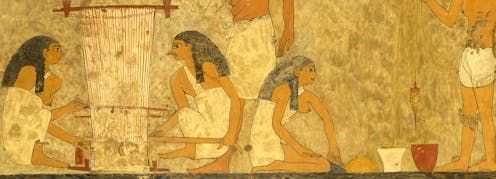
This corroborates evidence from visual art of textile workshops from the same period.
Work life, home life
Archaeological evidence suggests textile production occurred both within homes and in dedicated workshops.
Evidence from the excavations at Elephantine suggests homes had several rooms with multiple purposes, including courtyards, entrance vestibules, kitchens with ovens (recognisable by blackened walls and ash deposits), and possible stairs leading to roof spaces.
Privacy would have been limited. Daily life would have included close interaction with animals, as evidenced by attached animal pens.
More recently, close to the house where the provision list was discovered, archaeologists found needles, spindles, shuttles, and remains of pegs for a large loom.
These were found both inside houses and in the courtyards attached to them.
It’s hard to know what exactly these buildings were for; they probably served multiple purposes.
Lives shaped by class and legal status
Not all girls at Elephantine had the same experience of life. The town’s position at Egypt’s southern frontier in this period meant it was home to diverse populations, which included migrants, enslaved people and transitory workers.
A letter dating to the reign of King Amenemhat III documents some families, including women and children, arriving at Elephantine seeking work during a famine in their home region.

This evidence can be compared to a legal document from the same time period but from another Egyptian town, El Lahun. This document mentions the purchase and transfer of enslaved women and infants who are called Aamut, referring to a region in West Asia. The document shows they have been given new Egyptian names.
These documents remind us factors such as class and legal status have always profoundly shaped girls’ lives.
Valuing the work of girls
Accessing the everyday thoughts, feelings, and perspectives of many ancient people, especially children, is challenging for historians. We don’t, for instance, have a wealth of personal diaries from ancient Egypt to learn about girls’ interior lives.
But what’s clear is that girls were not merely passive participants in society. They were active economic contributors, who often received formal compensation for their work.
Historians must always look beyond elite contexts to incorporate diverse evidence types – administrative documents, archaeological remains, and artistic representations – to construct a more complete picture of ancient lives.
Authors: Julia Hamilton, Lecturer in History and Archaeology, Macquarie University


















