

maybe our pampered pets would be better off without us
- Written by: Nancy Cushing, Associate professor, University of Newcastle
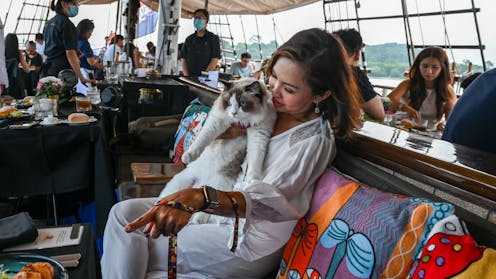
Pet-keeping is often promoted for the benefits it brings humans. A close association with another animal can provide us with a sense of purpose and a daily dose of joy. It can aid our health, make us more conscientious and even help us form relationships with other humans.
But the situation is perhaps not as rosy for the animal itself. Domesticated animals often live longer than their free-living counterparts, but the quality of those lives can be compromised. Pets can be fed processed foods that can lead to obesity. Many are denied a sexual life and experience of parenthood. Exercise can be limited, isolation is common and boredom must be endured.
In the worst cases, pets suffer due to selective breeding practices, physical abuse and unethical commercial breeding.
Is this the best life for the species we feel closest to? This question was raised for me when I heard the story of Valerie, the dachshund recaptured in April this year after almost 18 months living on her own on South Australia’s Karta Pintingga/Kangaroo Island.
Valerie: the story that captivated a nation
Valerie, a miniature dachshund, escaped into the bush during a camping trip on Kangaroo Island in November 2023. After several days of searching, her bereft humans returned to their home in New South Wales. They assumed the tiny dog, who had lived her life as a “little princess”, was gone forever.
Fast-forward a year, and sightings were reported on the island of a small dog wearing a pink collar. Word spread and volunteers renewed the search. A wildlife rescue group designed a purpose-built trap, fitting it out with items from Valerie’s former home.
After several weeks, a remotely controlled gate clattered shut behind Valerie and she was caught.
Cue great celebrations. The searchers were triumphant and the family was delighted. Social media lit up. It was a canine reenactment of one of settler Australia’s enduring narratives: the lost child rescued from the hostile bush.
A dog’s-eye view
But imagine if Valerie’s story was told from a more dog-centred perspective. Valerie found herself alone in a strange place and took the opportunity to run away. She embarked on a new life in which she was responsible for herself and could exercise the intelligence inherited from her boar-hunting ancestors.
No longer required to be a good girl, Valerie applied her own judgement – that notorious dachshund “stubbornness” – to evade predators, fill her stomach and pass her days.
Some commentators assumed Valerie must have been fed by anonymous benefactors – reflecting a widely held view that pets have limited abilities.
Veterinary experts, however, said her diet likely consisted of small birds, mammals and reptiles she killed herself – as well as roadkill, other carrion and faeces.
Valerie was clearly good at life on the lam. Unlike the human competitors in the series Alone Australia, she did not waste away when left in an island wilderness. Instead, she gained 1.8 kg of muscle – and was so stocky she no longer fit the old harness her humans brought to collect her. She had literally outgrown her former bonds.
Valerie could have sought shelter with the island’s humans at any time, but chose not to. She had to be actively trapped. Once returned to her humans, she needed time to reacclimatise to life as a pet.
Not all missing pets thrive in the wild. But all this raises the question of whether Valerie’s rescue would be better understood as a forced return from a full life of freedom, to a diminished existence in captivity?
A long history of pets thriving in the wild
Other examples exist which suggest an animal’s best life can take place outside the constraints of being a pet.
Exotic parrots have fled lives in cages to form urban flocks. In the United States, 25 species initially imported as pets have set up set up self-sustaining, free-living populations across 23 states.
Or take the red-eared slider turtle, which is native to parts of the US and Mexico. It’s illegal to keep the turtles as pets in Australia, but some of those smuggled in have later been released into urban wetlands where they have established large and widespread populations.
Cats are perhaps the most notorious example of escaped pets thriving on their own in Australia. They numbers in the millions, in habitats from cities to the Simpson Desert to the Snowy Mountains, showing how little they need human assistance.
One mark of their success is their prodigious size. At up to 7kg, free-living cats can be more than twice the weight of the average domestic cat.
Around the world, exotic former companion mammals, birds, fish, reptiles, amphibians and insects have all established populations large enough to pose problems for other species.
Rethinking animals as pets
Of course, I am not advocating that pets be released to the wild, creating new problems. But I do believe current pet-keeping practices are due for reconsideration.
A dramatic solution would be to take the animal out of the pet relationship. Social robots that look like seals and teddy bears are already available to welcome you home, mirror your emotions and offer up cuddles without the cost to other animals.
A less radical option is to rethink the idea of animals as “pets” and instead see them as equals.
Some people already enjoy these unforced bonds. Magpies, for example, are known to have strong allegiances with each other and are sometimes willing to extend those connections to humans in multi-species friendships.
As for Valerie, she did make “her little happy sounds” when reunited with her humans. But she might look back with nostalgia to her 529 days of freedom on Kangaroo Island.
Authors: Nancy Cushing, Associate professor, University of Newcastle


















