

How do sleep trackers work, and are they worth it? A sleep scientist breaks it down
- Written by: Dean J. Miller, Senior Lecturer, Appleton Institute, HealthWise Research Group, CQUniversity Australia
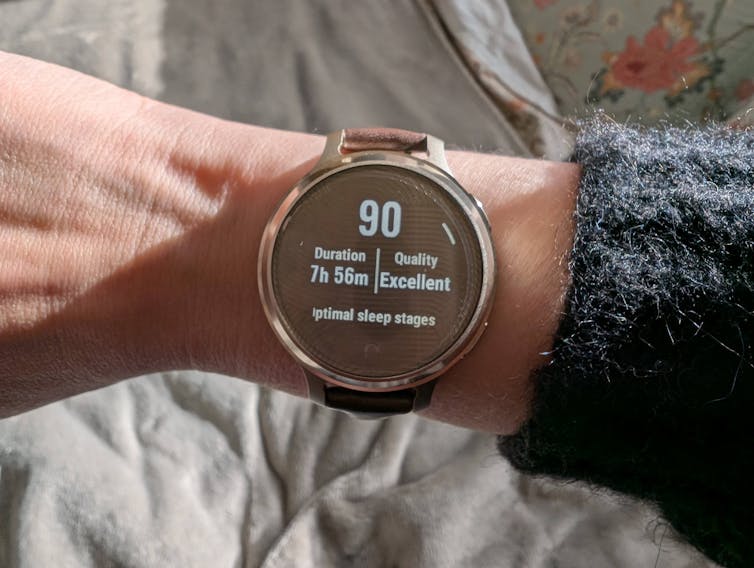
Many smartwatches, fitness and wellness trackers now offer sleep tracking among their many functions.
Wear your watch or ring to bed, and you’ll wake up to a detailed sleep report telling you not just how long you slept, but when each phase happened and whether you had a good night’s rest overall.
Surfing is done in the ocean, planes fly in the sky, and sleep occurs in the brain. So how can we measure sleep from the wrist or finger?
The gold standard of sleep measurement
If you’ve ever had a sleep study or seen someone with dozens of wires attached to their head, body and face, you’ve encountered polysomnography or PSG.
Eye movements, muscle tone, heart rate and brain activity are measured and assessed by experts to detect which stage of sleep or wakefulness a person is in.
When we sleep, we cycle through different stages, generally classified as light sleep, slow-wave sleep (also known as deep sleep), and rapid eye movement or REM sleep.
Each stage has an effect on brain activity, muscle tone and heart rate – which is why sleep scientists need so many wires.
Accurate? Absolutely. Convenient? Like two left shoes.
This is where the convenience of wearable at-home sleep trackers comes in.
What sensors are in sleep trackers?
Since the 1990s, sleep researchers have been using actigraphy to measure people’s sleep outside the laboratory.
An actigraphy device is similar to a wristwatch and uses accelerometers to measure the person’s movement. Coupled with sleep diaries, actigraphy assumes a person is awake when they’re moving and asleep when still. Simple.
While this is a scientifically accepted method of estimating sleep, it’s prone to mislabelling being awake but at rest (such as when reading a book) as sleep.
There’s one key addition that makes wrist-worn sleep trackers more accurate – PPG or photoplethysmography.
It’s hard to pronounce, but photoplethysmography is a key driver in the explosion of wearable health tracking.
It uses those little green lights on the skin-side of the wearable to track the amount of blood passing through your wrist at any given time. Clip-on pulse oximeters used by doctors are the same type of tech.
The addition of PPG to a wrist tracker allows for the measurement of raw data like heart rate and breathing rate. From this data, the wearable can estimate a number of physiological metrics, including sleep stages.
Since fitness wearables already have accelerometers and PPG to track your physical activity and heart rate, it makes sense to use these sensors to track sleep too. But how accurate are they?

How do scientists test sleep trackers?
Two main factors determine the accuracy of sleep trackers. How well does the device detect whether you’re asleep or awake? And how well can it distinguish the sleep stages?
To answer these questions, sleep scientists conduct validation studies. Participants sleep overnight in a laboratory while wearing both a sleep tracker and undergoing PSG.
Then, scientists compare the data from both methods in 30-second blocks called “epochs”. That means for a nine-hour sleep there will be 1,080 epochs to compare.
If both the device and PSG indicate “sleep” for the same epoch, they’re in agreement. If the device indicates “wake” and PSG indicates “sleep” for the same epoch, that’s considered an error. The same is done for sleep stages.
How accurate are sleep trackers?
In a 2022 study of several popular trackers, most correctly identified more than 90% of sleep epochs. But because light sleep and restful wake are so similar, wearables struggle more to estimate wakefulness, correctly identifying between 26% and 73% of wake epochs.
When it comes to sleep stages, wearables are less precise, correctly identifying between 53% and 60% of sleep stage epochs. However, for some devices and some sleep stages the precision can be greater. A recent validation study showed that a latest generation ring-shaped wearable didn’t differ from PSG for estimating light sleep and slow wave sleep.
In short, most modern sleep trackers do a decent job of estimating your total sleep each night. Some are more accurate for sleep staging, but this level of detail isn’t essential for improving the basics of your sleep.
Do I need a sleep tracker?
If you’re struggling with sleep, you should speak to your doctor. A sleep tracker can be a useful tool to help track your sleep goals, but ultimately your behaviour is what will improve sleep.
Keeping regular bedtimes and wake-up times, having a distraction-free sleep space, and keeping home lighting low in the evenings can all help to improve your sleep.
If you love tracking your sleep, make sure your device has been independently validated. While sleep stage data may not be essential, devices that perform well in estimating sleep stage also tend to be more accurate at detecting when you’re asleep or awake. When reviewing your data, look at long term trends in sleep rather than day-to-day variability.
If you don’t love your sleep tracker, you can take it off or ignore it. For some people, access to sleep data can negatively impact sleep by creating stress and anxiety for getting a perfect night’s sleep. Instead, focus on improving your healthy sleep strategies and pay attention to how you feel during the day.
Authors: Dean J. Miller, Senior Lecturer, Appleton Institute, HealthWise Research Group, CQUniversity Australia


















