why traditional Persian music should be known to the world
- Written by: Darius Sepehri, Doctoral Candidate, Comparative Literature, Religion and History of Philosophy, University of Sydney
Weaving through the rooms of my Brisbane childhood home, carried on the languid, humid, sub-tropical air, was the sound of an Iranian tenor singing 800-year old Persian poems of love. I was in primary school, playing cricket in the streets, riding a BMX with the other boys, stuck at home reading during the heavy rains typical of Queensland.
I had an active, exterior life that was lived on Australian terms, suburban, grounded in English, and easy-going. At the same time, thanks to my mother’s listening habits, courtesy of the tapes and CDs she bought back from trips to Iran, my interior life was being invisibly nourished by something radically other, by a soundscape invoking a world beyond the mundane, and an aesthetic dimension rooted in a sense of transcendence and spiritual longing for the Divine.
I was listening to traditional Persian music (museghi-ye sonnati). This music is the indigenous music of Iran, although it is also performed and maintained in Persian-speaking countries such as Afghanistan and Tajikistan. It has ancient connections to traditional Indian music, as well as more recent ones to Arabic and Turkish modal music.
It is a world-class art that incorporates not only performance but also the science and theory of music and sound. It is, therefore, a body of knowledge, encoding a way of knowing the world and being. The following track is something of what I might have heard in my childhood:
Playing kamancheh, a bowed spike-fiddle, is Kayhān Kalhor, while the singer is the undisputed master of vocals in Persian music, ostād (meaning “maestro”) Mohammad Reza Shajarian. He is singing in the classical vocal style, āvāz, that is the heart of this music.
A non-metric style placing great creative demands on singers, āvāz is improvised along set melodic lines memorised by heart. Without a fixed beat, the vocalist sings with rhythms resembling speech, but speech heightened to an intensified state. This style bears great similarity to the sean-nos style of Ireland, which is also ornamented and non-rhythmic, although sean-nos is totally unaccompanied, unlike Persian āvāz in which the singer is often accompanied by a single stringed instrument.
A somewhat more unorthodox example of āvāz is the following, sung by Alireza Ghorbāni with a synthesised sound underneath his voice rather than any Persian instrument. It creates a hypnotic effect.
Even listeners unfamiliar with Persian music should be able to hear the intensity in the voices of Ghorbāni and Shajarian. Passion is paramount, but passion refined and sublimated so that longing and desire break through ordinary habituated consciousness to point to something unlimited, such as an overwhelming sense of the beyond.
Beyond media contrived images
The traditional poetry and music of Iran aim to create a threshold space, a zone of mystery; a psycho-emotional terrain of suffering, melancholy, death and loss, but also of authentic joy, ecstasy, and hope.
Iranians have tasted much suffering throughout their history, and are wary of being stripped of their identity. Currently, economic sanctions are being re-applied to Iran’s entire civilian population, depriving millions of ordinary people of medicine and essentials.
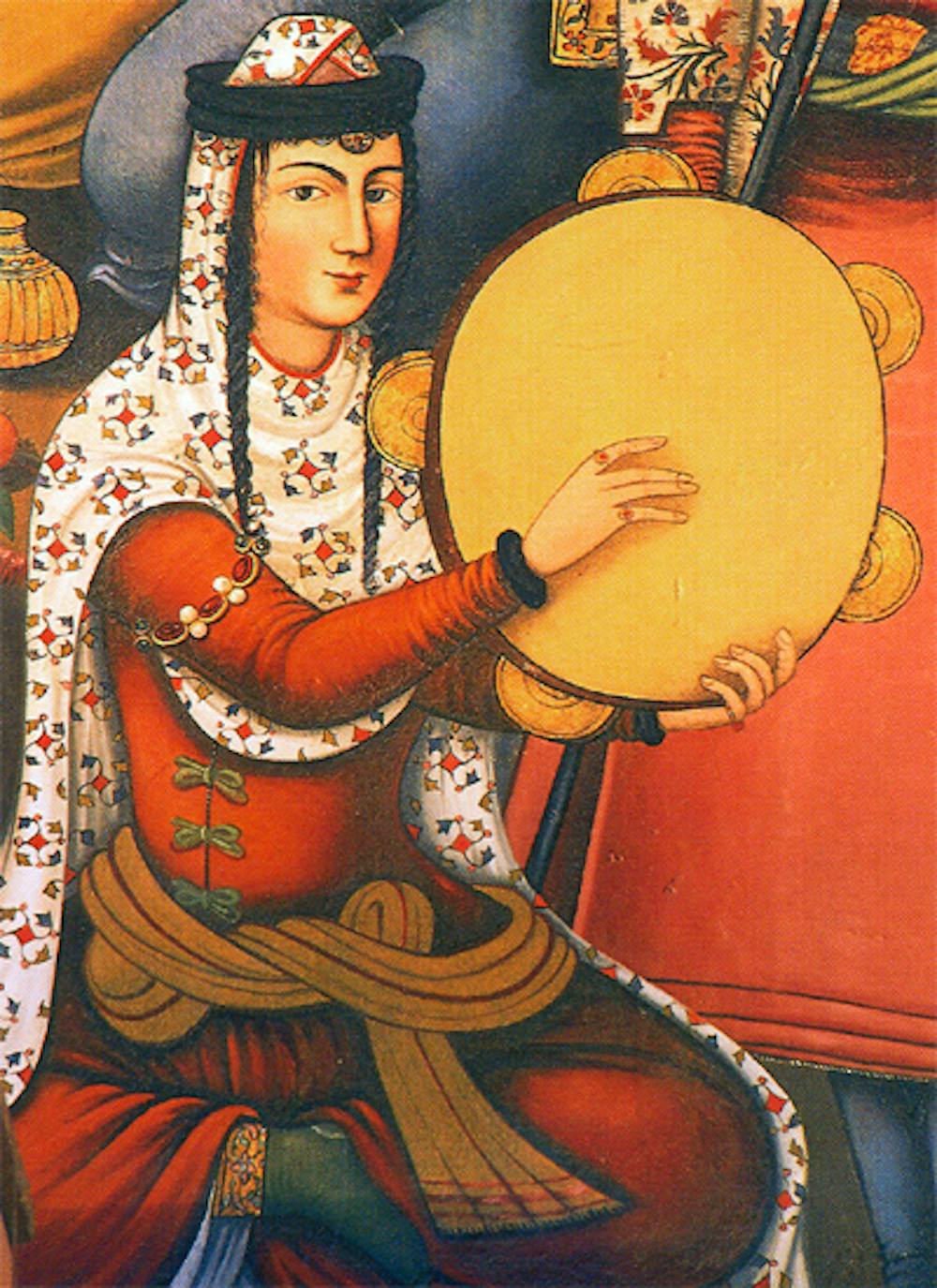 A Persian woman playing the Daf, a frame drum, from a painting on the walls of Chehel-sotoon palace, Isfahan, 17th century.
Wikimedia Commons
A Persian woman playing the Daf, a frame drum, from a painting on the walls of Chehel-sotoon palace, Isfahan, 17th century.
Wikimedia Commons
Traditional Persian music matters in this context of escalating aggression because it is a rich, creative artform, still living and cherished. It binds Iranians in a shared culture that constitutes the authentic life of the people and the country, as opposed to the contrived image of Iran presented in Western media that begins and ends with politics.
This is a thoroughly soulful music, akin not in form but in soulfulness with artists such as John Coltrane or Van Morrison. In the Persian tradition, music is not only for pleasure, but has a transformative purpose. Sound is meant to effect a change in the listener’s consciousness, to bring them into a spiritual state (hāl).
Like other ancient systems, in the Persian tradition the perfection of the formal structures of beautiful music is believed to come from God, as in the Pythagorean phrase, the “music of the spheres.”
Because traditional Persian music has been heavily influenced by Sufism, the mystical aspect of Islam, many rhythmic performances (tasnif, as opposed to āvāz) can (distantly) recall the sounds of Sufi musical ceremonies (sama), with forceful, trance-inducing rhythms. (For instance in this Rumi performance by Alireza Eftekhari).
Even when slow, traditional Persian music is still passionate and ardent in mood, such as this performance of Rumi by Homayoun Shajarian, son of Mohammad-Reza:
Another link with traditional Celtic music is the grief that runs through Persian music, as can be heard in this instrumental by Kalhor.
Grief and sorrow always work in tandem with joy and ecstasy to create soundscapes that evoke longing and mystery.
Connections with classical poetry
The work of classical poets such as Rumi, Hāfez, Sa’di, Attār, and Omar Khayyām forms the lyrical basis of compositions in traditional Persian music. The rhythmic structure of the music is based on the prosodic system that poetry uses (aruz), a cycle of short and long syllables.
Singers must therefore be masters not only at singing but know Persian poetry and its metrical aspects intimately. Skilled vocalists must be able to interpret poems. Lines or phrases can be extended or repeated, or enhanced with vocal ornaments.
Thus, even for a Persian speaker who knows the poems being sung, Persian music can still reveal new interpretations. Here, for example (from 10:00 to 25:00 mins) is another example of Rumi by M.R. Shajarian:
This is a charity concert from 2003 in Bam, Iran, after a horrendous earthquake destroyed the town. Rumi’s poem is renowned among Persian speakers, but here Mohammad-Reza Shajarian sings it with such passion and emotional intensity that it sounds fresh and revelatory.
“Without everyone else it’s possible,” Rumi says, “Without you life is not liveable.”
While such lines are originally drawn from the tradition of non-religious love poems, in Rumi’s poems the address to the beloved becomes mystical, otherworldly. After a tragedy such as the earthquake, these lyrics can take on special urgency in the present.
When people listen to traditional music, they, like the singers, remain still. Audiences are transfixed and transported.
According to Sufi cosmology, all melodious sounds erupt forth from a world of silence. In Sufism, silence is the condition of the innermost chambers of the human heart, its core (fuad), which is likened to a throne from which the Divine Presence radiates.
Because of this connection with the intelligence and awareness of the heart, many performers of traditional Persian music understand that it must be played through self-forgetting, as beautifully explained here by master Amir Koushkani:
Persian music has roughly twelve modal systems, each known as a dastgah. Each dastgah collects melodic models that are skeletal frameworks upon which performers improvise in the moment. The spiritual aspect of Persian music is made most manifest in this improvisation.
Shajarian has said that the core of traditional music is concentration (tamarkoz), by which he means not only the mind but the whole human awareness. It is a mystical and contemplative music.
The highly melodic nature of Persian music also facilitates expressiveness. Unlike Western classical music, there is very sparing use of harmony. This, and the fact that like other world musical traditions it includes microtonal intervals, may make traditional Persian music odd at first listen for Western audiences.
Solo performances are important to traditional Persian music. In a concert, soloists may be accompanied by another instrument with a series of call-and-response type echoes and recapitulations of melodic phrases.
Similarly, here playing the barbat, a Persian variant of the oud, maestro Hossein Behrooznia shows how percussion and plucked string instruments can forge interwoven melodic structures that create hypnotic soundscapes:
Ancient roots
The roots of traditional Persian music go back to ancient pre-Islamic Persian civilisation, with archaeological evidence of arched harps (a harp in the shape of a bow with a sound box at the lower end), having been used in rituals in Iran as early as 3100BC.
Under the pre-Islamic Parthian (247BC-224AD) and Sasanian (224-651AD) kingdoms, in addition to musical performances on Zoroastrian holy days, music was elevated to an aristocratic art at royal courts.
Centuries after the Sasanians, after the Arab invasion of Iran, Sufi metaphysics brought a new spiritual intelligence to Persian music. Spiritual substance is transmitted through rhythm, metaphors and symbolism, melodies, vocal delivery, instrumentation, composition, and even the etiquette and co-ordination of performances.
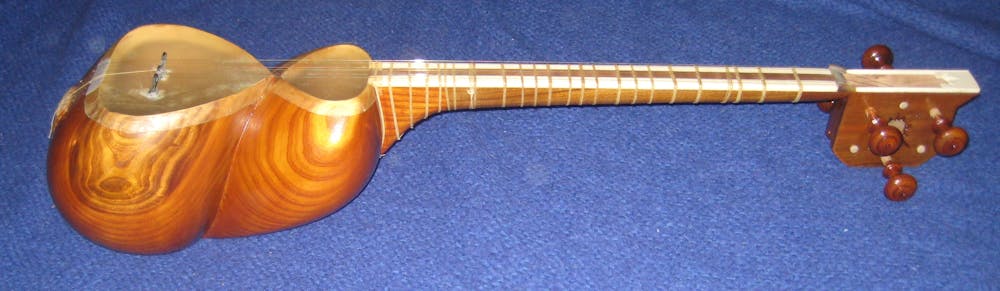 A six-string fretted lute, known as a tār.
Wikimedia Commons
A six-string fretted lute, known as a tār.
Wikimedia Commons
The main instruments used today go back to ancient Iran. Among others, there is the tār, the six-stringed fretted lute; ney, the vertical reed flute that is important to Rumi’s poetry as a symbol of the human soul crying out in joy or grief; daf, a frame drum important in Sufi ritual; and the setār, a wooden four-stringed lute.
The tār, made of mulberry wood and stretch lambskin, is used to create vibrations that affect the heart and the body’s energies and a central instrument for composition. It is played here by master Hossein Alizadeh and here by master Dariush Talai.
Music, gardens, and beauty
Traditional Persian music not only cross-pollinates with poetry, but with other arts and crafts. At its simplest, this means performing with traditional dress and carpets on stage. In a more symphonic mode of production, an overflow of beauty can be created, such as in this popular and enchanting performance by the group Mahbanu:
They perform in a garden: of course. Iranians love gardens, which have a deeply symbolic and spiritual meaning as a sign or manifestation of Divine splendour. Our word paradise, in fact, comes from the Ancient Persian word, para-daiza, meaning “walled garden”. The walled garden, tended and irrigated, represents in Persian tradition the cultivation of the soul, an inner garden or inner paradise.
The traditional costumes of the band (as with much folk dress around the world) are elegant, colourful, resplendent, yet also modest. The lyrics are tinged with Sufi thought, the poet-lover lamenting the distance of the beloved but proclaiming the sufficiency of staying in unconsumed desire.
As a young boy, I grasped the otherness of Persian music intuitively. I found its timeless spiritual beauty and interiority had no discernible connection with my quotidian, material Australian existence.
Persian music and arts, like other traditional systems, gives a kind of “food” for the soul and spirit that has been destroyed in the West by the dominance of rationalism and capitalism. For 20 years since my boyhood, traditional Persian culture has anchored my identity, healed and replenished my wounded heart, matured my soul, and allowed me to avoid the sense of being without roots in which so many unfortunately find themselves today.
It constitutes a world of beauty and wisdom that is a rich gift to the whole world, standing alongside Irano-Islamic architecture and Iranian garden design.
The problem is the difficulty of sharing this richness with the world. In an age of hypercommunication, why is the beauty of Persian music (or the beauty of traditional arts of many other cultures for that matter) so rarely disseminated? Much of the fault lies with corporate media.
Brilliant women
Mahbanu, who can also be heard here performing a well-known Rumi poem, are mostly female. But readers will very likely not have heard about them, or any of the other rising female musicians and singers of Persian music. According to master-teachers such as Shajarian, there are now often as many female students as male in traditional music schools such as his.
Almost everyone has seen however, through corporate media, the same cliched images of an angry mob of Iranians chanting, soldiers goose-stepping, missile launches, or leaders in rhetorical flight denouncing something. Ordinary Iranian people themselves are almost never heard from directly, and their creativity rarely shown.
The lead singer of the Mahbanu group, Sahar Mohammadi, is a phenomenally talented singer of the āvāz style, as heard here, when she performs in the mournful abu ata mode. She may, indeed, be the best contemporary female vocalist. Yet she is unheard of outside of Iran and small circles of connoisseurs mainly in Europe.
A list of outstanding modern Iranian women poets and musicians requires its own article. Here I will list some of the outstanding singers, very briefly. From an older generation we may mention the master Parisa (discussed below), and Afsaneh Rasaei. Current singers of great talent include, among others, Mahdieh Mohammadkhani, Homa Niknam, Mahileh Moradi, and the mesmerising Sepideh Raissadat.
Finally, one of my favourites is the marvelous Haleh Seifizadeh, whose enchanting singing in a Moscow church suits the space perfectly.
The beloved Shajarian
Tenor Mohammad-Reza Shajarian is by far the most beloved and renowned voice of traditional Persian music. To truly understand his prowess, we can listen to him performing a lyric of the 13th century poet Sa’di:
As heard here, traditional Persian music is at once heavy and serious in its intent, yet expansive and tranquil in its effect. Shajarian begins by singing the word Yār, meaning “beloved”, with an ornamental trill. These trills, called tahrir, are made by rapidly closing the glottis, effectively breaking the notes (the effect is reminiscent of Swiss yodeling).
By singing rapidly and high in the vocal range, a virtuoso display of vocal prowess is created imitating a nightingale, the symbol with whom the poet and singer are most compared in Persian traditional music and poetry. Nightingales symbolise the besotted, suffering, and faithful lover. (For those interested, Homayoun Shajarian, explains the technique in this video).
As with many singers, the great Parisa, heard here in a wonderful concert from pre-revolutionary Iran, learned her command of tahrir partly from Shajarian. With her voice in particular, the similarity to a nightingale’s trilling is clear.
Nourishing hearts and souls
The majority of Iran’s 80 million population are under 30 years of age. Not all are involved in traditional culture. Some prefer to make hip-hop or heavy-metal, or theatre or cinema. Still, there are many young Iranians expressing themselves through poetry (the country’s most important artform) and traditional music.
National and cultural identity for Iranians is marked by a sense of having a tradition, of being rooted in ancient origins, and of carrying something of great cultural significance from past generations, to be preserved for the future as repository of knowledge and wisdom. This precious thing that is handed down persists while political systems change.
Iran’s traditional music carries messages of beauty, joy, sorrow and love from the heart of the Iranian people to the world. These messages are not simply of a national character, but universally human, albeit inflected by Iranian history and mentality.
This is why traditional Persian music should be known to the world. Ever since its melodies first pierced my room in Brisbane, ever since it began to transport me to places of the spirit years ago, I’ve wondered if it could also perhaps nourish the hearts and souls of some of my fellow Australians, across the gulf of language, history, and time.
Authors: Darius Sepehri, Doctoral Candidate, Comparative Literature, Religion and History of Philosophy, University of Sydney