

Drone footage captured orcas crafting tools out of kelp – and using them for grooming
- Written by: Vanessa Pirotta, Postdoctoral Researcher and Wildlife Scientist, Macquarie University
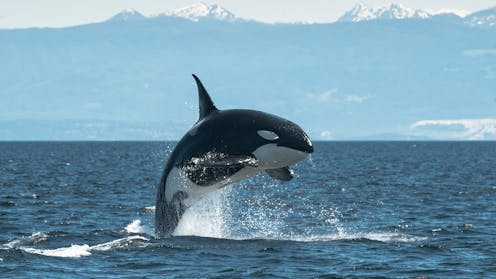
The more we learn about orcas, the more remarkable they are. These giant dolphins are the ocean’s true apex predator, preying on great white sharks and other lesser predators.
They’re very intelligent and highly social. Their clans are matrilineal, centred around a older matriarch who teaches her clan her own vocalisations. Not only this, but the species is one of only six known to experience menopause, pointing to the social importance of older females after their reproductive years. Different orca groups have fashion trends, such as one pod who returned to wearing salmon as a hat, decades after it went out of vogue.
But for all their intelligence, one thing has been less clear. Can orcas actually make tools, as humans, chimps and other primates do? In research out today by United States and British researchers, we have an answer: yes.
Using drones, researchers watched as resident pods in the Salish Sea broke off the ends of bull kelp stalks and rolled them between their bodies. This, the researchers say, is likely to be a grooming practice – the first tool-assisted grooming seen in marine animals.
This video shows whales using kelp tools in what appears to be social grooming behaviour. Credit: Center for Whale Research.Self kelp: why would orcas make tools?
Tool use and tool making have been well documented in land-based species. But it’s less common among marine species. This could be partly due to the challenge of observing them.
This field of research expands what we know these animals are capable of. Not only are orcas spending time making kelp into a grooming tool, but they’re doing it socially – two orcas have to work together to rub the kelp against their bodies.
To make the tool, the orcas use their teeth to grab a stalk of kelp by its “stipe” – the long, narrow part near the seaweed’s holdfast, where it tethers to the rock. They use their teeth, motion of their body and the drag of the kelp to break off a piece of this narrow stipe.
Next, they approach a social partner, flip the length of the kelp onto their rostrum (their snout-like projection) and press their head and the kelp against their partner’s flank. The two orcas use their fins and flukes to trap the kelp while rolling it between their bodies. During this contact, the orcas would roll and twist their bodies – often in an exaggerated S-shaped posture. A similar posture has been seen among orcas in other groups, who adopt it when rubbing themselves on sand or pebbles.
Why do it? The researchers suggest this practise may be social skin-maintenance. Bottlenose dolphin mothers are known to remove dead skin from their calves using flippers, while tool-assisted grooming of a partner has been seen in primates, but infrequently and usually in captivity.
Orcas across different social groups, ages and genders were seen doing this. But they were more likely to groom close relatives or those of similar age. There was some evidence suggesting whales with skin conditions were more likely to do the kelp-based grooming.
Humpback whales are known to wear kelp in a practice known as “kelping”. But this study covers a different behaviour, which the authors dub “allokelping” (kelping others).

A surprise from well-studied pods
Interestingly, this new discovery comes from some of the most well-studied and famous orcas in the world – a group known as the southern resident killer whales. If you were a child of the 90s, you would have seen them in the opening scene of Free Willy, the movie which set me on my path to study cetaceans.
These orcas consist of three pods known as J, K and L pods. Each live in the Salish Sea in the Pacific Northwest on the border of Canada and the US.
Researchers fly drones over these resident pods most days and have access to almost 50 years of observations. But this is the first time the tool-making behaviour has been seen.
Unfortunately, these pods are critically endangered. They’re threatened by sound pollution from shipping, polluted water, vessel strike and loss of their main food source – Chinook salmon.

Orcas are smart
In one sense, the findings are not a surprise, given the intelligence of these animals.
In the Antarctic, orcas catch seals by making waves to wash them off ice floes. Before European colonisation, orcas and First Nations groups near Eden hunted whales together.
They can mimic human speech, while different groups have their own dialects. These animals are awe-inspiring – and sometimes baffling, as when a pod began biting or attacking boats off the Iberian peninsula.
While orcas are often called “killer whales”, they’re not whales. They’re the biggest species of dolphin, growing up to nine metres long. They’re found across all the world’s oceans.
Within the species, there’s a surprising amount of diversity. Scientists group orcas into different ecotypes – populations adapted to local conditions. Different orca groups can differ substantially, from size to prey to habits. For instance, transient orcas cover huge distances seeking larger prey, while resident orcas stick close to areas with lots of fish.
Not just a fluke
Because orcas differ so much, we don’t know whether other pods have discovered or taught these behaviours.
But what this research does point to is that tool making may be more common among marine mammals than we expected. No hands – no problem.
Authors: Vanessa Pirotta, Postdoctoral Researcher and Wildlife Scientist, Macquarie University


















