Australia’s university system is ‘battered’ and ‘broken’ – a new book surveys the wreckage and offers some solutions
- Written by Susan Forde, Professor, Media and Journalism, Griffith University
The Australian university sector has come under considerable pressure in recent years. It is currently in a parlous state.
Controversy swirls around hundreds of millions of dollars in underpayments to casual staff. Obscene salaries are paid to senior executives. Weekly announcements of course cuts and staff redundancies send a clear message that this is a sector in crisis.
For Emeritus Professor Graeme Turner, a highly respected humanities scholar and advisor to various governments and industry bodies, the Australian university sector is “broken”.
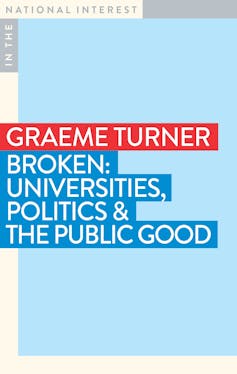
Review: Broken: Universities, Politics and the Public Good – Graeme Turner (Monash University Press)


Turner highlights the fact that the important Universities Accord review offered strong recommendations for structural change, but did not adequately consider the sector from the point of view of the academics working within it.
More than 50% of teaching is now delivered by casual staff on short-term contracts. Academic staff are experiencing burnout and high levels of dissatisfaction.
Turner describes the all-too-familiar quandary of young academics coming in to the profession. They face high teaching loads, insecure employment, periods of time with no pay in between semesters, and pressure to continue to publish their own research (unpaid), just to give themselves the smallest chance of achieving full-time ongoing work.
This situation, Turner says, has “become endemic, and there is no doubt that it will have long-term consequences […] we are rapidly burning through our next generation of university teachers and researchers”.
He writes of the “lack of hope in the future, the sense of resignation in response to institutional change they have no capacity to reverse, that is now firmly embedded in the sector’s workforce”.
The Dawkins reforms
Though things are undoubtedly coming to a head, the origins of the current crisis go a long way back. The sweeping Dawkins reforms, named after John Dawkins, education minister in the Hawke and Keating governments, began in 1987. They marked the start of the corporatisation of Australian universities.
Dawkins forced mergers between existing universities and colleges of advanced education, targeted research funding to areas considered essential to economic growth and placed a greater emphasis on universities finding new ways to fund their activities. These patterns have continued, with increasing verve, into the new millennium.
 John Dawkins.
National Archives of Australia/AAP
John Dawkins.
National Archives of Australia/AAP
The changes have led to a deteriorating relationship between academic staff and senior management, who have become increasingly managerial and corporate in their orientation. A recent article by investigative journalist Rick Morton highlights this in detail. Morton exposes the close and costly relationships between a number of Australian universities and wealthy consultancy firms. These relationships, sources told Morton, have contributed to the “mind-boggling stupidity” of some executive decisions.
“Even when senior managers have strong academic roots,” observes Turner, “they tend, over time, to more thoroughly identify with their current managerial role […] Many vice chancellors now operate more like a CEO than an academic leader. This looks like an implicit surrender to the practices and values of business.”
The detrimental impact of policies that force universities to be entrepreneurial is at the heart of Turner’s argument.
One of the biggest sources of additional funding is international students, who can be charged high fees for both undergraduate and postgraduate study. At the University of Sydney (and indeed many Group of Eight universities), international students constitute almost 50% of the student body.
They deliver significant financial benefits to the institution. But this, in turn, makes the sector vulnerable to geopolitical shifts, international pandemics and changing government policies around international students.
Government interventions
The system has been further “broken” by some governments’ attempts to politically intervene in the grant application process. This process is traditionally protected by rigorous peer review, independent analysis, and various levels of expert review.
In 2004 and 2005 under the Howard government, and again in 2017 and 2018 under the Morrison government, education ministers rejected the recommendations of the Australian Research Council’s College of Experts. They refused to sign off on grants that had been recommended for funding, most of them from within the humanities and social sciences.
Prime minister Scott Morrison appealed to an anti-intellectual streak in Australian society when he condemned
any university that, you know, keeps itself separate from the rest of the community and walks around in gowns and looks down on everybody. And, you know, only looks at things that are [not] remotely interesting to anyone.
He was backed up with relish by Rupert Murdoch’s News Corp and Sky News. The Australian newspaper and other News Corp mastheads supported education minister Simon Birmingham’s decision to veto “absurd research”. The right-wing think tank the Institute of Public Affairs argued that Birmingham had “saved Australians around $4.2 million by vetoing 11 utterly useless Australian Research Council grants”.
Turner describes the government interventions as a corruption of an assessment process that prides itself on its independence from political interference. He argues they brought Australian research into international disrepute.
Further politicisation of universities occurred with the Morrison government’s Job-Ready Graduates package. Bachelor of Arts students now leave university with a debt in the realm of $50,000. Communications students being trained at the forefront of digital and social media are lumbered with a similar debt, even though these graduates are unlikely to be working in highly paid industries anytime soon after graduation.
Despite the Albanese government’s assertion that this policy needed to be reversed, it remains in place.
 Scott Morrison’s government wanted university graduates to be ‘job ready’.
Morgan Sette/AAP
Scott Morrison’s government wanted university graduates to be ‘job ready’.
Morgan Sette/AAP
Potential solutions
While Turner describes the system as “battered” and “broken”, he offers some solutions. These are complex, due to the difficulties of reversing decades of poor policy, neglect and problematic organisational shifts.
Turner argues that an immediate injection of substantial funding is required to make up for lost decades, but recognises this is unlikely. Instead, he focuses on how current funding could be allocated more effectively and efficiently.
Firstly, the sector should be strategically redesigned not to be a competitive marketplace for students and research income. Different purposes and trajectories should be established for individual institutions.
This would assist regional universities, which struggle to compete with their metropolitan counterparts, especially the Group of Eight universities, which attract the vast majority of major grants and students.
The announcement of the Australian Research Council Laureate Fellowship outcomes just last week was a demonstration of this inequity. The fellowships are the most prestigious of the council’s research schemes, providing $3-4 million over five years to individual researchers for large research programs. Of the 17 awarded, 13 went to Group of Eight universities. None went to a regional university.
A “planned investment system” that supports the sustainability of regional universities – so important to their communities and towns – is part of the solution.
 Graeme Turner.
Monash University Publishing
Graeme Turner.
Monash University Publishing
An “overarching structural and strategic plan” to support diversity and eliminate unnecessary duplication across metropolitan universities could also be part of the solution. Turner proposes a national audit to identify requirements for skills and training, maintain the viability of disciplines and “dislodge commercial self-interest as the prime driver of the leading universities’ operations”.
The research funding system also needs attention. Around 80% of people currently applying for funding to the major funding institution, the Australian Research Council, are unsuccessful.
There is an opportunity cost in applying for a grant with a very slim chance of success. Yet institutions continue to push researchers to pursue uncompetitive applications. On top of this, there is the high cost of research infrastructure at universities to support the constant grant application process.
Turner instead suggests a substantial allocation of the institutions’ block grant funding back to departments, centres or schools to support research activity. Time currently spent applying for grants could instead be spent working on actual research to build track records and competitiveness.
Broken is a comprehensive, evidence-based account of the flaws in the current system and the negative effects on staff, students and the national interest. Turner supports the establishment of the Australian Tertiary Education Commission to provide national oversight and strategic guidance. But the government’s current proposal, he argues, “falls well short of what will be required”.
The evidence suggests a major overhaul is required to remake Australia’s universities into institutions that attract, educate and enable students and academics, and drive the intellectual endeavour of our nation. Turner shows this cannot and will not be achieved under current circumstances. But there are solutions, if a government is prepared to take up the challenge.
Authors: Susan Forde, Professor, Media and Journalism, Griffith University