What did ancient Rome smell like? Honestly, often pretty rank
- Written by Thomas J. Derrick, Gale Research Fellow in Ancient Glass and Material Culture, Macquarie University
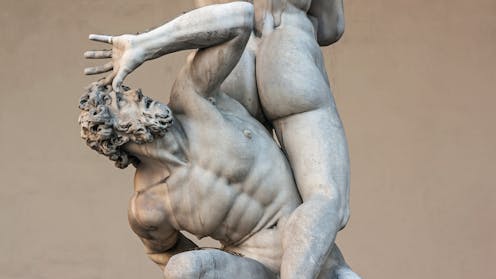
The roar of the arena crowd, the bustle of the Roman forum, the grand temples, the Roman army in red with glistening shields and armour – when people imagine ancient Rome, they often think of its sights and sounds. We know less, however, about the scents of ancient Rome.
We cannot, of course, go back and sniff to find out. But the literary texts, physical remains of structures, objects, and environmental evidence (such as plants and animals) can offer clues.
So what might ancient Rome have smelled like?
Honestly, often pretty rank
In describing the smells of plants, author and naturalist Pliny the Elder uses words such as iucundus (agreeable), acutus (pungent), vis (strong), or dilutus (weak).
None of that language is particularly evocative in its power to transport us back in time, unfortunately.
But we can probably safely assume that, in many areas, Rome was likely pretty dirty and rank-smelling. Property owners did not commonly connect their toilets to the sewers in large Roman towns and cities – perhaps fearing rodent incursions or odours.
Roman sewers were more like storm drains, and served to take standing water away from public areas.
Professionals collected faeces for fertiliser and urine for cloth processing from domestic and public latrines and cesspits. Chamber pots were also used, which could later be dumped in cesspits.
This waste disposal process was just for those who could afford to live in houses; many lived in small, non-domestic spaces, barely furnished apartments, or on the streets.
A common whiff in the Roman city would have come from the animals and the waste they created. Roman bakeries frequently used large lava stone mills (or “querns”) turned by mules or donkeys. Then there was the smell of pack animals and livestock being brought into town for slaughter or sale.

The large “stepping-stones” still seen in the streets of Pompeii were likely so people could cross streets and avoid the assorted feculence that covered the paving stones.
Disposal of corpses (animals and human) was not formulaic. Depending on the class of the person who had died, people might well have been left out in the open without cremation or burial.
Bodies, potentially decaying, were a more common sight in ancient Rome than now.
Suetonius, writing in the first century CE, famously wrote of a dog carrying a severed human hand to the dining table of the Emperor Vespasian.
Deodorants and toothpastes
In a world devoid of today’s modern scented products – and daily bathing by most of the population – ancient Roman settlements would have smelt of body odour.
Classical literature has some recipes for toothpaste and even deodorants.
However, many of the deodorants were to be used orally (chewed or swallowed) to stop one’s armpits smelling.
One was made by boiling golden thistle root in fine wine to induce urination (which was thought to flush out odour).
The Roman baths would likely not have been as hygienic as they may appear to tourists visiting today. A small tub in a public bath could hold between eight and 12 bathers.
The Romans had soap, but it wasn’t commonly used for personal hygiene. Olive oil (including scented oil) was preferred. It was scraped off the skin with a strigil (a bronze curved tool).
This oil and skin combination was then discarded (maybe even slung at a wall). Baths had drains – but as oil and water don’t mix, it was likely pretty grimy.
Scented perfumes
The Romans did have perfumes and incense.
The invention of glassblowing in the late first century BCE (likely in Roman-controlled Jerusalem) made glass readily available, and glass perfume bottles are a common archaeological find.

Animal and plant fats were infused with scents – such as rose, cinnamon, iris, frankincense and saffron – and were mixed with medicinal ingredients and pigments.
The roses of Paestum in Campania (southern Italy) were particularly prized, and a perfume shop has even been excavated in the city’s Roman forum.
The trading power of the vast Roman empire meant spices could be sourced from India and the surrounding regions.
There were warehouses for storing spices such as pepper, cinnamon and myrrh in the centre of Rome.
In a recent Oxford Journal of Archaeology article, researcher Cecilie Brøns writes that even ancient statues could be perfumed with scented oils.
Sources frequently do not describe the smell of perfumes used to anoint the statues, but a predominantly rose-based perfume is specifically mentioned for this purpose in inscriptions from the Greek city of Delos (at which archaeologists have also identified perfume workshops). Beeswax was likely added to perfumes as a stabiliser.
Enhancing the scent of statues (particularly those of gods and goddesses) with perfumes and garlands was important in their veneration and worship.
An olfactory onslaught
The ancient city would have smelt like human waste, wood smoke, rotting and decay, cremating flesh, cooking food, perfumes and incense, and many other things.
It sounds awful to a modern person, but it seems the Romans did not complain about the smell of the ancient city that much.
Perhaps, as historian Neville Morley has suggested, to them these were the smells of home or even of the height of civilisation.
Authors: Thomas J. Derrick, Gale Research Fellow in Ancient Glass and Material Culture, Macquarie University
Read more https://theconversation.com/what-did-ancient-rome-smell-like-honestly-often-pretty-rank-257111