

Citizens of the Great Barrier Reef: going beyond our backyard to protect the reef
- Written by: Georgina Gurney, Environmental Social Science Research Fellow, James Cook University
From place-based to problem-based campaigns, we are seeing a rise in initiatives aiming to foster collective environmental stewardship among concerned citizens across the globe. These international communities have arisen to meet new environmental challenges and seize the opportunities presented by our increasingly connected world.
Traditional approaches to community engagement have tended to focus only on the involvement of local people. However, the recently launched Citizens of the Great Barrier Reef initiative highlights the changing nature of community engagement aimed at fostering environmental stewardship.
In a globalised world, maintaining treasures like the Great Barrier Reef and other ecosystems affected by global-scale threats demands new approaches that involve participation not only of people living locally, but also those in distant places.
A connected world
Today’s environmental problems tend to be characterised by social and environmental connections with distant places.
In terms of environmental connections, places such as the Great Barrier Reef are increasingly affected by global threats. These include: poor water quality associated with port dredging driven by international mining; reef fisheries influenced by national and international markets; and, most importantly, coral bleaching caused by climate change. Social and political action beyond the local is need to combat these threats.
Read more: Coral bleaching comes to the Great Barrier Reef as record-breaking global temperatures continue
Social connections are increasing through both ease of travel and social media and other forms of virtual communication. This provides opportunities to engage more people across the globe to take meaningful action than ever before. People are able to form and maintain attachments to special places no matter where they are in the world.
Our recent research, involving more than 5,000 people from over 40 countries, shows that people living far from the Great Barrier Reef can have strong emotional bonds comparable to locals’ attachments. These bonds can be strong enough to motivate them to take action.
Harnessing social media
Increasing social connections across the globe don’t only allow people in distant locations to maintain their attachments to a place. They also provide a vehicle to leverage those attachments into taking meaningful actions to protect these places.
Such strategies can now be used even in the most remote of locations – such as 60 metres above the forest floor in a remote part of Tasmania.
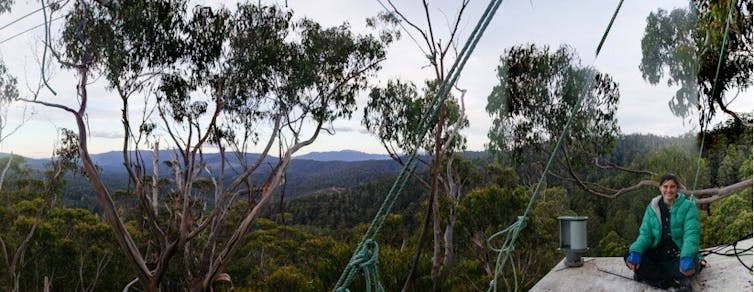 Environmental activist Miranda Gibson, who remained engaged with activists around the world during a tree-sitting protest in the Tyenna Valley, southern Tasmania.
AAP
Environmental activist Miranda Gibson, who remained engaged with activists around the world during a tree-sitting protest in the Tyenna Valley, southern Tasmania.
AAP
During her 451-day tree sit, activist Miranda Gibson co-ordinated an online action campaign. She was able to engage a global audience through blogging, live streaming and posting videos and photos.
Read more: Digital tree-sitting: environmental protest when media is everywhere
Social media provide a new way to foster a sense of community among people far and wide. In this sense, “community” doesn’t have to be local; individuals with common interests and identities can share a sense of community globally. Indeed, this is a key ingredient for collective action.
Employing images and language targeted to appeal to people’s shared attachments to a place can help increase collective stewardship of that place.
These global communities reflect “imagined communities”, a concept developed by political scientist Benedict Anderson to analyse nationalism. Anderson suggests that nations are imagined in the sense that members “will never know most of their fellow members or even hear of them, yet in the minds of each lives the image of their communion”.
Such communities of environmental stewardship can have significant impact. For example, this type of community – which UTAS Professor Libby Lester termed “transnational communities of concern” – played a key role in the decline in Japanese market demand for Tasmanian forest products.
Beyond slacktivism
An important challenge in engaging distant communities in environmental stewardship is to avoid the pitfalls of “slacktivism”.
This refers to the phenomenon of people taking online actions that require little effort, such as joining a Facebook group. It makes them feel good about contributing to a cause but can stop them from taking further action that has real on-the-ground impacts.
Read more: 'Slacktivism' vs 'snarktivism': how do you take your online activism?
More meaningful options are available to people in remote places that can result in real change. These include lobbying national governments, international organisations (such as the World Heritage Committee), or transnational corporations (to prioritise corporate social responsibility, for example). Most organisations that have successfully engaged distant people in environmental stewardship, including Fight for Our Reef, have tended to take a political approach to help with lobbying efforts.
Other meaningful actions that can be undertaken remotely include supporting relevant NGOs and reducing individual consumption.
A new approach to global citizenship
The Citizens for the Reef emphatically state that they are “not looking for Facebook likes” but seek “real action”.
The six actions being promoted include reducing consumption of four disposable products, eliminating food wastage, and financially supporting crown-of-thorns starfish control. Signed-up citizens are given an “impact score”, based on undertaking these actions and recruiting others, and can compare their progress to others around the world.
The initiative provides an example of a new form of environmental activism that is emerging in response to increasing global environmental and social connection. The significant challenge for this initiative is to gain the sustained engagement of enough people to achieve real-world impact.
Ultimately, however, while the local to global public certainly have a critical part to play in addressing these threats, this does not diminish the responsibility of government and the private sector for safeguarding the future livelihood of the Great Barrier Reef.
Authors: Georgina Gurney, Environmental Social Science Research Fellow, James Cook University


















