Mauna Loa Observatory captured the reality of climate change. The US plans to shut it down
- Written by Alex Sen Gupta, Associate Professor in Climate Science, UNSW Sydney
The greenhouse effect was discovered more than 150 years ago and the first scientific paper linking carbon dioxide levels in the atmosphere with climate change was published in 1896.
But it wasn’t until the 1950s that scientists could definitively detect the effect of human activities on the Earth’s atmosphere.
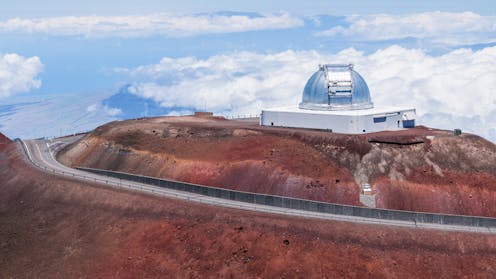
In 1956, United States scientist Charles Keeling chose Hawaii’s Mauna Loa volcano for the site of a new atmospheric measuring station. It was ideal, located in the middle of the Pacific Ocean and at high altitude away from the confounding influence of population centres.
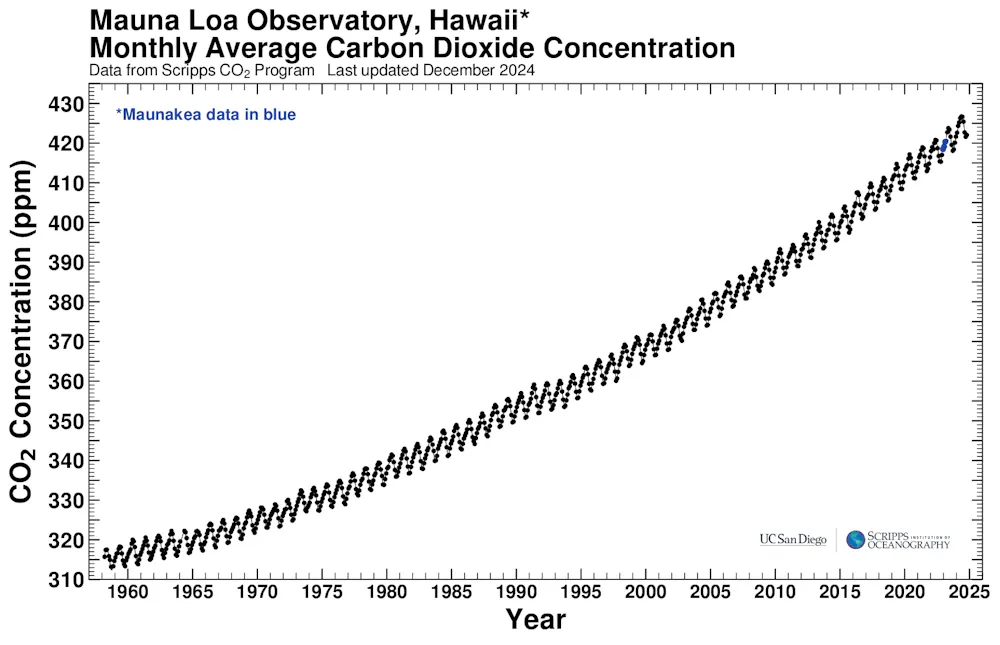
Data collected by Mauna Loa from 1958 onward let us clearly see the evidence of climate change for the first time. The station samples the air and measures global CO₂ levels. Charles Keeling and his successors used this data to produce the famous Keeling curve – a graph showing carbon dioxide levels increasing year after year.
But this precious record is in peril. US President Donald Trump has decided to defund the observatory recording the data, as well as the widespread US greenhouse gas monitoring network and other climate measuring sites.
We can’t solve the existential problem of climate change if we can’t track the changes. Losing Mauna Loa would be a huge loss to climate science. If it shuts, other observatories such as Australia’s Kennaook/Cape Grim will become even more vital.
What did Mauna Loa show us?
The first year of measurements at Mauna Loa revealed something incredible. For the first time, the clear annual cycle in atmospheric CO₂ was visible. As plants grow in summer, they absorb CO₂ and draw it out of the atmosphere. As they die and decay in winter, the CO₂ returns to the atmosphere. It’s like Earth is breathing.
Most land on Earth is in the Northern Hemisphere, which means this cycle is largely influenced by the northern summer and winter.
The annual cycle of carbon dioxide is largely due to plant growth and decay in the northern hemisphere.It only took a few years of measurements before an even more profound pattern emerged.
Year on year, CO₂ levels in the atmosphere were relentlessly rising. The natural in-out cycle continued, but against a steady increase.
Scientists would later figure out that the ocean and land together were absorbing almost half of the CO₂ produced by humans. But the rest was building up in the atmosphere.
Crucially, isotopic measurements meant scientists could be crystal clear about the origin of the extra carbon dioxide. It was coming from humans, largely through burning fossil fuels.
Mauna Loa has now been collecting data for more than 65 years. The resulting Keeling curve graph is the most iconic demonstration of how human activities are collectively affecting the planet.
When the last of the Baby Boomer generation were being born in the 1960s, CO₂ levels were around 320 parts per million. Now they’re over 420 ppm. That’s a level unseen for at least three million years. The rate of increase far exceeds any natural change in the past 50 million years.
The reason carbon dioxide is so important is that this molecule has special properties. Its ability to trap heat alongside other greenhouse gases means Earth isn’t a frozen rock. If there were no greenhouse gases, Earth would have an average temperature of -18°C, rather than the balmy 14°C under which human civilisation emerged.
The greenhouse effect is essential to life. But if there are too many gases, the planet becomes dangerously hot. That’s what’s happening now – a very sharp increase in gases exceptionally good at trapping heat even at low concentrations.
Keeping our eyes open
It’s not enough to know CO₂ is climbing. Monitoring is essential. That’s because as the planet warms, both the ocean and the land are expected to take up less and less of humanity’s emissions, letting still more carbon accumulate in the air.
Continuous, high-precision monitoring is the only way to spot if and when that happens.
This monitoring provides the vital means to verify whether new climate policies are genuinely influencing the atmospheric CO₂ curve rather than just being touted as effective. Monitoring will also be vital to capture the moment many have been working towards when government policies and new technologies finally slow and eventually stop the increase in CO₂.
The US administration’s plans to defund key climate monitoring systems and roll back green energy initiatives presents a global challenge.
Without these systems, it will be harder to forecast the weather and give seasonal updates. It will also be harder to forecast dangerous extreme weather events.
Scientists in the US and globally have sounded the alarm about what the closure would do to science. This is understandable. Stopping data climate collection is like breaking a thermometer because you don’t like knowing you’ve got a fever.
If the US follows through, other countries will need to carefully reconsider their commitments to gathering and sharing climate data.
Australia has a long record of direct atmospheric CO₂ measurement, which began in 1976 at the Kennaook/Cape Grim Baseline Air Pollution Station in north-west Tasmania. This and other climate observations will only become more valuable if Mauna Loa is lost.
It remains to be seen how Australia’s leaders respond to the US retreat from climate monitoring. Ideally, Australia would not only maintain but strategically expand its monitoring systems of atmosphere, land and oceans.
Authors: Alex Sen Gupta, Associate Professor in Climate Science, UNSW Sydney