Teeth record the hidden history of your childhood climate and diet
- Written by Tanya M. Smith, Professor in the Australian Research Centre for Human Evolution & Griffith Centre for Social and Cultural Research, Griffith University
The climate we live in affects our lives in profound ways: hot summers, cold winters, dry spells and wet weather all leave their mark.
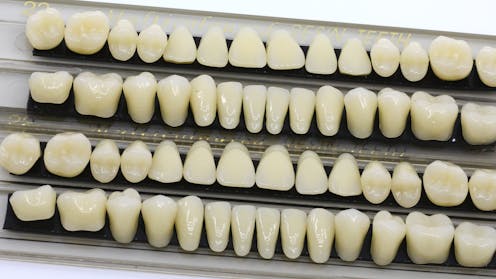
For growing children, one way seasons and storms are recorded is in their teeth. As we have shown in new research, teeth contain a week-by-week climatic history of their owner’s childhood.
To establish this, we studied the teeth of wild chimpanzees, captive macaque monkeys, and a woman born in Brisbane in January 1990. Her infancy included distinctive weather events – but its more powerful use is to reveal the climates that shaped individual lives thousands or even millions of years ago.
How does it work?
You wouldn’t know it, but changes in rainfall and temperature cause subtle changes in drinking water. Specifically, they affect the proportions of different atomic variants of oxygen (the isotopes oxygen-18 and oxygen-16).
Under a microscope, you can see tiny lines inside teeth that correspond to daily layers of growth. Using a machine called the Sensitive High Resolution Ion MicroProbe (SHRIMP) at the Australian National University, we vaporised spots of enamel corresponding to these lines and analysed the oxygen isotopes in the vapour.
Once we know about the balance of oxygen isotopes, we can work backwards to determine changes in drinking water and the corresponding climatic conditions.
Brisbane, 1990
Our Australian tooth donor began her life during a wet summer during which a cyclone dumped enormous amounts of rain on Brisbane and surrounds, and months of high rainfall in the region persisted through to autumn.

Her tooth enamel formed during the summer of 1990 showed oxygen isotope trends that were consistent with the rainfall patterns at the time. The minimum values occurred close in time to the wettest period, and the maximum values happened towards the end of the long dry spell that began later in the year.
After she reached her first birthday, these climate markers became more challenging to interpret. This likely happened because she began to consume more cooked foods, which carry a different isotope balance from raw food and breast milk.
Diet records
Thankfully, the SHRIMP can also help us learn more about these dietary changes by measuring nitrogen isotopes in the tooth dentine (which is found under the outer layer of enamel). There is a known relationship between the balance of nitrogen-15 and nitrogen-14 and the protein in a child’s diet.
In an earlier study, we looked at these records in the same tooth. Mothers’ milk contains high levels of nitrogen-15, and our donor showed a clear signal of rising values from birth. Shortly after six months of age, her nitrogen isotope ratio began to fall, as her mother gradually began offering her fruits and vegetables to supplement her exclusive milk diet.

During our donor’s second year of life, she was fed more solid foods, including bread, cheese, eggs, and yogurt – leading to a further decline in the isotopic ratio. She continued breastfeeding at night for a few months into her third year, and finally as she ceased nursing entirely, her nitrogen values reached a minimum.
From 35 years ago to 17 million years ago
Fine-scaled isotopic studies such as these are a world first. Teeth are typically sampled with hand-held drills or small saws to measure inputs from water and food.
These coarse sampling methods are relatively common and inexpensive, but they cannot show short-term changes in the composition of teeth. This limits how well they can be used to identify important environmental or dietary changes.
Our new technique has many applications. We’ve studied Neanderthal children from the Rhône basin of southeastern France, who experienced some rough seasons 250,000 years ago. By SHRIMPing thin tooth slices, and relating this to enamel formation ages, we were even able to estimate the seasons in which one child was born and weaned 2.5 years later.
 Designed for geological studies, the Sensitive High Resolution Ion MicroProbe (SHRIMP) can be used to determine the balance of different atomic variants in many different kinds of material – including teeth.
Tanya Smith / Australian Academy of Science
Designed for geological studies, the Sensitive High Resolution Ion MicroProbe (SHRIMP) can be used to determine the balance of different atomic variants in many different kinds of material – including teeth.
Tanya Smith / Australian Academy of Science
We have just begun to produce isotopic weaning curves for humans who lived several hundred to several thousand years ago, yielding new insights into ancient maternal behaviour and infant health.
This technology can also be applied to much more ancient fossils, including apes who lived in Africa 17 million years ago. In this instance, isotopic differences between fossils were consistent with other evidence that a changing climate played an important role in influencing the anatomy and development of humanity’s forebears.
Teeth hold many more tales, and technological breakthroughs such as those at the Australian National University will continue to reveal hidden details of our ancient humanity as well as the unintended consequences of our modern lifestyles.
Authors: Tanya M. Smith, Professor in the Australian Research Centre for Human Evolution & Griffith Centre for Social and Cultural Research, Griffith University