

Scandal has erupted over bestselling memoir The Salt Path. In the ‘fake news’ era, what’s the standard for truth in memoir?
- Written by: Nicola Redhouse, Lecturer, Publishing and Editing, The University of Melbourne
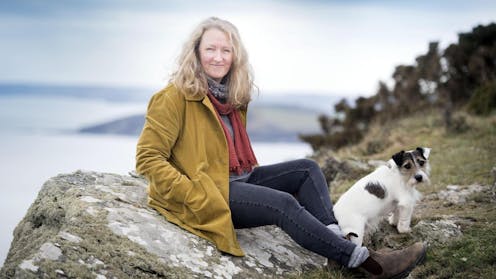
Raynor Winn, author of bestselling memoir The Salt Path – also a film starring Gillian Anderson – has been accused of deception in her story of hardship and healing. In Winn’s account, after their “forever home” is dispossessed, she and her partner, Moth (who faces a terminal diagnosis) decide to walk the famous 630-mile South West Coast Path along the dramatic cliffs of southwestern England.
This week, an Observer investigation cast doubt over key aspects of Winn’s memoir, which has sold nearly 2 million copies worldwide.
Her response? A statement through her lawyer that raises enduring questions about what it means to claim a story is the “truth”:
The Salt Path lays bare the physical and spiritual journey Moth and I shared, an experience that transformed us completely and altered the course of our lives. This is the true story of our journey.
Publisher Penguin Michael Joseph told The Bookseller it “undertook all the necessary pre-publication due diligence” and that “prior to the Observer enquiry, we had not received any concerns about the book’s content”. Number 9 Films and Shadowplay Features told the UK’s Sky News their film was a “faithful adaptation” of a book.
The trailer for the 2025 film of The Salt Path, starring Gillian Anderson as Winn.In the book, Winn claims she and her husband lost their home in North Wales after making a bad investment in a friend’s business, leaving them liable for debts when it folded. The Observer report claims they lost the house after Winn defrauded her employer of about £64,000, then borrowed £100,000 (with 18% interest) from a distant relative, secured against their house, to repay the money. The couple’s house was reportedly repossessed after they were sued to recover the money owed.
While in the book they wrote they had nowhere to go, the Observer reports that the couple “owned land in France on which they had previously stayed”.
The report also raised serious doubts about Moth’s terminal diagnosis of corticobasal degeneration (CBD), a rare condition in the same family as Parkinson’s disease. He has been living with it for 18 years, “with no visibly acute symptoms”, according to the Observer, but it usually has a life expectancy of around six to eight years and the specialists the publication spoke to were “sceptical”.
While they still make headlines, do these scandals around fabrication have the same impact they once did, in today’s era of “fake news”? And what is “truth” in memoir anyway? I’ve long considered this question, as a memoir author and nonfiction book editor.
Expectations of memoir
Of course, we’ve been here before – most infamously, perhaps, 20 years ago with James Frey, 1990s poster boy for literary pork pies. In 2005, key claims in his addiction memoir, A Million Little Pieces, were debunked by website The Smoking Gun, which posts legal documents, arrest records and police mugshots.
Frey’s US publisher, Random House, was sued by a group of readers for breach of contract and fraud. The publisher offered refunds to any reader with a receipt for buying the book. Culturally, Frey suffered a blow worse than anything financial: he was cancelled by Oprah.
The cultural contract around truth in memoir is historically shaped – and it is fraying under pressure. As a nonfiction book editor, I worked closely with memoirists on techniques to flag for the reader where they might be slipping into the imagined. Simple lines like “I imagine it like this”, or more complex tricks such as shifts in point of view, tell the reader they are moving into the invented.
Editors do this work with authors because genre sets up the reader’s expectations of what they are about to enter into. When it comes to memoir, those expectations are weighted: we expect the book will be basically factual, even if fictional techniques are employed.
“The ability to shock and dismay people based on a story unearthing lies? I don’t think it would have anywhere near the effect nowadays,” current Smoking Gun editor William Bastone told the New York Times last month, talking about Frey’s scandal.
In last month’s interview, Frey indignantly argued his book was “85% true […] as most memoirs are”. His main retort, though, was more philosophical: “When Picasso makes a self-portrait, if it’s not photorealist, is it invalid?”
Is a true story akin to the facts? What does it matter, and to whom?
In the case of A Million Little Pieces, the question was interrogated legally. To call something memoir is to make a contract with the reader around facts – and this was breached. In the case of The Salt Path, that process is still unfolding.
But how exactly do we cordon off facts from embellishments? Is fact strictly tied to the observable: times, places, names, events, chronologies? Can something be true but not factual? What about feelings?
Pain itself is known to be experienced in variable ways, and any hotel review will tell you one person’s ultimate luxury is another’s shabby hell. The task of the writer is, surely, to reflect the peculiarly specific feeling of their living.
You say tomato, I say apple

Memoirist Vivian Gornick argues there are two layers to a work of literature: the situation (“the context or circumstance, sometimes the plot”) and the story (“the emotional experience that preoccupies the writer: the insight, the wisdom, the thing one has come to say”).
What, then, of the old mercurial beast that is memory? In my own memoir, I recorded the discombobulating moment in which my sister recalled to me a memory I was certain was mine. We had both remembered one of our father’s patients, a child in therapy with him, coming up to us at school and telling us our father loved her more than he loved us.
The emotional resonance of the memory belonged to both of us – and the meaning it carried bore the thing I had come to say. It didn’t matter who it had happened to.
Did it matter I had told readers it had happened to me, when no one was entirely sure? Memory, after all, is liable to extraordinary forces – we know this from neuroscience, from witness testimony, from psychotherapeutic scandals.
Perhaps it changes the ethics of the question to understand I believed it had happened to me. Like the mens rea required of a crime (a knowledge of the wrongfulness of the act), the intention to lie or deceive the reader might be what matters.
Memoir is craft – not autobiography
Fundamentally, memoirists always manipulate story. Memoir is not autobiography. It involves a careful selection of the parts of our life that fit together to make a narrative – and it can employ a vast spectrum of fictional techniques. Carmen Maria Machado’s In the Dream House, for example, uses a disjointed narrative arc of strung-together genre tropes (like sci-fi and self-help) to tell the story of her time in an abusive relationship.
Helen Garner has written about the careful act of shaping the “I” who appears in her nonfiction. “There can be no writing without the creation of a persona,” she says. “In order to write intimately – in order to write at all – one has to invent an ‘I’.”

But it is clear that for Garner, the creation of a persona is not mere invention. We know this because she has spoken, too, about the freedom fiction gives her to make things up – a freedom she no doubt embraced after criticism over her conflation of multiple people into a single person in The First Stone.
But facts are facts, right? If we can’t pinpoint where, when, who, or what, we are in a world of sci-fi, or a world where a president can make 30,573 false or misleading claims in just four years – and still remain president. Imagine that.
Memoir in a post-truth world
Much of Frey’s indignance now seems to stems from the absurdity of how low the bar has sunk when it comes to standards of truth. And he has a point.
To know whether an image is counterfeit, now we have to hope it includes hands (notoriously difficult for AI to master). Ours is a world where social media, absent of checks and balances, is the only growing source of news media. A world where whole journals are compromised by the mass generation of fake science – and where we swallow wholesale the documentarian claims of “reality TV”, while knowing it is scripted.
In such a world, what’s a little fuzziness around the exact reasons a couple found themselves without a home and walking the cliffs of Devon?
The contract with a reader is an emotional one – to believe someone has lived through the story they are telling involves a different kind of investment of self: a deeper empathy, a willingness to sit with pain or joy or fear that was real for the writer. And that is worth honouring.
As a writer, I am always in my writing. Whether fiction or nonfiction, what I produce is “of me”. As memoirist Leslie Jamison puts it: “Everything exterior to me is metabolized by my particular interiority.”
But I ask something different of a reader when I tell them my work is memoir – I ask them to trust me. Fiction might end up offering a version of my story that communicates the emotional truth of my story more powerfully, but it does not ask the reader to bear witness.
Authors: Nicola Redhouse, Lecturer, Publishing and Editing, The University of Melbourne