why real ‘de-extinction’ is unlikely to fly
- Written by Nic Rawlence, Associate Professor in Ancient DNA, University of Otago
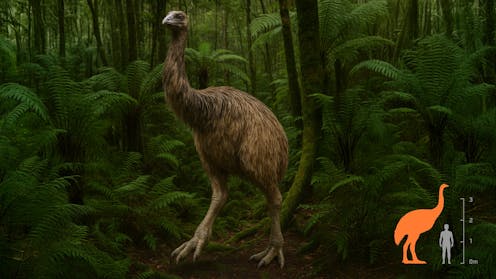
The announcement that New Zealand’s moa nunui (giant moa) is the next “de-extinction” target for Colossal Biosciences, in partnership with Canterbury Museum, the Ngāi Tahu Research Centre and filmmaker Peter Jackson, caused widespread alarm among scientists.
This follows the US company’s recreation of a “dire wolf”, which was essentially a genetically engineered grey wolf. But that project was probably easy compared to the latest plan to resurrect the moa.
I think it’s a pipe dream and there are several reasons why.
Firstly, birds are harder to “de-extinct” than placental mammals. One would need a surrogate egg to bring chicks to term, and for many moa species there are no eggs from living birds big enough to house a developing chick. In this case, artificial eggs would need to be developed.
Then there is evolutionary history. From my own work and the research of others, we know the moa is most closely related to the tinamou, a small flying bird in South America.
To get to the common ancestor of the moa and tinamou, you’d have to go back some 60 million years of evolution. That’s a lot of time for mutations to evolve in genes controlling how moa look, that would need to be re-engineered to bring back moa traits.
The evolutionary history of the palaeognath group is even deeper. Formerly known as ratites, this group includes the tinamou and lineages of living flightless birds (emu, kiwi, cassowary, rhea, ostrich) and extinct ones (New Zealand’s moa and Madagascar’s elephant birds).
Genetically engineering a tinamou or any other birds in this group to create a moa hybrid would be challenging given this deep evolutionary timescale – certainly much harder than genetically engineering a grey wolf. And in any case, this would not recreate a moa, but merely something that may look like a moa. As one critic put it, it would not have the mauri (life force) of a moa.
There are no living analogues of moa within the palaeongath group. We don’t know whether birds created through de-extinction methods would function like a moa in the ecosystem.
Moa are unique, even among other flightless birds, in that they had no wings – all other flightless birds still have remnant wings. As a start, any genetic engineering would need to target regions of the genome that control the expression of genes for wing formation. This could have unintended consequences.
Working with moa ethically
I’m involved in an ongoing project to sequence high-quality genomes of several species of moa in New Zealand to study their evolutionary history.
In our conversations with tangata whenua around the country, there has been no support for de-extinction. Iwi (tribes) also want moa bone samples and all DNA extracts and sequence data to stay in New Zealand.
A major question is whether Colossal has undertaken wider engagement. Ngāi Tahu is a very large iwi with lots of individual rūnanga (tribal councils) throughout the South Island.
My research team has engaged with individual rūnanga, and we know they are opposed to de-extinction. I would like Colossal, Canterbury Museum and the Ngāi Tahu Research Center to disclose how widely they consulted across Ngāi Tahu.
The numerous iwi at the top of the South Island are also against the de-extinction of the giant moa (or any moa) which also lived in their rohe (region). De-extinction of a giant moa would really need a South Island-wide or even national consensus before going ahead.
Ecological concerns with de-extinction
Māori have expressed longstanding concerns about not being involved in discussions about genetic engineering and the potential of bone samples or genetic material going offshore.
With this announcement, it’s encouraging to see the Ngāi Tahu Research Centre is driving the project and that there are discussions around the need to restore habitat that would be suitable for moa.
This is a challenge in its own right as there is little left. Parts of the eastern South Island were once covered in mosaics of open forest shrubland that were dominated by kowhai and lancewood, which have no analogue today.
Even if we were to bring back an extinct species and kept individuals in a game reserve, we would need to produce enough (at least 500) to avoid inbreeding and genetic drift (random loss or retention of genes in a population).
The birds would require sufficient funding for their ongoing conservation. This raises worries that money could be pulled from efforts to save living endangered species, pushing them closer to extinction.
It’s undeniable the genetic engineering technology Colossal is developing could have real benefits to the conservation of New Zealand’s endangered species. Let’s say we could genetically engineer a kākāpō so it becomes resistant to a disease. That’s perhaps a project worth doing if there was widespread community support.
Investing the money that goes into this project in the conservation of New Zealand’s currently endangered biodiversity would, in my view, be better than bringing back moa as an ecotourism venture.
Authors: Nic Rawlence, Associate Professor in Ancient DNA, University of Otago