Rugby headgear can’t prevent concussion – but new materials could soften the blows over a career
- Written by Nick Draper, Professor of Sport and Exercise Science, University of Canterbury
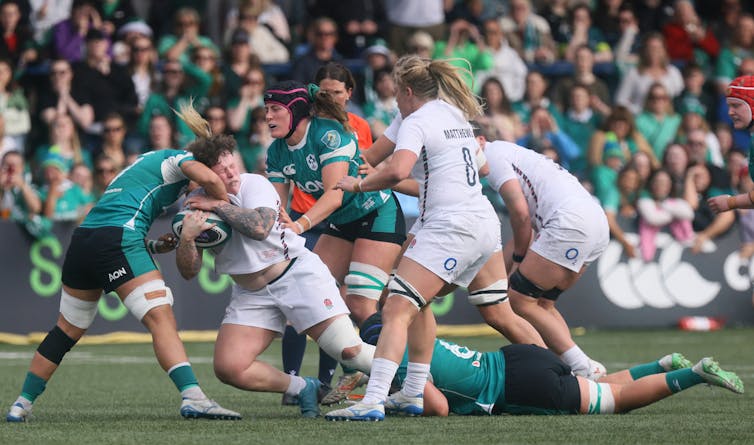
The widely held view among rugby players, coaches and officials is that headgear can’t prevent concussion. If so, why wear it? It’s hot, it can block vision and hearing, and it can be uncomfortable.
Headgear was originally designed to protect players from cuts and abrasions. But players still hope it will offer them a degree of protection against the collisions they experience in the game. Some players adopt it after previous concussions.
We’re now seeing increasing numbers of professional players opting in. The Irish men’s team, for example, field up to five players each match sporting headgear. In Japan, it’s mandatory for juniors. And more parents in New Zealand are making their children wear it, too.
The exact specifications for rugby match kit – boots, shorts, shoulder pads and headgear – are regulated through World Rugby’s Law 4 and Regulation 12. In 2019, the governing body launched a trial enabling players to wear headgear with new technical specifications in training and matches.
The specifications have meant manufacturers can take advantage of novel “isotropic” materials that can potentially reduce the impact forces experienced by players.
Conventional headgear is composed of soft foams that flatten when a player’s head collides with the ground or another player. As such, they can only minimally absorb those collision forces.
Isotropic materials behave differently. They can absorb impacts from multiple directions and may offer a level of protection against the effects on a player’s head of a tackle or other collision event.
Given these changes, and in light of recent research, we may need to change the narrative around rugby headgear: while it may not prevent concussion, it might reduce the total contact “burden” experienced by players in a game and over a whole season. And this could have benefits for long-term brain health.
Impacts across seasons and careers
Contact in rugby – through tackles, at the breakdown, and in scrums and lineouts – leads to players experiencing a number of collisions or “head acceleration events”. This contact is most commonly head to ground, head to body or head to head.
By having players use “smart” mouthguards with embedded micro-accelerometers and gyroscopes to capture head movements, researchers can now measure each collision and each player’s contact load in a game – and potentially over a career.
A player’s total contact load is found by adding together the magnitude of the impacts they experience in a game. These are measured as “peak linear accelerations” or “peak rotational accelerations”.
While past research and media attention has focused on concussion, it has become clear the total contact burden in training and matches – the total “sub-concussive knocks” through head acceleration events – may be as important, if not more so.
One of our own research projects involved following 40 under-16 players wearing smart mouthguards for all training and matches across one season. Peak Linear accelerations are measured as a g-force (g). Activities such as such as running, jumping and shaking the head would measure under 8g, for example, whereas heading a soccer ball might measure 31g.
The results of our study showed the players differed greatly in their cumulative exposure over a whole season, from 300g to nearly 14,000g. These differences would be amplified further over an entire rugby career.
Some of the variation is likely due to a player’s team position, with loose forwards having a greater burden than others. But it also seems some players just enjoy the contact aspects of the game more than others.
Potential benefits of new headgear materials
Researcher Helen Murray at the University of Auckland has highlighted the need for more research into the burden of collisions, rather than just concussions, over a rugby career. In particular, we need to know more about its effect on future brain health.
We hope to contribute to this by following our existing cohort of players through their careers. In the meantime, our research has examined the potential of existing rugby headgear and new isotropic materials to mitigate peak accelerations in rugby collisions.
Using the field data collected from male and female players over the past four seasons, we have designed laboratory testing protocols to compare the conventional and newer materials.
The results suggest the new forms of headgear do have the potential to reduce the impact burden for players.
We found 55–90% of head acceleration events do involve direct contact with the head. As such, collision-mitigation headgear could be beneficial. And our laboratory testing produced an estimated 30% reduction in peak linear accelerations with the headgear compared to without.
The nature of concussion is complex and related to the size of an impact as well as its direction and angle. For instance, we observed the concussions experienced by the junior players occurred between 12g and 62g – well below the male threshold of 70g requiring professional players to be removed from the field for a head injury assessment.
Currently, it seems unlikely headgear can prevent concussion. But it does appear new headgear materials could significantly reduce the total impact burden for players during their careers. And this may help safeguard their future brain health.
Authors: Nick Draper, Professor of Sport and Exercise Science, University of Canterbury