the risk if NZ gets climate adaptation policy wrong today
- Written by Tom Logan, Senior Lecturer Above the Bar, Civil and Natural Resources Engineering, University of Canterbury
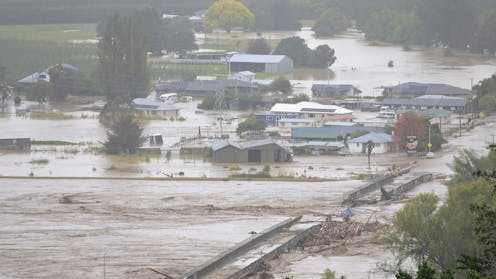
New Zealand 2050: On the morning of February 27, the sea surged through the dunes south of the small town of Te Taone, riding on the back of Cyclone Harita’s swollen rivers and 200mm of overnight rainfall.
By mid-morning, floodwaters had engulfed entire streets. Power was out. Roads were underwater. Emergency services responded swiftly, coordinating evacuations and establishing shelters.
But for many residents, the realisation came days later: the help they expected after the water receded – support to rebuild, relocate or recover – wasn’t coming.
“We lost everything,” says Mere Rākete, a solo mother of three, standing outside her home, now uninhabitable. “I rang the council, the government helpline, even the insurance company. They all said I’m not covered.”
Mere lives in a suburb long identified as “high risk” under national climate risk maps. She didn’t stay there because she ignored the risk. She stayed because she had no viable alternative.
“They say we had a choice. But when houses here were $400,000 and anything safer was $700,000, what choice is that?”
No more buyouts
Although this story is fictitious, it describes a plausible future based on how New Zealand’s draft climate adaptation framework could play out. It reflects the likely consequences of policy decisions that focus narrowly on financial exposure.
Last week’s recommendations from the Ministry for the Environment’s Independent Reference Group rightly called for urgent and improved risk information. But they focused narrowly on direct risk to property and infrastructure.
In particular, the group proposed that beyond 2045 the government should not buy out property owners after climate-related disasters (or those at high risk of future events).
Responding to the recommendations last week, climate policy analyst Jonathan Boston wrote that ruling out property buyouts “is philosophically misguided, morally questionable, administratively inept, and politically naïve”.
But it appears the government shares the reference group’s view. Addressing the current flooding disaster in the Tasman district, Prime Minister Christopher Luxon said, “In principle, the government won’t be able to keep bailing out people in this way.”
Beyond the specifics of financial compensation, however, lie the cascading and systemic risks that follow a major weather event. In reality, the impacts do not stop at the property boundary.
When a family is displaced, or even fears displacement, the consequences ripple outward: schooling is disrupted, jobs are lost, mental health declines, community networks fragment and local economies suffer.
Research shows how the after-effects of a disaster domino through interconnected systems, affecting health, housing, labour markets and social cohesion.
A policy decades in the making
Back to the future: our fictional town of Te Taone sits in a floodplain identified decades ago. By the 2040s, insurance had become unaffordable. New development slowed but many families, especially those on lower incomes, remained, with few relocation options.
The adaptation framework proposed in 2025, based on a “beneficiary pays” model, created a 20-year transition period that ended in 2045. After that, residents in high-risk areas became ineligible for buyouts or standard recovery funding.
Future government investment was limited to Crown-owned assets or projects with “national benefit”. Restoration of local infrastructure such as roads and power lines would depend on whether councils or ratepayers could pay.
Today, parts of Te Taone remain cut off. Power is still out in some areas. The school has relocated inland. Local shops have closed. Many homes are damaged, waterlogged, or destroyed, and some families are now living in tents.
“It’s not that we weren’t warned,” says a local community worker. “It’s just that we couldn’t afford to do anything but live with the risk and hope for the best.”
Te Taone’s experience is now raising deeper concerns that Aotearoa New Zealand’s climate adaptation framework may be entrenching a form of “climate redlining”. Those with the means can move to escape risk, while others are left behind to bear it.
Adaptation or abandonment?
Māori communities are especially affected. Parts of the floodplain include ancestral land, some communally owned, some leased by whānau who cannot easily relocate. In many cases, this land was only recently returned from the Crown, after years of land court proceedings or Treaty settlements.
The prospect of abandoning it again, without coordinated support, echoes earlier waves of institutional neglect. Mere Rākete is now considering joining a class action, one of several reportedly forming across the country.
Residents are challenging the government or local councils over a failure in their duty of care by allowing homes to be built, sold or inhabited in known risk zones without clear and enforceable warnings or adequate alternatives.
Meanwhile, adaptation experts are calling for a reset: a national compensation framework with clear eligibility rules, long-term investment in affordable housing beyond hazard-prone areas.
Above all, they argue, government policy based on a climate adaptation framework developed 25 years ago has not reduced exposure to risk. Instead, it has redistributed it from those who could leave to those who couldn’t.
In the meantime, the remaining residents of Te Taone wait for the next cyclone and wonder whether, next time, anyone will help.
Planning with people in mind
Our imagined future scenario can be avoided if governments take a broader view of adaptation. Treating climate risk as an individual responsibility may reduce short-term government liability. But it will not reduce long-term social and fiscal liability.
The risk of failing to act systemically is that the country pays in other ways – in fractured communities, rising inequity and preventable harm.
Adaptation to climate change has to be about more than limiting the upfront costs of buyouts or infrastructure repairs. Ignoring the wider impacts will only shift the burden and increase it over time.
Real economic and community resilience means planning with people in mind, investing early and making sure no one is left behind. That work must begin now.
Authors: Tom Logan, Senior Lecturer Above the Bar, Civil and Natural Resources Engineering, University of Canterbury