How safe are the chemicals in sunscreen? A pharmacology expert explains
- Written by Ian Musgrave, Senior Lecturer in Pharmacology, University of Adelaide
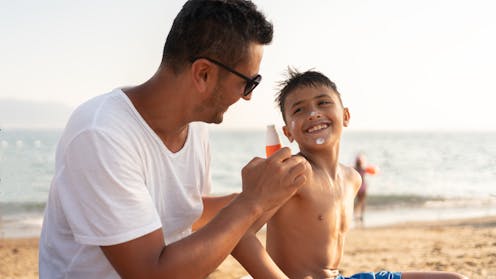
Last week, the Therapeutic Goods Administration (TGA) released its safety review of seven active ingredients commonly used in sunscreens.
It found five were low-risk and appropriate for use in sunscreens at their current concentrations.
However, the TGA recommended tighter restrictions on two ingredients – homosalate and oxybenzone – to reduce how much can be used in a product. This is based on uncertainty about their potential effects on the endocrine system, which creates and releases hormones.
This news, together with recent reports some products may have inflated their claims of SPF coverage, might make Australians worried about whether their sunscreen products are working – and safe.
But it’s not time to abandon sunscreens. In Australia, all sunscreens must pass a strict approval process before going on the market. The TGA tests the safety and efficacy of all ingredients, and this recent review is part of the TGA’s continuing commitment to safety.
The greatest threat sunscreen poses to Australians’ health is not using it.
Australia has the highest incidence of melanoma and non-melanoma skin cancer worldwide, and approximately 95% of melanoma cases in Australia are linked to ultraviolet (UV) exposure.
Still, it’s understandable people want to know what’s in their products, and any changes that might affect them. So let’s take a closer look at the safety review and what it found.
What are the active ingredients in sunscreen?
There are two main types of sunscreen: physical and chemical. This is based on the different active ingredients they use.
An active ingredient is a chemical component in a product that has an effect on the body – basically, what makes the product “work”.
In sunscreens, this is the compound that absorbs UV rays from the Sun. The other ingredients – for example, those that give the sunscreen its smell or help the skin absorb it – are “inactive”.
Physical sunscreens typically use minerals, such as titanium dioxide and zinc oxide, that can absorb the Sun’s rays but also reflect some of them.
Chemical sunscreens use a variety of chemical ingredients to absorb or scatter UV light, both long wave (UVA) or short wave (UVB).
The seven active ingredients in this review are in chemical sunscreens.
Why did the TGA do the review?
Our current limits for the concentrations of these chemicals in sunscreen are generally consistent with other regulatory agencies, such as the European Union and the US Food and Drug Administration.
However, safety is an evolving subject. The TGA periodically reexamines the safety of all therapeutic goods.
Last year, the TGA revised its method of estimating sunscreen exposure to more closely model how skin is exposed to sunscreens over time.
This model considers how much sunscreen someone typically applies, how much skin they cover (whole body versus face and hands, or just face) and how it’s absorbed through the skin.
Given this new model – along with changes in the EU and US approaches to sunscreen regulation – the TGA selected seven common sunscreen ingredients to investigate in depth.
Determining what’s safe
When evaluating whether chemicals are safe for human use, testing will often consider studies in animals – especially when there is no or limited data on humans. These animal tests are done by the manufacturers, not the TGA.
To take into account any unforeseen sensitivity humans may have to these chemicals, a “margin of safety” is built in. This is typically a concentration 50–100 times lower than the dose at which no negative effect was seen in animals.
The sunscreen review used a margin of safety 100 times lower than this dose as the safety threshold.
For most of the seven investigated sunscreen chemicals, the TGA found the margin of safety was above 100.
This means they’re considered safe and low-risk for long-term use.
However, two ingredients, homosalate and oxybenzone, were found to be below 100. This was based on the highest estimated sunscreen exposure, applied to the body at the maximum permitted concentration: 15% for homosalate, 10% for oxybenzone.
At lower concentrations, other uses – such as just the hands and face – could be considered low-risk for both ingredients.
What are the health concerns?
Homosalate and oxybenzone have low acute oral toxicity – meaning you would need to swallow a lot of it to experience toxic effects, nearly half a kilogram of these chemicals – and don’t cause irritation to eyes or skin.
There is inconclusive evidence about oxybenzone potentially causing cancer in rats and mice – but only at concentrations to which humans will never be exposed via sunscreens.
The key issue is whether the two ingredients affect the endocrine system.
While effects have been seen at high concentrations in animal studies, it is not clear whether these translate to humans exposed to sunscreen levels.
No effect has been seen in clinical studies on fertility, hormones, weight gain and, in pregnant women, fetal development.
The TGA is being very cautious here, using a very wide margin of safety under worst-case scenarios.
What are the recommendations?
The TGA recommends the allowed concentration of homosalate and oxybenzone be reduced.
But exactly how much it will be lowered is complicated, depending on whether the product is intended for adults or children, specifically for face, or the whole body, and so on.
However, some sunscreens would need to be reformulated or warning labels placed on particular formulations. The exact changes will be decided after public consultation. Submissions close on August 12.
What about benzophenone?
There is also some evidence benzophenone – a chemical produced when sunscreen that contains octocrylene degrades – may cause cancer at high concentrations.
This is based on studies in which mice and rats were fed benzophenone well above the concentration in sunscreens.
Octocrylene degrades slowly over time to benzophenone. Heat makes it degrade faster, especially at temperatures above 40°C.
The TGA has recommended restricting benzophenone to 0.0383% in sunscreens to ensure it remains safe during the product’s shelf life.
The Cancer Council advises storing sunscreens below 30°C.
The bottom line
The proposed restrictions are very conservative, based on worst-case scenarios.
But even in worst-case scenarios, the margin of safety for these ingredients is still below the level at which any negative effect was seen in animals.
The threat of cancer from sun exposure is far more serious than any potential negative effect from sunscreens.
If you do wish to avoid these chemicals before new limits are imposed, several sunscreens are available that provide high levels of protection with little or no homosalate and oxybenzone. For more information, consult product labels.
Authors: Ian Musgrave, Senior Lecturer in Pharmacology, University of Adelaide