

How do we understand life on Earth? An 18th-century rivalry charts the tension between two types of science ‘genius’
- Written by: John Long, Strategic Professor in Palaeontology, Flinders University
The modern science biography must hold back no punches in its mission to represent the subject’s life, equally celebrating their great works while including their personal shortcomings.
Jürgen Neffe’s Einstein: A Biography (2005) and Dava Sobel’s The Elements of Marie Curie (2024) are wonderful examples of this style. Such books succeed in clearly explaining the complex science of their subject’s work for non-scientific readers, enabling a deep appreciation of their achievements and bringing them to life as rounded, flawed humans.
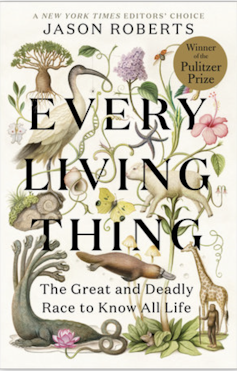
Review: Every Living Thing – The Great and Deadly Race to Know all Life – Jason Roberts (Hachette)
Jason Roberts’ Every Living Thing – The Great and Deadly Race to Know all Life is another of these rare works. This engrossing, precisely researched book focuses on two central characters born in the same year: Carl Linnaeus (1707-1778), a Swede, and Frenchman Georges-Louis LeClerc, the Compte de Buffon (1707-1788), better known as just Buffon.
Roberts’ book won the 2025 Pulitzer Prize for biography. His writing pulls the reader effortlessly through the story, revealing delightful, unexpected twists and turns in the two men’s complex and disparate lives. Each worked diligently to reach a level of global notoriety for their many published books. Both are revered in the natural history world today.
Linnaeus, a biologist and physician, is known for his system of hierarchical classification: how all living things comprise a genus and species, (we humans are Homo sapiens), which fit into families, orders, classes and so on. (A good many intermediate ranks were added later). While his work has been hugely influential, Linnaeus is portrayed by Roberts at times as being lazy, vain and unethical.
Linnaeus was primarily driven to be the first to name new species. Buffon was working on a grand thesis of how all life’s organisms function and are related to one another. A wealthy count who inherited a vast fortune at the age of ten, Buffon trained as a lawyer but became fascinated by the trees that grew in his large garden.
Buffon is best known today for his extensive books on natural history and works on mathematics and cosmology. He calculated the Earth was much older than the Bible predicted and that life sprung from unorganised matter. He explored the relationships between organisms rather than how they were classified. His core work formed the basis for modern evolutionary theory.

He boasted that he scaled Mount Caitumbyn (a name no longer listed on maps of the Lapland area), exaggerating its height and the dangers of the trip. However, he couldn’t have done this as it would have involved a 1,400 km detour from his itinerary. He was openly corrupt at times, taking fees to write his own students’ essays. His vanity was evident through his (anonymous) glowing reviews of his own works.
Despite these faults, the scientific work Linnaeus achieved has formed the fundamental framework for all modern taxonomy – the science of the classification of life. He did get something right, even though his many parts of his published works were deeply flawed.
Buffon’s brilliance
Georges-Louis LeClerc, later the Compte de Buffon, was born into a wealthy middle class family. He was an average student who eventually obtained a law degree, despite his wild times at university, where he engaged in deadly duels. In his twenties he built a three-storey mansion in the town of Montebard in Dijon and developed an immense garden. His interest in botany grew as he began experiments on trees.
Soon he adopted a rigorous daily routine, waking up at 5am every day, dressing, then walking at first light to work. He worked all day with brief pauses for meals and a short nap, wrapping up at 7pm. Skipping dinner, he fasted every night. He kept to this same schedule for 50 years.
Buffon idolised Isaac Newton and learned his calculus. He solved an ancient mystery about a weapon invented by Archimedes, which used giant mirrors to intensify the sun’s rays and set fire to the Roman fleet in 212 BCE.
Buffon build a replica to show the French military how this tactic had worked. He also solved complex mathematical equations and wrote papers on probability and statistics.
His real passion though was natural history. Buffon became motivated to explore the structure of animals and plants to determine the relationships between species. His biological work starts in earnest at volume four of his 35-volume set Histoire Naturelle, Générale et Particulière by examining three farm animals in mundane detail to define what it means to be a horse, donkey or bull.
Buffon expressed clear ideas about evolution 100 years before Charles Darwin. All of the components of Darwin’s theory – the how, where and why of natural selection and how species change – are there in Buffon’s works. This was recognised by Darwin in his revised fourth edition of Origin of the Species (1866) when he admitted in an addendum that Buffon “was the first author who, in modern times, has treated [the origin of species] in a scientific spirit”.
Buffon’s method of exploring the deep science of a topic was artfully delivered by his skilful prose. While other scholars (like Linnaeus) published in Latin, Buffon wrote in the popular French so all could read his work. He was France’s best selling non-fiction author for his day, and honoured by admittance into the Académie Française, the nation’s highest literary honour.
Rivalry
The book outlines the rivalry between the two men, spurred on by their differing intellectual approaches to understanding natural history.
Buffon’s chief critique of Linnaeus’s system of classification was that it was entirely arbitrary, set up by a whim, not from research. Linnaeus’ response was to imply Buffon’s work was an experiment that lacked a practical path, implying it had no economic application to biology.
Ironically, when Linnaeus published his tenth edition of his book in 1758, he vindicated Buffon’s criticism by changing his system quite radically for no clear reason.
As the two men settled into their main projects we see genius emerges from the slow, often painful, creation of new knowledge applied to problem-solving.
Buffon’s written works not only deal with nature, but also “excoriate slavery”, support women’s sexual rights (arguing rightly that men used the concept of “virginity” to control women) and proclaim all humans are but one species of equal capability.
Linnaeus, on the other hand, was obsessed by one task – classifying all life. In the 18th century, it was believed there were around 4,000 species on Earth, as derived from a guess of how many animals and plants might fit on Noah’s Arc. Linnaeus eventually conceded there must be at least 40,000 species. Today, we have over one million species documented, with up to a trillion calculated to possibly exist.
While Linnaeus made lasting contributions to biology through these classifications, he stirred the hornet’s nest by seeing humans as four distinct species, each based on superficial differences and inferred personality traits. His approach reeked of white supremacy. Roberts rightly points out it formed the basis for all systemic racism from then on.
Lasting legacies
Roberts is a “more or less” self-taught writer. He honed his skills writing massive technical manuals for computer programming, some more than 600 pages long. This book follows his earlier A Sense of the World: How a Blind Man became History’s Greatest Traveler, about the travels of blind Englishman James Holman (2006).
There are a few small technical errors in this otherwise masterful work. A delightful chapter about the platypus tells us it generates an electric field, whereas it actually has sensitive electrosensory cells to detect the electric fields of its prey.
A section about Darwin’s work mentions British biologist Alfred Russel Wallace had ideas along “similar lines”, but it would have helped to mention Darwin and Wallace first published their preliminary ideas on evolution in a joint paper in June, 1858, a year before Darwin’s On the Origin of Species was published.
Read more: Guide to the classics: Darwin's On the Origin of Species
Still, overall, the research presented in this book is very tight.
It shows Buffon’s cross-disciplinary use of science, maths, physics and chemistry in his analyses of living things positioned him way ahead of his time. He savoured the study of natural history, whereas Linneaus gobbled it up in greedy mouthfuls.
Both left lasting legacies. Aside from their voluminous written works, still widely cited today, their many disciples carried on and further developed their works after their deaths. These include many famous names (French biologist Jean-Baptiste Lamarck, and zoologist Georges Cuvier, British biologist Thomas Huxley) who are discussed in the last chapters.
The remaining parts of Linnaeus’s biological collections are housed in London in the rooms of The Linnean Society, a lasting tribute to the founder of modern taxonomy. He is buried at Uppsala cathedral.
Buffon is remembered not just through his books, but also by a magnificent marble statue commissioned by King Louis XVI, now in the grand gallery of evolution in Paris’s natural history museum.
It is inscribed with these words: “All nature bows to his genius”. Buffon’s preserved heart sits in the pedestal below this statue.
Authors: John Long, Strategic Professor in Palaeontology, Flinders University



















