Hold up, humans. Ants figured out medicine, farming and engineering long before we did
- Written by Tanya Latty, Associate Professor in Entomology, University of Sydney
Think back to a time you helped someone move a heavy object, such as a couch. While at first the task may have appeared simple, it actually required a suite of advanced behaviours.
The job needed verbal commands for social coordination (“pivot!”) and anticipation of near-future events (moving other furniture out of the way). It also required a clear, shared vision of the final goal (which room to take the couch to).
It’s a small but satisfying example of human cooperation. But before we all get too pleased with ourselves, consider that ants – creatures with tiny brains and no capacity for speech – routinely pull off feats that rival, and sometimes exceed, our own.
Understanding ant intelligence
Earth is literally crawling with ants. Scientists estimate there are at least 20 quadrillion ants on Earth. That’s 20 followed by 15 zeros – more ants than stars in our galaxy!
These incredible insects are amongst the most successful organisms on the planet. Part of the success comes from an ability to form complex societies, ranging from a few individuals to millions. And those societies, or colonies, are remarkably co-operative.
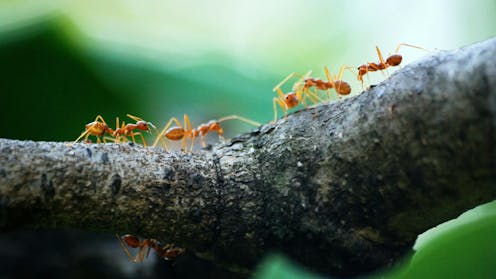
Take, for example, ants’ abilities to move large food items. To do it, they mobilise teams of dozens – or even hundreds – of fellow workers. Together, they efficiently work together to transport the load back to the nest.
Longhorn crazy ants (Paratrechina longicornis) are even known to clear debris from a path before a heavy object arrives – seemingly anticipating its trajectory and preparing the way.
One experiment pit longhorn crazy ants against humans, all tasked with moving T-shaped objects (scaled to body size) through tight spaces. In some trials, the human teams were not permitted to speak or use gestures.
And the result? Ants performed better in larger groups compared to smaller ones, showing the clear benefits of collective action. In contrast, human performance did not improve with group size. And when communication was restricted, human performance declined as group size increased.
All this highlights how ants rely on collective intelligence, without the need for central control or sophisticated cognition.
Expert farmers
Humanity’s invention of agriculture 12,000 years ago is understandably hailed as one of our greatest achievements.
But leaf cutter ants beat us to it. These ants (from the species Atta and Acromyrmex) evolved to undertake large-scale agriculture about 55 million years ago.
These ants cut and transport fresh leaves not to eat directly, but to feed a fungus that serves as their main food source.
This evolutionary partnership allows the ants to feed colonies with populations in the millions.
Remarkably, leaf cutter ants have also evolved a form of biological pest control to protect their crops from bacteria. Some worker ants patrol the gardens, detecting infected sections of the fungus. Then they apply antibiotics produced by bacteria that live on their bodies.
What’s more, many ant species farm aphids and other sap-sucking insects.
As these farmed insects feed on plant sap, they excrete a sugary liquid the ants eagerly collect. In return, ants serve as bodyguards, defending their tiny livestock from predators such as ladybirds and lacewings.
In some species, queen ants gently carry sap-sucking insects in their jaws as they fly off to start new colonies. Fossilised ants preserved in amber suggest this behaviour evolved up to 20 million years ago, long before humans domesticated animals.
Ant medicine
Medical care may seem like a distinctly human innovation. But several ant species have evolved sophisticated ways to treat injuries.
When a Florida carpenter ant (Camponotus floridanus) is injured during a battle between colonies, its nest-mates will amputate a damaged limb to prevent infection from spreading. Ants receiving this battlefield care are more likely to survive than ants left untreated.
Some ants can also detect infection and treat infected wounds by cleaning them and applying antimicrobial secretions from specialised glands.
Master builders
Some ant species are known to literally put their bodies on the line for the colony.
Army ants (Eciton burchellii) join their bodies together to form structures. These include bridges across gaps on the forest floor, and “scaffolds” across steep terrain to prevent other ants from slipping.
Even the nest is made of hundreds of thousands of ants joined together, complete with tunnels and chambers housing the larvae and the queen. The entire structure is packed up and rebuilt each day, after the colony emigrates a few hundred metres into the forest.
Weaver ants (Oecophylla smaragdina), meanwhile, self-assemble into rope ladders to span vertical gaps.
They also form a line of workers that pull leaves together in treetops to form nests. Once the leaves are winched into place, other ants arrive with ant larvae in their jaws. Each larva produces a tiny blob of silk which the ants use to glue the leaves together.
Fire ants (Solenopsis invicta), a major pest species, owes its invasive success partly to a unique method of dispersal.
When their underground nests are flooded by rain, the ants join together into a huge raft which floats on a layer of buoyant larvae. These rafts can ride floodwaters in safety for hundreds of kilometres, until the ants reach dry land.
Lessons for humanity?
Humans rightly take pride in our greatest achievements – agriculture, medicine, engineering and building civilisations. But remarkably, ants mastered these innovations millions of years before we did.
Ants may be tiny – but by working together they can build complex societies and solve many problems. They might even teach humans a thing or two.
Authors: Tanya Latty, Associate Professor in Entomology, University of Sydney