New study peers beneath the skin of iconic lizards to find ‘chainmail’ bone plates – and lots of them
- Written by Roy Ebel, PhD Candidate in Evolutionary Biology, Museums Victoria Research Institute
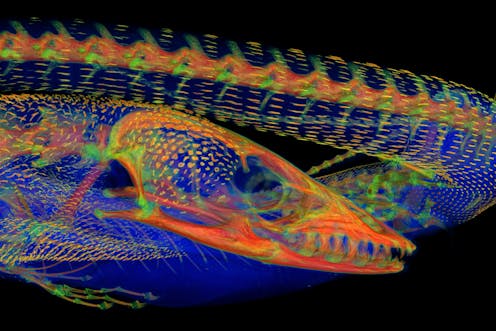
Monitor lizards, also known in Australia as goannas, are some of the most iconic reptiles on the continent. Their lineage not only survived the mass extinction that ended the reign of non-avian dinosaurs, but also gave rise to the largest living lizards on Earth.
Today, these formidable creatures pace through forests and scrublands, flicking their tongues as they go.
A new study published in the Zoological Journal of the Linnean Society looks beneath their skin. For the first time, it reveals hidden bone structures that may hold the key to the evolutionary success of goannas in Australia.
An essential organ
The skin is an organ essential for survival. In some animals, it includes a layer of bone plates embedded among the skin tissue. Think of the armour-like plates in crocodiles or armadillos: these are osteoderms.
Their size ranges from microscopic to massive, with the back plates of the stegosaurus as the most impressive example.

We have only just started to understand these enigmatic structures. Osteoderms can be found in animal lineages that diverged up to 380 million years ago. This means these bone plates would have evolved independently, just like active flight did in birds, pterosaurs and bats.
But what is their purpose? While the advantage of flight is undisputed, the case is not as clear for osteoderms.
The most obvious potential would be for defence – protecting the animal from injuries. However, osteoderms may serve a far broader purpose.
In crocodiles, for example, they help with heat regulation, play a part in movement, and even supply calcium during egg-laying. It is the interplay of these poorly understood functions that has long made it difficult to pinpoint how and why osteoderms evolved.

A cutting-edge technique
To help resolve this enigma, we had to go back to the beginning.
Surprisingly, to date science has not even agreed on which species have osteoderms. Therefore, we assembled an international team of specialists to carry out the first large-scale study of osteoderms in lizards and snakes.
We studied specimens from scientific collections at institutions such as the Florida Museum of Natural History, the Natural History Museum in Berlin, and Museums Victoria.
However, we soon learnt that this came with challenges. Firstly, the presence of osteoderms can vary dramatically between individuals of the same species. Secondly, there is no guarantee that osteoderms are sufficiently preserved in all specimens.
Most importantly, they are buried deep within skin tissue and invisible to the naked eye. Traditionally, finding them meant destroying the specimen.
Instead, we turned to micro-computed tomography (micro-CT), an imaging technique similar to a medical CT scan, but with much higher resolution. This allowed us to study even the tiniest anatomical structures while keeping our specimens intact.
 Micro-CT-based, computer-generated 3D model of Rosenberg’s goanna (Varanus rosenbergi), with the left half showing osteoderms and endoskeleton.
Roy Ebel
Micro-CT-based, computer-generated 3D model of Rosenberg’s goanna (Varanus rosenbergi), with the left half showing osteoderms and endoskeleton.
Roy Ebel
Using computer-generated 3D models, we then digitally explored the bodies of lizards and snakes from all parts of the world. Incorporating data from prior literature, we processed almost 2,000 such samples in our search for osteoderms.
To illustrate our results, we devised a technique called radiodensity heatmapping, which visually highlights the locations of bone structures in the body.
For the first time, we now have a comprehensive catalogue showing where to find osteoderms in a large and diverse group; this will inform future studies.
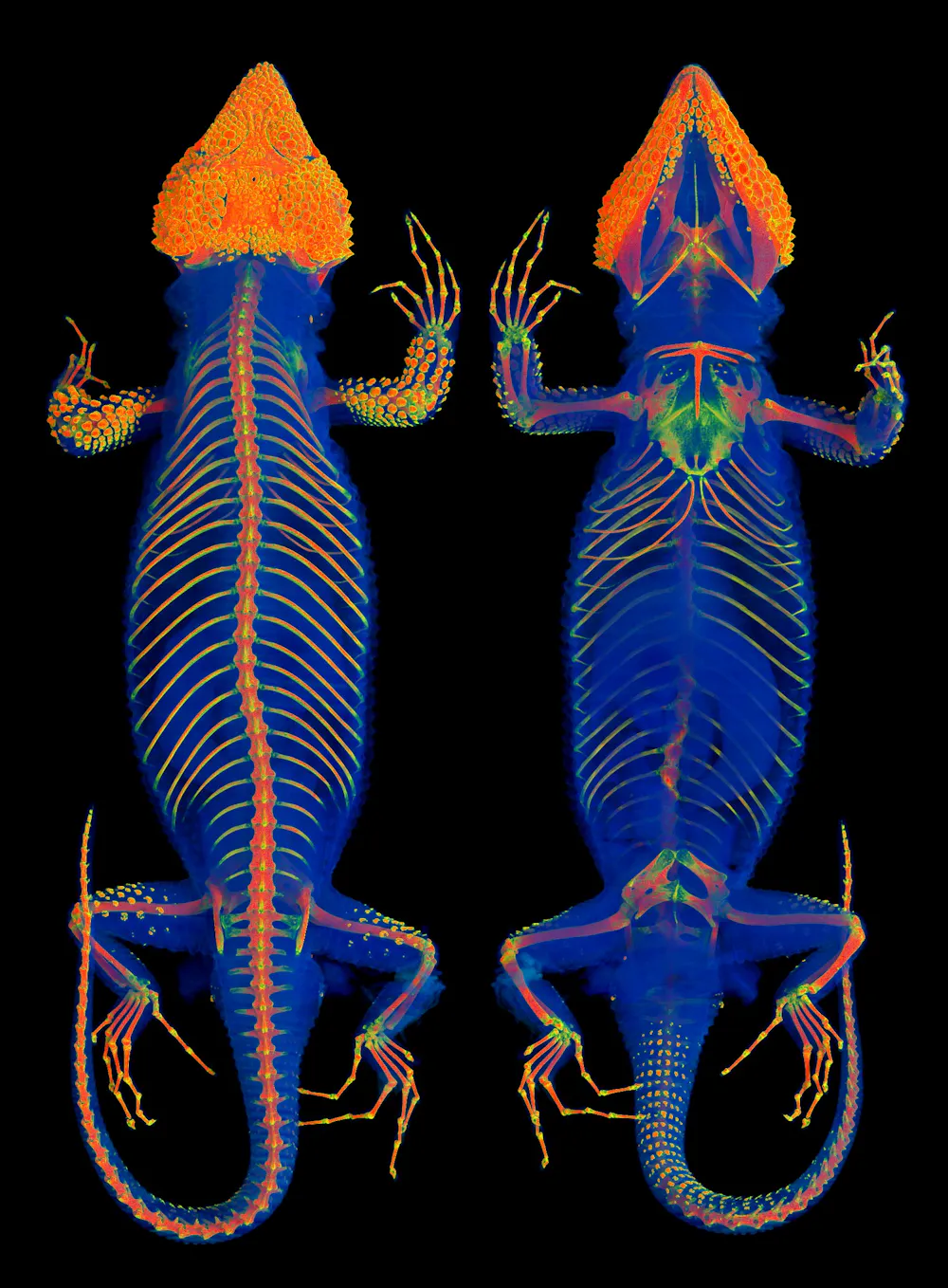 Radiodensity heatmapping shows newly discovered osteoderms (yellow to red) in the limbs and tail of the Mexican knob scaled lizard (Xenosaurus platyceps).
Roy Ebel
Radiodensity heatmapping shows newly discovered osteoderms (yellow to red) in the limbs and tail of the Mexican knob scaled lizard (Xenosaurus platyceps).
Roy Ebel
Not just anatomical curiosity
What we found was unexpected. It was thought only a small number of lizard families had osteoderms. However, we encountered them nearly twice as often as anticipated.
In fact, our results show nearly half of all lizards have osteoderms in one form or another.
Our most astonishing finding concerned goannas. Scientists have been studying monitor lizards for more than 200 years. They were long thought to lack osteoderms, except in rare cases such as the Komodo dragon.
So we were all the more surprised when we discovered previously undocumented osteoderms in 29 Australo-Papuan species, increasing their overall known prevalence five times.
 Examples of newly discovered osteoderms (magenta) in Australo-Papuan monitor lizards.
Roy Ebel
Examples of newly discovered osteoderms (magenta) in Australo-Papuan monitor lizards.
Roy Ebel
This isn’t just an anatomical curiosity. Now that we know Australian goannas have osteoderms, it opens up an exciting new avenue for further studies. This is because goannas have an interesting biogeographic history: when they first arrived in Australia about 20 million years ago, they had to adapt to a new, harsh environment.
If osteoderms in goannas showed up around this time – possibly owing to new challenges from their environment – we’d gain crucial insights into the function and evolution of these enigmatic bone structures.
Not only may we just have found the key to an untold chapter in the goanna story, our findings may also improve our understanding of the forces of evolution that shaped Australia’s unique reptiles as we know them today.
Authors: Roy Ebel, PhD Candidate in Evolutionary Biology, Museums Victoria Research Institute