Our cultural touchstone series looks at works that have had a lasting influence.
Kazuo Ishiguro’s Never Let Me Go was published 20 years ago. Since then, the Japanese-born English writer has been awarded the Nobel Prize in 2017 and knighted for services to literature in 2018.
Never Let Me Go has been translated into over 50 languages. It has been adapted into a film, two stage plays, and a ten-part Japanese television series. A critical and commercial success, the novel has been reissued in an anniversary edition with a fresh introduction from the author.

A spate of reappraisals has accompanied this anniversary: “An impossibly sad novel […] it made me cry several times […] sadness spilled off every page.” “No matter how many times I read it,” one critic wrote, “Never Let Me Go breaks my heart all over again.”
These brief excerpts are clear: the novel pulls us into a morass of sadness that never lets us go. “I’ve usually been praised for producing stuff that makes people cry,” Ishiguro has said. “They gave me a Nobel prize for it.”
Strange and familiar
I want to reconsider the emotional charge of Never Let Me Go.
The deluge of tears attested to by critics hinges on the relationship Ishiguro meticulously crafts between narrator and reader. This is initiated in the novel’s first lines. Ishiguro places us in an alternative 1990s England. His opening gambit will be familiar to novel readers:
My name is Kathy H. I’m thirty-one years old, and I’ve been a carer now for over eleven years. That sounds long enough, I know, but actually they want me to go on for another eight months […] My donors have always tended to do much better than expected.
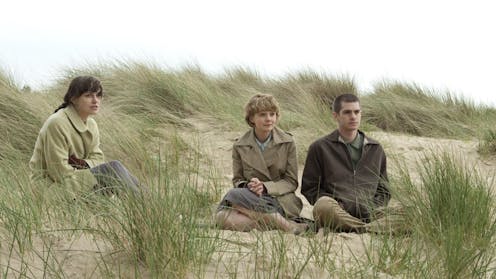
Within a few pages, the narration slips into Kathy’s recollections of her idyllic 1970s youth at a boarding school called Hailsham. We are immersed in a childhood world of friendship and exclusion, jealousy and love. This is a recognisable world. Ishiguro’s first-person narration affords the reader vicarious access to Kathy’s interior tangle of emotion, desire and reflection, such that we can recognise something of ourselves in her.
Yet something is amiss in her narration. Flat and rather affectless, it is a decidedly less curious, less passionate and more tempered mode of narration than we might expect. The threadbare texture frays the narrative world. What are we to make of the opaque references to “carer”, “they” and “donors”?
This uncanny tension between the strange and the familiar simmers until a third of the way through the novel, when a “guardian” at Hailsham reveals the students’ futures:
Your lives are set out for you. You’ll become adults, then before you’re old, before you’re even middle-aged, you’ll start to donate your vital organs. That’s what each of you was created to do.
Good liberals
Kathy is a clone, condemned to death so her organs can be harvested for “normals”. That this heartless system “reduces the most hardened critics to tears” comes as no surprise. After all, Ishiguro has evoked the familiar genre of the 19th-century boarding-school bildungsroman to encourage us to believe that this is a form of subjectivity we can share. This bildung – the German word for “formation” – is not an integration into society but rather a dismemberment by society.
That this does not provoke anger, in readers and characters alike, does come as a surprise. For if the proclamation of the students’ fates is not distressing enough, Ishiguro forces us to confront the clones’ response or, rather, the lack thereof. There are no incandescent flashes of fury or even mild expressions of dismay.
Instead, the clones are “pretty relieved” when the speech stops. Knowledge of their impending death passes them like a ship in the night, inciting “surprisingly little discussion”. In this disconcerting silence, the relation between reader and clone is mediated through another genre: science fiction.
The bildungsroman and science fiction, identification and misidentification, intimacy and estrangement – these are the tools of Ishiguro’s trade. He manipulates them, and us, with precision. There is intimacy as we recognise that the students’ everyday lives – reading novels, creating art, playing sport – are much like our own. There is estrangement as we realise that the clones are willingly cooperating in their own deaths. They will “donate” and “complete” in the narrative’s chilling terms.
In other words, we cry because the clones are just like us, but our anger towards the machinery of donation is blunted because the clones are not yet us, in that their complicity eerily lacks our instinct for self-preservation.
Confident that we will take ourselves as the measuring stick, Ishiguro compels us to adopt a position of superiority characterised by a paternalistic ethos of sympathy and care. In this way, he persuades us to read as good liberals. We acknowledge the humanity of the clones and embrace the diversity of our common condition. At the same time, we are complacent in the knowledge that we are almost the same, but not quite. We are insulated by a disavowed difference.
An abstract formal equality, evacuated of concrete historical content, is precisely what is expressed when the same critics who praise the novel’s melancholic tone claim that Ishiguro shows us “what it is to be human” or that he enlivens this otherwise “meaningless cliche”.
Beyond liberal sentiments
Is Ishiguro doing anything more than offering a banal endorsement of common humanity? It seems to me that he is, and in doing so he is summoning our liberal sentiments only to turn them against us.
The mechanism he uses is as old as the novel form itself: the romance plot. Romance leads to the happily-ever-after of marriage: a perfect union in which each person completes the other.
Not long after we learn that Kathy and her friends are clones destined to die, we become privy to a rumour: students who can prove they are “properly in love” are eligible for a “deferral” of their donations. To fast-forward through the novel’s tangled romance plot to the denouement, Kathy and Tommy – a fellow clone – track down Hailsham’s former administrator to plead their case. Not only is their request for deferral rejected, but the possibility of deferral is dispelled as a pernicious rumour.
The allure of romance has been a lure, a cold steel trap in the guise of a warm embrace. Ishiguro dangles the promise of romance only to expose its sinister echoes in the donation system.
The “completion” of romance is macabrely inverted. Completion through matrimonial union with an ideal other is transformed into the “donation” of organs, which completes an unknown “normal”, whose life can continue as a result of the clone’s death.
Cover of the first edition of Never Let Me Go (2005)
Ishiguro positions us so that we are unwittingly aligned with the “normal” population, whose “overwhelming concern was that their own children, their spouses, their parents, their friends, did not die from cancer, motor neuron disease, heart disease”.
What we want the clones to do (resist their fates) and the means of doing so (romance) are revealed as responsible for the donation system. If we want Kathy and Tommy to live because they love each other – and we do because Ishiguro has compelled us to care for them – then we are endorsing the logic that designates them as disposable in the first place.
The anger Ishiguro has deliberately blunted returns, redoubled. Our care is transformed into complicity. We, rather than the clones, are the targets of Ishiguro’s ire.
Translating this into political terms, Ishiguro is giving aesthetic form to neoliberalism’s eclipse of liberalism. It is no coincidence that Never Let Me Go takes place in England between the 1970s and 1990s, the exact period of neoliberalism’s emergence and consolidation.
But this is no simple transition. Never Let Me Go implies that liberalism is the ghost in the neoliberal machine. The novel is a representation of a vicious neoliberal class system, where those who can afford replacement parts can substantiate the fantasy of liberal individualism, while those who can’t serve as replacement parts.
In this sense, Ishiguro can be read as posing a series of incisive questions, not simply offering the platitude that we are all human. What are the costs of love? Why is there a trade-off between caring for those close to us and caring for those who are distant? How do our claims of shared humanity pave the way for domination? Why do we assume that our way of life is superior because it is predicated on liberal principles? How do we break from a callous system in which we too are complicit?
Twenty years on, these questions are as relevant as ever. To begin answering them, perhaps we have to wipe the tears from our eyes and turn to anger.
Authors: Matthew Taft, Course Coordinator in English and Theatre Studies, The University of Melbourne
Read more




 Cover of the first edition of Never Let Me Go (2005)