

Bali is built on informal and ‘illegal’ settlements. Bulldozing Bingin Beach misses the real threat of overdevelopment
- Written by: Kim Dovey, Professor of Architecture and Urban Design, The University of Melbourne
Balinese officials have begun the demolition of more than 40 businesses at Bingin Beach, a popular tourist spot in the Uluwatu region.
In June, the Balinese House of Representatives determined the settlement is on public land, and is therefore illegal and needs to be demolished. But I’d argue it doesn’t.
The ‘illegal’ settlement
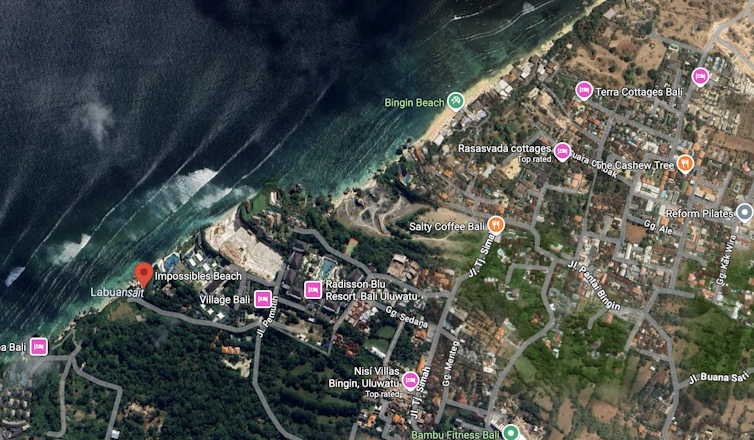
The Bingin Beach coastal settlement began development in the 1970s as an informal surfer hub at the base of a steep escarpment. The beach is a few hundred metres long and largely disappears at high tide.
Originally lined with a string of makeshift warungs (small food stores) and cheap accommodations, the settlement has grown incrementally over the decades, up and along the escarpment, with an intensive mix of surf shops, restaurants and small hotels.
The steepness of the slope precludes vehicle access. The only public access is via two somewhat narrow pedestrian stairways.

While it initially served the surfer community, the settlement now caters to a broader tourist market, with some rooms going for upwards of US$150 per night.
But after more than 50 years of incremental development, the House of Representatives has declared the settlement was illegally constructed on state land, and has ordered the demolition of 45 buildings – effectively the entire settlement.
While most of the buildings seem highly durable, the demolition order is based on illegality, and not durability. A spokesperson for the traders argues most of the businesses are locally owned, and livelihoods are at stake.
The ‘legal’ settlement
The former farmland at the top of the escarpment is also covered with tourist developments that mostly emerged since 2010, and now extend up to a kilometre inland. This is a much more familiar landscape for Bali: a mix of walled hotel compounds and private villas, with manicured gardens and swimming pools.
However, one could scarcely call this larger settlement “planned”. Shops and restaurants emerge wherever they can find a market along the narrow roads. There are no sidewalks and pedestrians are constantly engaged in an anxious game of negotiated passing.
The infrastructure of roads and lanes has also been designed incrementally, across the former farm fields, as the settlement developed. The resulting street network is convoluted and largely unwalkable. The most common street sign is “no beach access this way”.
What is informality?
I’m an academic, architect and urban planner who studies informal settlements and informal urbanism more generally. In this context “informal” can mean illegal, makeshift and unplanned, but it can also mean incremental, adaptive and inventive.
Informal settlement is the means by which a large proportion of Indonesians produce affordable housing. It is also the most traditional form of indigenous housing globally.
After many decades of governments trying to demolish such settlements, the overwhelming consensus across the United Nations Human Settlements Programme is that wholesale demolition is rarely an answer. On-site formalisation and upgrading is the more sustainable pathway.
When engaging with informal settlements, we need to preserve the infrastructures that work and only demolish where necessary. The Bingin Beach escarpment settlement has proven sustainable and has become an integral part of the local heritage.
Its demolition will destroy livelihoods and displace the surfing market, while feathering other nests.
So why is it being demolished? Perhaps to clear the ground for the next round of up-market resorts – what urban studies research calls “accumulation by disposession”. Bingin is widely seen as a major real estate hotspot for investment.
What is overdevelopment?
One of the key dangers of informal settlement is “overdevelopment”. Without formal planning codes, density can escalate to destroy the very attraction that produced the settlement.
Most buildings along the Bingin Beach escarpment are two to four storeys, and step back with the slope of the escarpment. The exception is the 2019 addition of the Morabito Art Cliff hotel that rises more than six storeys, obscuring the natural landscape, blocking views, and setting a precedent for more of the same.
If everyone in the area built like this, the Bingin settlement would be replaced with a cliff of buildings. To demolish this one building would set a useful precedent of containing the settlement to a sustainable scale.
The Impossibles dream
A few hundred metres south-west of Bingin Beach, a different story unfolds near the beach known as Impossibles. Here, a precarious limestone cliff largely precludes access to the beach, and the clifftop has long been lined with low-rise tourist compounds.

This earlier layer of development is now being demolished and replaced with larger, denser resorts as part of the Amali project which claims a “rare cliff-front location”. The location is “rare” because about half of the 50-metre-high cliff has been excavated to construct villa units quite literally in the cliff.
This excavation was well underway when, in May 2024, it caused much of the remaining natural cliff face to collapse onto the beach and into the ocean. It remains unclear whether the excavation was formally approved. Either way, it prompts the question: what if everyone did that?
The Bingin escarpment and the Impossibles cliff face represent very different kinds of development. One is incremental, irregular and geared to its social and environmental context, while the other is large-grain and environmentally destructive. It makes no sense to demolish the former in order to make way for the latter.
It is imperative to not only save the Bingin Beach settlement, which is part of Bali’s surfing heritage, but also to awaken from the impossible dream of building more and more villas on this fragile and limited coastland.
Authors: Kim Dovey, Professor of Architecture and Urban Design, The University of Melbourne


















