What is chikungunya virus, and should we be worried about it in Australia?
- Written by Jacqueline Stephens, Associate Professor in Public Health, Flinders University
This week, the World Health Organization (WHO) raised concerns about a surge in the number of cases of a mosquito-borne viral infection called chikungunya.
Diana Rojas Alvarez, a medical officer at the WHO, highlighted an outbreak occurring across La Réunion and Mayotte. These small islands in the Indian Ocean were previously hit during an epidemic of the virus in 2004–05.
Between August 2024 and May 2025, more than 47,500 confirmed cases and 12 deaths from chikungunya were reported in La Réunion. Some 116 cases were reported in Mayotte between March and May this year.
But more than 100 countries have seen local transmission of this virus to date, and the WHO has also flagged recent cases in Africa, Asia and Europe.
So, what is chikungunya, how does it spread, and should we be worried here in Australia?
What are the symptoms?
The main symptoms of chikungunya include fever, joint pain and joint swelling. However, other symptoms may include headache, rash, muscle pain, nausea and tiredness. On rare occasions, chikungunya can be fatal.
Some people are more prone to having worse symptoms, including infants, older adults, and people with pre-existing medical conditions.
Symptoms can take up to 12 days to appear, but most people start to experience symptoms three to seven days after being bitten by an infected mosquito.
There’s no specific treatment for chikungunya other than managing the pain with medications, such as paracetamol.
Most people recover after a few weeks, but some people can experience ongoing tiredness and joint pains for many months, or even years.
How does it spread?
Infected female mosquitoes spread chikungunya. The mosquitoes become infected when they feed on a person carrying the virus in their blood. Once infected, the virus reproduces in the mosquito, and then they can transmit it to other people when the mosquitoes bite them.
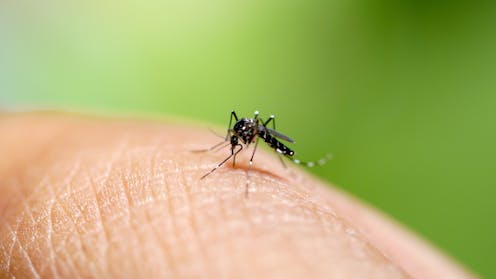
There are more than 3,000 different types of mosquitoes on Earth, but only two are commonly involved in transmitting chikungunya: Aedes aegypti and Aedes albopictus.
A. aegypti and A. albopictus look similar and can be easily confused. Both are about 4–7 millimetres in size and have similar black and white markings on their thorax and legs.
Both are day-time biters, unlike other mosquitoes that typically bite at dawn or dusk. They’re known as “ankle biters” because they mainly bite exposed legs and ankles. These aggressive mosquitoes bite multiple times and are known to follow people indoors to get their meal of human blood.
These species also transmit dengue virus, yellow fever virus and Zika virus.
Where does chikungunya occur?
Chikungunya was first documented in Tanzania in 1952. While outbreaks initially occurred across Africa and Asia, over time the virus has spread around the world. As of December 2024, local transmission of chikungunya had been reported in 119 countries and territories.
The 2004–05 epidemic was the largest so far, with hundreds of thousands of people infected. The epidemic started in the Indian Ocean islands, but eventually spread across to India. Since then, outbreaks have become more frequent and widespread.
A key contributor to the proliferation of chikungunya is climate change. Warmer temperatures, altered rainfall patterns, and increased humidity are creating ideal conditions for mosquito breeding. This allows the mosquitoes to adapt to new environments and therefore expand into new habitats.
The increase is also partly because chikungunya has evolved and been introduced into new populations, whose immune systems have not previously been exposed to the virus.
So, should we be worried?
While evidence suggests A. aegypti has been present in northern Queensland since the 1800s (outbreaks of dengue occurred in Townsville in 1879 and Rockhampton in 1885), A. albopictus is a more recent arrival, first documented in the Torres Strait in 2005.
A. aegypti mosquitoes are now found in areas across north, central and southern Queensland, while A. albopictus is currently still only found in the Torres Strait.
Nonetheless, to date, there have been no recorded cases of chikungunya transmission within Australia.
But cases do occur in people who have recently travelled overseas, most often to South and Southeast Asia, or the Pacific Islands.
In 2023 there were 42 cases of chikungunya recorded in Australia, 70 in 2024, and 90 so far in 2025. Previous years have seen figures above 100, however numbers in recent years may have been lower due to COVID impacting travel.
As climate change continues to support the spread of A. aegypti and A. albopictus, the risk of transmission within Australia increases.
That said, there is some evidence we might be lucky in Australia, with potential immune protection from a related local virus, Ross River virus.
I’m travelling, what should I do?
Two vaccines are approved for use in the United States against chikungunya, but there’s currently no vaccine approved in Australia. The only way to reduce your risk of infection is to avoid being bitten by mosquitoes.
People travelling to places where chikungunya is known to occur should wear loose-fitting and light-coloured clothing with enclosed shoes, use insect repellent, close windows and consider using mosquito bed nets. Taking these steps also reduces the risk of other mosquito-borne infections, such as dengue fever.
If you travel to a place where chikungunya occurs and you get bitten by mosquitoes, monitor yourself for signs and symptoms.
If you become unwell, see a doctor immediately.
Authors: Jacqueline Stephens, Associate Professor in Public Health, Flinders University