Is US beef safe to eat? How worried should we be about ‘mad cow disease’, growth hormones and fatty meat?
- Written by Ruth McHugh-Dillon, Assistant Health Editor
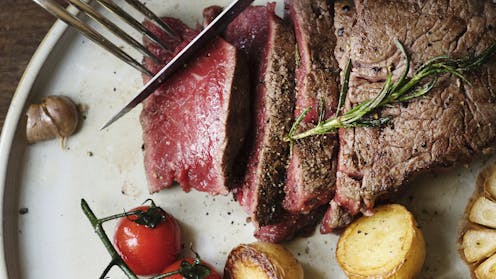
Australians woke on Thursday to the surprising news the federal government had lifted decades-long biosecurity restrictions on beef from the United States.
The government has brushed aside claims the decision was made to appease US President Donald Trump. Agriculture Minister Julie Collins has said the government’s review of US imports was based “purely on science” and found the US is adequately managing disease risk.
But given the restrictions were first introduced in 2003 in response to a US outbreak of mad cow disease, many people will be wondering if US beef is safe to eat.
The US also has different rules about hormone and antibiotic use in cows. You may have also heard US beef is fattier.
So, is it healthy? And what are the risks? We asked three experts to break down the health and safety of eating beef from the US.
Is US beef fattier? Is Australian beef healthier?
Animals’ diets can affect what’s in the meat we eat.
Grain-fed beef is common in the US, while in Australia cows tend to feed on grass during summer and may eat hay in winter. However, Australian farmers are increasingly using grain, thanks to drought and other pressures.
So, if beef from the US is mainly grain-fed, does this make it less healthy?
Studies have reviewed the available evidence on grain-fed beef versus grass-fed beef.
Here’s what they found overall (although variations can occur due to the animal’s genes and seasonal and environmental changes).
Total fat. Grass-fed beef can be 30–75% lower in fat, compared to grain-fed beef. If you eat 100 grams of grain-fed beef, this can mean eating up to 20g more fat than meat from grass-fed cows.
Cholesterol. We have less data on this, but a separate study shows grass-fed beef contains less cholesterol than grain-fed. However the difference is small, and eating cholesterol in food has less impact on your blood cholesterol levels than eating saturated fats.
Saturated fat. There are small differences between grass-fed and grain-fed beef, but not enough to know whether there would be any impact on cholesterol levels.
Omega-3 fats. Grass-fed beef may contain up to five times higher levels of omega-3 fats, which are beneficial for heart and joint health. This could be an important source of omega-3 for people who don’t eat much fish, which has high levels.
Conjugated linoleic acid. This is another fat with potential health benefits, including reducing the build-up of fats in artery walls. Grass-fed beef has higher levels.
Antioxidants (beta-carotene and vitamin E). Grass-fed beef can have on average up to five times more antioxidants, compared to grain-fed beef. But the levels are so low in meat, it’s unlikely to be a significant source.
Protein. Grass-fed beef has slightly higher levels. But given close to 99% of people already eat enough protein, this is not significant.
Overall then, grass-fed beef – more common in Australia – comes out as the healthier option.
Evangeline Mantzioris, Program Director of Nutrition and Food Sciences, University of South Australia
Can I catch ‘mad cow disease’ from US beef?
When it comes to beef, perhaps the most significant safety concern is bovine spongiform encephalopathy, more commonly known as “mad cow disease”.
This infectious disease is caused by abnormal proteins that can spread in cows and cause nervous system damage.
Humans can’t get mad cow disease. But in rare cases if you eat diseased meat you can develop a variant called Creutzfeldt-Jakob disease, which leads to dementia and premature death.
There was a major outbreak of mad cow disease during the 1990s, mainly concentrated in the United Kingdom but also affecting the US.
So, is it still a risk in US beef?
Australia’s food safety regulator deems it low risk, giving US beef its highest “category 1” rating for safety overall or for mad cow disease.
But the public is often still concerned about mad cow disease due to occasional outbreaks in cattle in the US.
Australia is also currently free of certain bacterial diseases that affect US cows, such as bovine tuberculosis and bovine brucellosis. These usually spread between live animals, but there is a risk to humans from undercooked meat or unpasteurised dairy products.
Other major cattle diseases caused by viruses – such as foot and mouth disease and lumpy skin disease – are not a concern in the US.
Thomas Jeffries, Senior Lecturer in Microbiology, Western Sydney University
Does US beef contain growth hormones and antibiotics?
The use of growth hormones and antibiotics in cattle is more tightly controlled in Australia than the US.
In the US, cattle can be given approved natural or synthetic hormones to help them grow. These are regulated by the US Food and Drug Administration, with strict limits on hormone residues allowed in meat.
The levels are extremely low, well below those found naturally in foods such as eggs and soy. There is no credible evidence that hormone residues at these low levels pose a health risk to humans.
Antibiotics are also used in US beef production to prevent and treat illness. Since 2017, antibiotics that are also used to treat human infections – and which could be made less effective by overuse in animals – can no longer be used simply to promote growth. A veterinarian must oversee their use.
Read more: The rise and fall of antibiotics. What would a post-antibiotic world look like?
In the US, before meat reaches the market, a specific amount of time must pass after an animal is treated with antibiotics or hormones before it can be slaughtered for food to ensure residue levels are safe. The Food and Drug Administration routinely tests meat to enforce these rules.
In Australia, the majority (more than 60%) of graded beef cattle are raised without using growth hormones, and antibiotic use is more tightly restricted. These are usually only prescribed by a veterinarian to treat, rather than prevent, illness.
These differences reflect Australia’s more cautious approach, but they do not mean US beef is unsafe.
For Australian consumers, choosing between local and imported beef is more about personal preference than actual health risk.
Those who prefer meat from animals not treated with growth hormones or raised under stricter antibiotic rules can choose Australian-grown or certified organic options.
Jimmy Chun Yu Louie, Associate Professor of Dietetics, Swinburne University of Technology
Authors: Ruth McHugh-Dillon, Assistant Health Editor