As post-election talks drag on, what will Hobart’s proposed stadium actually cost Tasmanians?
- Written by John Madden, Emeritus Professor, Centre of Policy Studies, Victoria University
In the wake of last week’s Tasmanian election that delivered another hung parliament, the new government will need to shore up crossbench support. One of the issues to be negotiated will be support for the new stadium due to be constructed next to Hobart’s historic docks. It won’t be an easy task given the bulk of likely crossbenchers are strongly opposed.
Whatever the political wrangling, it’s important this takes place in the light of the actual economics of the proposed stadium.
Building the 23,000 seat stadium is a condition of the state’s licence for an AFL team.
What the studies show
Fortunately, there have been several studies of the proposed waterfront stadium that attempt to evaluate its net social and economic benefits to the Tasmanian community. While estimates vary between the studies, they all indicate the benefits from the stadium are likely to be substantially below its cost.
The state government has downplayed the negative net-benefit estimates from these studies, citing positive impacts on the economy and employment. But the independent cost-benefit analysis undertaken by KPMG in 2024 already includes an assessment of the positive benefits for businesses and workers.
The whole point of a social cost-benefit analysis is to evaluate the entire effects on the welfare of the population of its reference region (Tasmania).
But does the cost-benefit analysis tell the whole story? In its consolidated report released last month, KPMG refers to unquantifiable intangible benefits not captured by its analysis.
Some of the benefits are ‘intangible’
On purely tangible economic criteria, as KPMG recognises, stadiums rarely have benefits that exceed costs. The justification for building stadiums is that the net economic cost is spent to acquire intangible benefits, such as national pride and social cohesion.
But on my reading, KPMG has already included estimates for the main intangible benefits. Indeed, there is research suggesting one of the intangible benefits that KPMG includes – health benefits – is tenuous. It would seem unlikely there are other significant unaccounted intangible benefits from the stadium.
In January, a further cost-benefit report was released. This report, by independent economist Nicholas Gruen, says KPMG overestimates benefits and underestimates costs.
Gruen performs his own cost-benefit analysis and finds the benefits to Tasmanians are likely to be less than half of what it costs them.
There are reasons for paying attention to pessimistic findings. The University of Oxford’s Bent Flyvbjerg and his colleague, Dirk Bester, have recently highlighted the dangers of optimism bias in cost-benefit analyses of public projects. They find unambiguous statistical evidence that projections of costs and benefits are consistently inaccurate and biased towards overoptimism.
If Gruen’s estimates are correct, the new stadium will come at a considerable cost to Tasmanians. There may be winners and losers. But Gruen’s results imply the Hobart stadium may come at a cost to the welfare of the average Tasmanian household of about A$3,300.
Indeed, it may turn out to be more. Recently, there has been a $190 million, or almost 25%, increase in estimated construction costs. That takes the total to $945 million, up from the most recent estimate of $755 million. The original costing was $715 million.
And it’s worse when viewed from a Tasmanian government perspective. That’s because the AFL, as is common with major sporting bodies, has ensured a contract in which all cost overruns are the responsibility of the state government.
Overall, the state government has committed to contribute $375 million and will be responsible on current estimates to find a further $315 million. The federal government will contribute $240 million and the AFL just $15 million.
Cost blowouts are very common
My recent literature review shows venues built for mega sporting events under urgent timelines and rigid specifications tend to have particularly large cost overruns.
While the budget for the Hobart stadium contains a significant amount for contingencies, cost overruns can be huge – for Olympic venues 172% on average. While the stadium is unlikely to see overruns of this magnitude, the downside risks imposed by current AFL requirement to build the stadium are considerable.
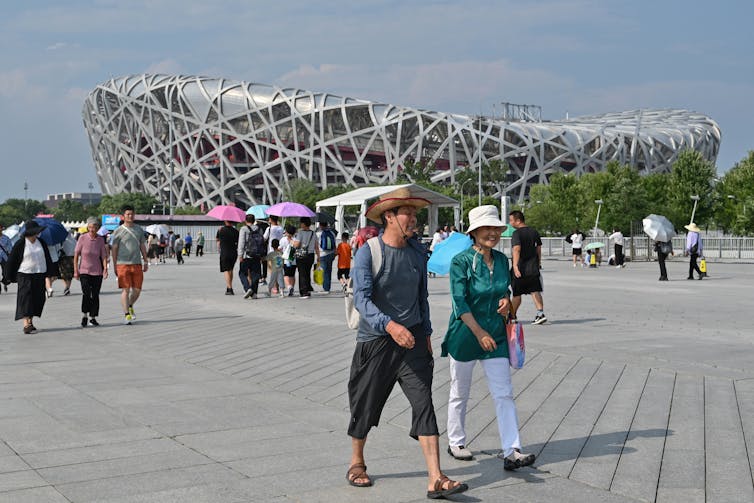
Can Tasmania draw a lesson from the Beijing National (Bird’s Nest Stadium), built for the 2008 Olympics, where it was decided to save costs by abandoning the planned retractable roof?
Gruen finds that not including the fixed, translucent roof would reduce the net social cost to Tasmanians by about 10%. And it would help lower risk exposure, and may substantially improve the aesthetics.
Hobart winter nights are only about one degree colder than Melbourne, so the necessity for a roof for AFL games is questionable, and it poses problems for test cricket. Against this, not having a roof might make it a less appealing venue for concerts.
Of course, not having a new stadium at all, but still having a Tasmanian AFL team, might represent the best outcome for the state. But standing up to the AFL comes at the risk of Tasmania not entering the AFL.
In the case of mega events, the history of negotiations between sporting organisations and potential host cities, however, is that cities most unwilling to jeopardise their chances of selection, end up with the worst deal. Sports economists refer to this as the “winner’s curse”.
Authors: John Madden, Emeritus Professor, Centre of Policy Studies, Victoria University