

Australia isn't taking the national security threat from far-right extremism seriously enough
- Written by: Greg Barton, Chair in Global Islamic Politics, Alfred Deakin Institute for Citizenship and Globalisation, Deakin University
This is part of a new series looking at the national security challenges facing Australia, how our leaders are responding to them through legislation and how these measures are impacting society. Read the rest of the series here.
Until the terror attack in Christchurch in March, the threat of far-right terrorism in Australia was one we knew was coming, but believed was well over the horizon.
The sordid story of the Christchurch attacker – “ordinary Australian” turned hateful bigot turned mass-murdering terrorist – contains some uncomfortable truths for our country, not least of which is the fact that the threat of far-right extremism has arrived in the here and now.
Just as troubling, yet even more challenging because it is so insidious, are the clear links between the Christchurch shooter’s motivations and our mainstream political discourse. Facing up to this threat requires us changing our approach both to hateful extremism and toxic political discourse.
Police and counter-terrorism officials have long been warning us of the rising threat of far-right violent extremism. Over the past decade, this has emerged as the number one terrorist threat in America and a persistent and growing threat in Europe.
Read more: Christchurch attacks are a stark warning of toxic political environment that allows hate to flourish
It’s tempting to say that had more resources been committed to tracking and monitoring far-right groups and individuals in Australia, the Christchurch terrorist perhaps could have been stopped.
But even in hindsight, things are not so clear. The Christchurch gunman was a lone actor with no previous history of significant violence, although his involvement in hateful extremism was well-known to family and friends.
This is the particular threat that keeps counter-terrorism experts awake at night, when so-called “cleanskins” (people with ostensibly spotless records) turn into lone-actor terrorists.
We are flying blind on far-right extremism
One clear lesson from Christchurch is that we need to pay more attention to hate speech and hate crimes.
It is true that “shit-posting” is a common occurrence on social media, and among all those people spouting off, it is extremely difficult to see who might become a violent extremist.
But clearly, we don’t understand the world of far-right extremism nearly as well as we should. We need a better way of monitoring and tracking far-right forums, social networks and the links between far-right individuals through their histories of travel and extremist communications.
We also have no centralised, national database of hate incidents. Hate crimes remain under-reported, poorly documented and de-prioritised to low levels of state policing.
Read more: Right-wing extremism has a long history in Australia
The result is that we are flying blind. We don’t get to see the patterns between far-right groups and internet “shit-posters” because we are not collecting the data.
If we made it a priority at the state and federal level to document hate incidents, whether crimes or not, we would at least have a sense of when and where the problem is growing and who is most significantly involved.
This wouldn’t eliminate the threat of far-right extremism, but it might help stop the next massacre and it would certainly contribute to making Australian society more healthy, welcoming and just.
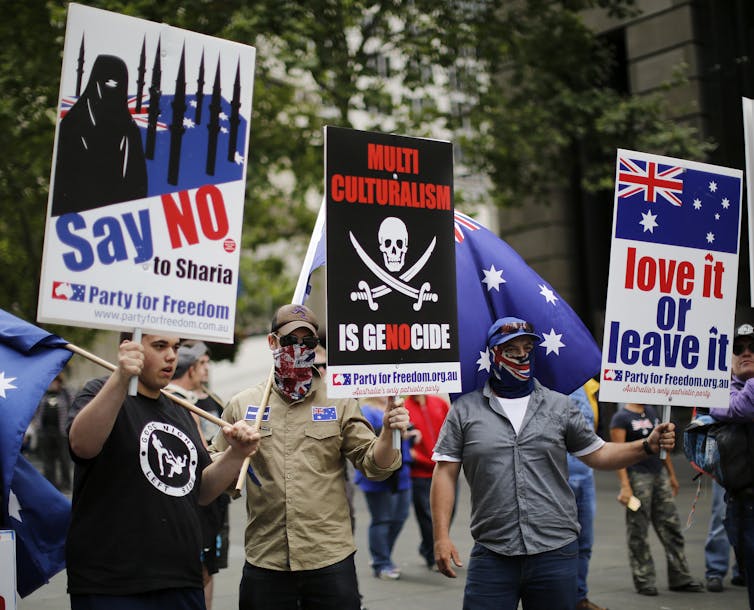 Anti-immigrant protesters at a Reclaim Australia rally in Sydney in 2015.
David Moir/AAP
Anti-immigrant protesters at a Reclaim Australia rally in Sydney in 2015.
David Moir/AAP
A disproportionate focus on Islamist terror threats
The September 11 attacks in America, and subsequent attacks by al-Qaeda in Bali, Madrid, London and elsewhere, triggered an enormous investment in counter-terrorism efforts in Australia.
This had barely begun to abate when the formation of the Islamic State (IS) caliphate in mid-2014 alerted us to the high rates of terror recruitment in Australia and prompted the raising of the national terrorism alert to the penultimate level in September 2014.
An intercepted phone call then triggered Australia’s largest-ever counter-terrorism operation. Shortly afterward, the Islamic State issued a call for random lone-actor attacks around the world and, within days, an 18-year-old launched a knife attack against two police officers in Melbourne.
Read more: Australia has enacted 82 anti-terror laws since 2001. But tough laws alone can't eliminate terrorism
These circumstances have led to 82 counter-terrorism laws being enacted in Australia since 2001, and 16 counter-terrorism operations since 2014, almost all of which have been responding to the threat posed by violent Islamist groups like al-Qaeda and IS.
This perception of the increased threat posed by these groups has resulted in a disproportionate investment in counter-terrorism compared with the response to the much greater threat posed by domestic violence.
At the same time, however, very little has been invested in preventative counter-terrorism measures, including countering far-right extremism.
A national discourse bound up in fear
We pride ourselves on being the world’s most successful multicultural society, yet we consistently turn a deaf ear to those who come up against hatred.
Just last month, for example, a new national survey found that 82% of Asian Australians, 81% of Australians of Middle Eastern background and 71% of Indigenous Australians had experienced some form of discrimination.
One reason why we are not yet ready to face up to this problem is that our national political discourse has for decades become bound up with the politics of fear, “othering”, and scapegoating minority communities.
When we demonise “illegal arrivals” and give license to the toxic rhetoric that we are being “swamped by Asians”, as Pauline Hanson put it in the late 1990s, or more recently “flooded by Muslims”, then we are buying into the core element of the narrative of terrorists like the Christchurch gunman.
In his manifesto, the gunman referenced the far-right extremist trope of “the great replacement” – the fear that white Christian society is being overrun by brown-skinned, non-Christian people who are changing its culture and society irrevocably.
He picked up this idea from parts of Europe where there is strong antagonism to migrants and Muslims. But he referenced it directly from the writings of the Norwegian far-right terrorist who shot dead 69 people and blew up another eight in July 2011.
This same argument featured in the manifesto of the El Paso gunman who murdered 22 people at a Walmart store in Texas last month. In it, he praised the Christchurch shooter and warned of a “Hispanic invasion” of Texas.
These alt-right terrorists are driven in part by a fantasy of going from “zero to hero” in the alt-right internet world and becoming renowned as “warrior defenders”.
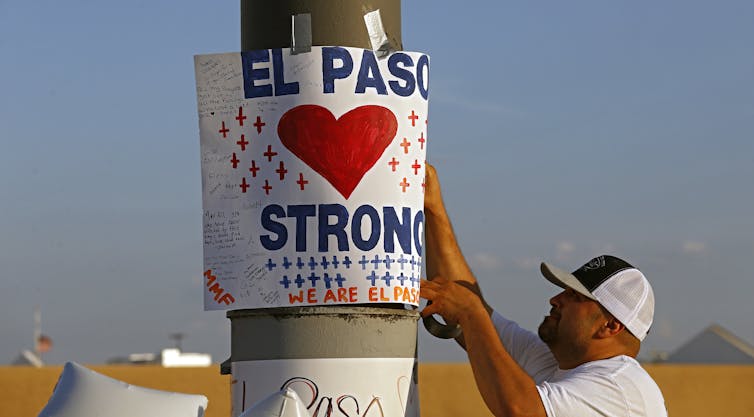 White nationalist manifestos are a recurring feature of far-right extremist attacks, like the one in El Paso this year.
Larry W. Smith/EPA
White nationalist manifestos are a recurring feature of far-right extremist attacks, like the one in El Paso this year.
Larry W. Smith/EPA
Prioritising far-right extremism
Prior to Christchurch, kicking the can down the road and prioritising other threats to our national security seemed an understandable, if not ideal response.
We now need to face the reality that of 50 terrorism-related deaths in the US last year, almost all involved far-right extremism. (Only one was linked to jihadi terrorism.) This is a pattern that’s been established for decades now. In fact, nearly three-quarters of all terrorist deaths in the US over the past decade have been linked to far-right extremism.
And while there is reason to hope the problem will never become quite so serious in Australia (despite the fact an Australian far-right extremist has murdered 51 people in another country), we need to do what we can now to counter the rise of hate speech and hate crimes – not later.
There are no quick fixes or guaranteed solutions, but these steps will make society better in ways that go far beyond the immediate threat of another terrorist attack.
Authors: Greg Barton, Chair in Global Islamic Politics, Alfred Deakin Institute for Citizenship and Globalisation, Deakin University


















